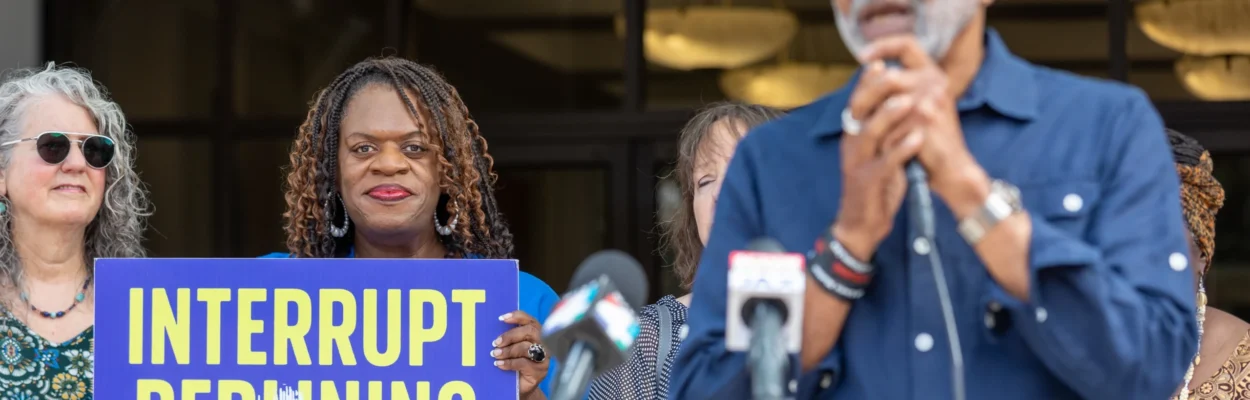
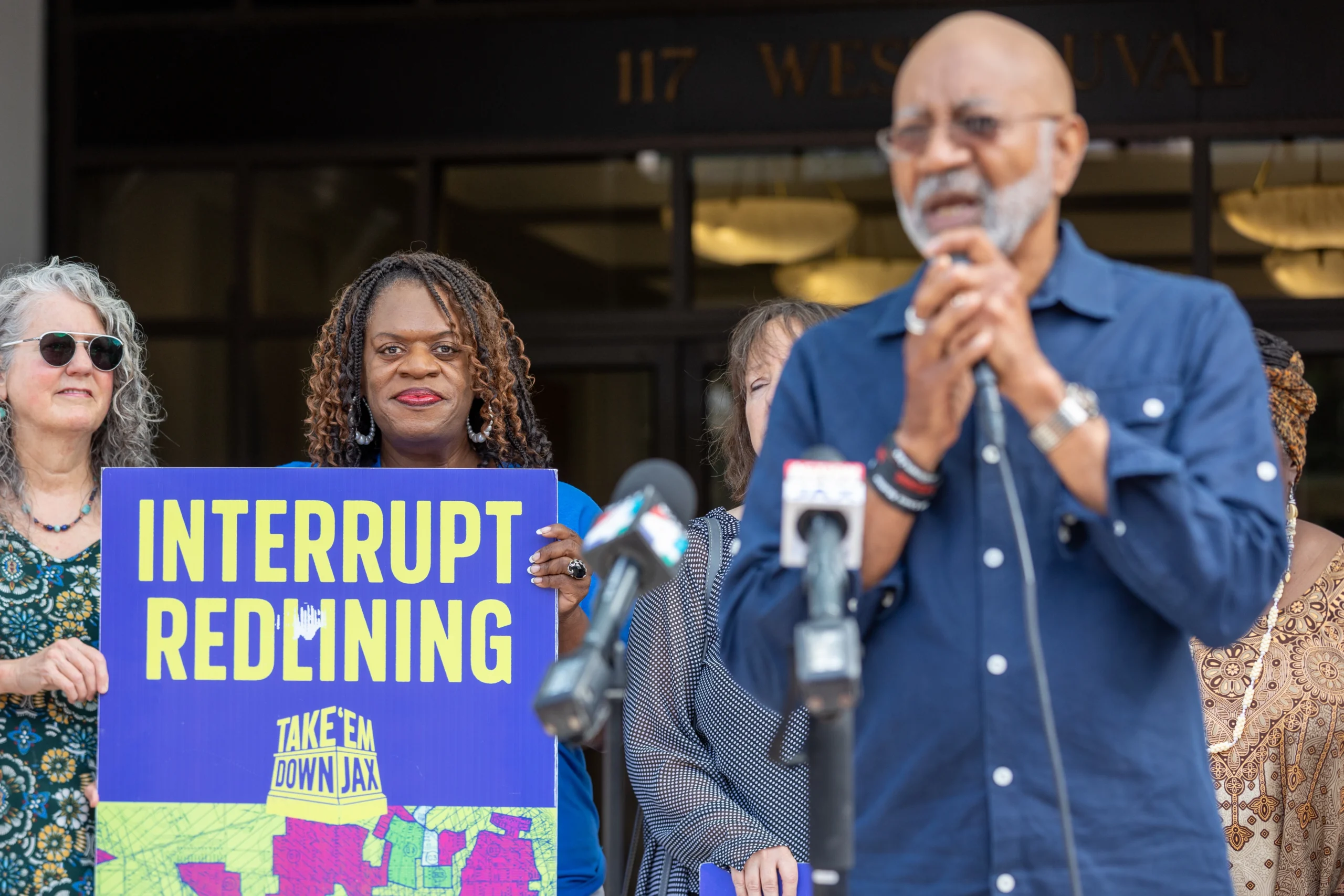
Congressional candidate LaShonda Holloway, center, holds a sign outside Jacksonville City Hall on Friday, May 22, 2026, denouncing any plans for a new jail facility in areas that were previously redlined. | Will Brown, Jacksonville Today
Published on May 27, 2026 at 4:56 pm
Free local news and info, in your inbox at 6 a.m. M-F. Sign up for the Jacksonville Today newsletter.
As city officials plan to replace Duval County’s aging Downtown jail, the Jacksonville City Council has declined to support a bill to discourage building the next jail facility in historically redlined neighborhoods.
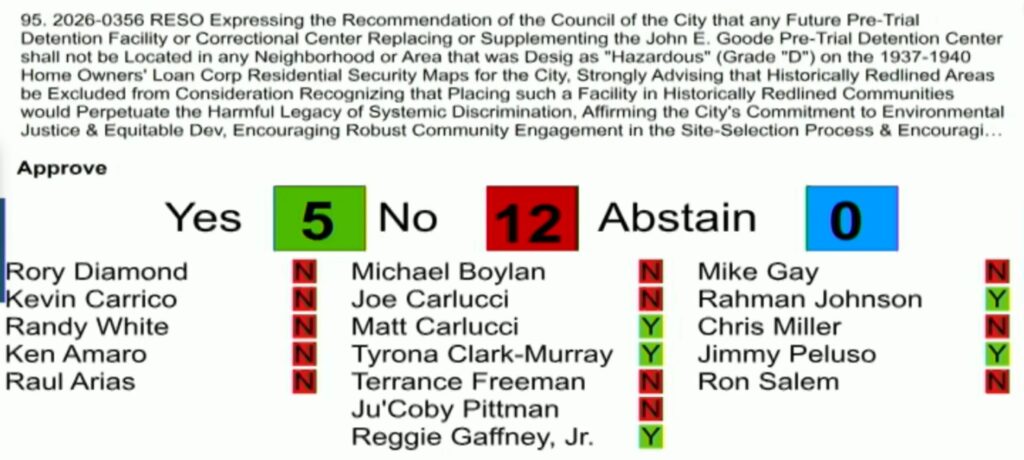
City lawmakers voted 12-5 on Tuesday night against council member Jimmy Peluso’s Resolution 2026-0356, which recommended that any correctional center developed to replace the John E. Goode Pre-Trial Detention Center be kept outside several redlined, predominantly Black neighborhoods.
Jacksonville Today thanks our sponsors. Become one.
In March, the city hired consulting firm CGL Companies for $750,000 to do a one-year study to locate three possible sites for the next Duval County Jail. City officials have touted the process as apolitical and bipartisan.
Council members who opposed Peluso’s bill say it’s premature to have a debate about where the jail shouldn’t go before the consultant completes its review.
But Peluso and local activists argue that while CGL and city officials are searching for sites is the right time to set some boundaries for the jail’s development.
Jacksonville Today thanks our sponsors. Become one.
“This is to help the consultant know areas where they should not be pursuing and looking at this moment and know what our intentions are and our thoughts are as a body early and before that report comes out,” Peluso said before the vote Tuesday. “To me, it’s to provide guardrails.”
How redlining shaped Jacksonville
Redlining originated with the National Housing Act of 1934. That legislation created the Federal Housing Administration and allowed its administrator to spur private financing for home loans.
The policy led to the Home Owners’ Loan Corp. providing grades for the mortgage security of neighborhoods.
A-rated neighborhoods were in green; B-rated neighborhoods were in blue; C-rated neighborhoods were in yellow. Meanwhile, D-rated neighborhoods were labeled hazardous and labeled red.
In Jacksonville, those so-called hazardous neighborhoods included Durkeeville, LaVilla, Moncrief and North Riverside.
City Council unanimously approved a resolution in 2024 that acknowledged the discriminatory housing practices in those communities in the 1930s and 40s, as well as Mixon Town, Sugar Hill, Eastside and Long Branch, that have limited their economic growth and health to present day.
Over the last 90 years, public investment — whether sewer connections, sidewalks or roads — in Jacksonville’s redlined communities has not been equal to other areas of the city.
Today, some of the Jacksonville neighborhoods that were redlined in the 1930s have some of Duval County’s highest concentrations of poverty. They are also places, according to data from the U.S. Census Bureau, where the life expectancy at birth is as much as a decade less than the statewide figure of 80.1 years.
“All we are asking for is one simple thing: that areas that have been (redlined) are not to be considered for a place that a jail will be built,” longtime local activist and anti-racist Wells Todd says. “That’s not a hard thing to ask for, not after the devastation that redlining has brought to the communities that are redlined. We have to understand that I-95 ran through the Black community and destroyed it — not only here in Jacksonville.
A portion of Interstate 95 sits on top of the former Wilder Park in the Sugar Hill neighborhood. Wilder Park was a thriving community gathering place for African Americans from 1927 until it was removed to make way for the interstate.
Jacksonville was far from the only Florida city that was redlined during the Roosevelt years.
Miami’s redlining maps included areas that either had low population density or a plurality of Cubans.
In Tampa, more than a third of residential properties were redlined. It focused primarily on the Ybor City and West Tampa areas. Today, portions of Interstate 275 and Interstate 4 run through those redlined neighborhoods.
However, then and now, Jacksonville has a higher percentage of Black residents than Miami and Tampa.
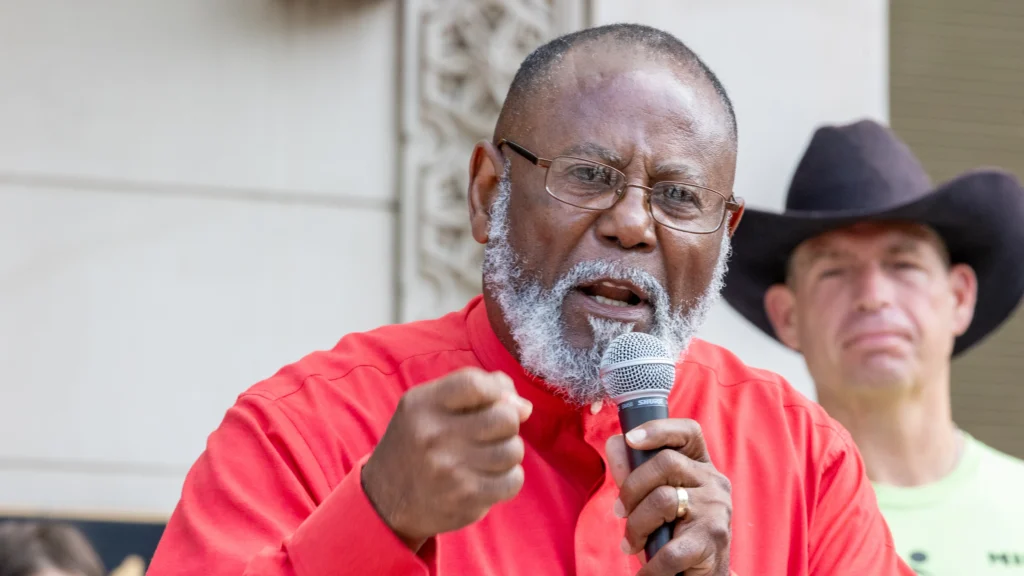
The Rev. R. L. Gundy has served as pastor of Mount Sinai Missionary Baptist Church in Springfield for decades. The church is within walking distance of formerly redlined areas and has congregants who live in redlined neighborhoods.
“If you’re serious about not committing things that harm people, if you’re serious about not discriminating, if you’re serious about not committing racism in this community, then support the resolution,” Gundy said at a news conference Friday.
Gundy says he would like to see the facility on the Westside adjacent to industrial facilities and not residential neighborhoods.
Bill ‘not performative’
Peluso’s bill was a statement of intent and, had it passed, would not have been legally binding.
But the Democrat pushed back Tuesday night against criticism ranging from the bill being premature to council member Rory Diamond’s assertion that it was “performative garbage.” Diamond added that he would not support a proposal to build the jail in a redlined community.
City officials expect the next jail to need room for mental health, health care, workforce development and juvenile services. Salem said virtual hearings that have been mainstreamed after the COVID-19 pandemic have also given less reason to place the jail near the courthouse.
But Peluso and the bill supporters worry the smaller buildings for pretrial or jail services could still be located in those neighborhoods.
“When you look at the map today, a lot of those redlined communities still look very much the same way as they did in the 1930s,” Peluso said during the Finance Committee meeting. “This is meant to show people who live in this city and have continued to live in those communities that we are not going to build a massive structure, or even a smaller scale one, in their neighborhoods.”
In an email Tuesday, the Deegan administration told Jacksonville Today that the Mayor’s Office understood the intention of Peluso’s bill and officials “support the neighborhoods that were left behind for many decades.” But Deegan’s office did not endorse the effort.
City officials have said the jail replacement could be a sprawling 500-acre campus as opposed to the tower currently sitting north of the St. Johns River. The administration says that will require more space than is available in the neighborhoods mentioned in Peluso’s bill.
But in its email, the Mayor’s Office held onto the position taken by the director of intergovernmental affairs, Brittany Norris, during a Finance Committee meeting last week — concern that the legislation would “lead to exclusions requested for every other council district.”
“Restrictions were not given to the site selection consultant so that their recommendations are based on data, available land, and specifications needed for the new facility. It’s unlikely that a site will be recommended in any of the neighborhood covered by bill #2026-0356 due to the large land requirements for the new facility,” the Mayor’s Office wrote. “And there will be ample opportunity for public input when the recommended sites are being reviewed by the administration, (Jacksonville Sheriff’s Office), and City Council.”
The study process for a new jail includes officials from several areas of the city government. It’s being led for Deegan’s chief administrative officer, Mike Weinstein; Jacksonville Sheriff’s Office Director Kevin Goff; and Republican City Council member Will Lahnen.
According to Lahnen, the city’s respective branches of government are “in lock step with each other.”
“We just cannot add more noise to what so far has been an apolitical process with the Mayor’s Office, JSO and the Council,” he said during the Finance Committee meeting.
Ultimately, five Council members suported the bill:
- Matt Carlucci
- Tyrona Clark-Murray
- Reggie Gaffney Jr.
- Rahman Johnson
- Peluso
The city’s argument about the jail’s need for land and a smooth planning process has not dissuaded residents concerned that no site has been ruled out.
“Redlining has always been a concern of ours and the effects that it has on communities,” Isaiah Rumlin, president of the Jacksonville Branch of the NAACP, told the council. “So we’re being proactive and coming before this council to address this situation to address this situation wherein we have adequate time to sit down and discuss this situation and the jail situation to make sure that as large as Jacksonville is — by land that is — that it will not be placed in a predominately African American community.
“The last question is, would you want this in your community?”