
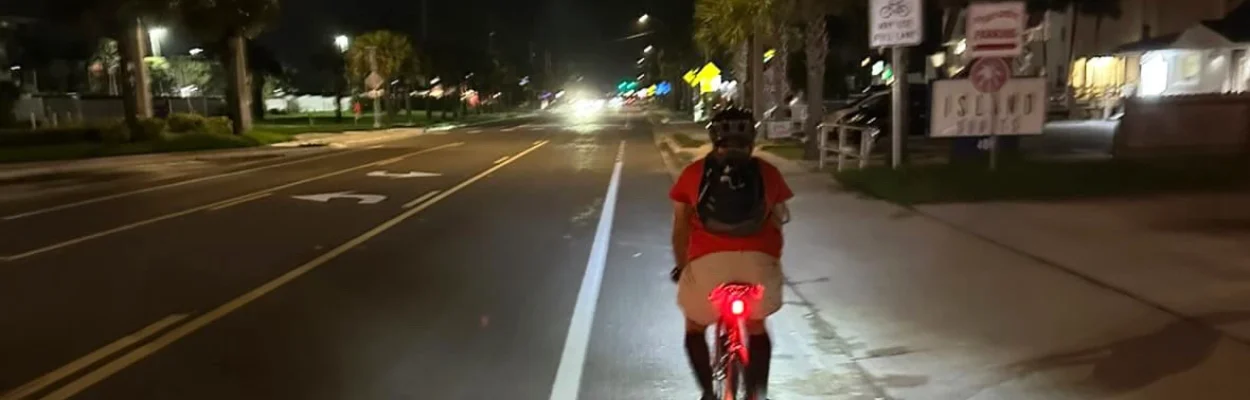
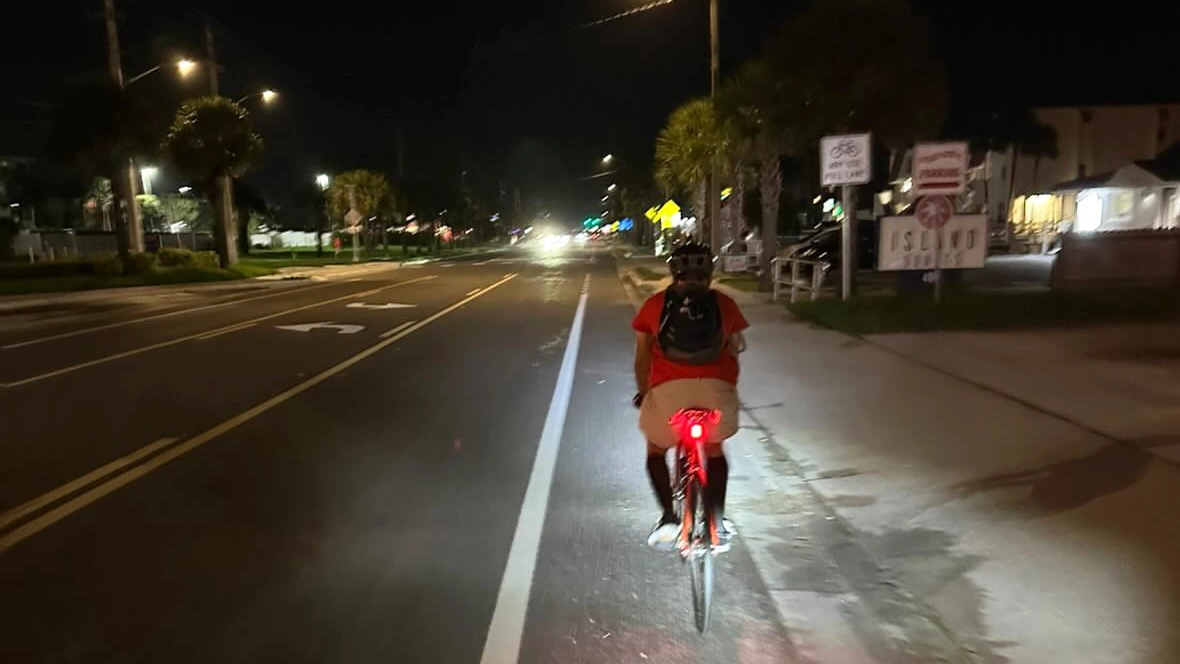
A cyclist rides at night in the bike lane of A1A Beach Boulevard. The local SUN Trail project will replace a sidewalk. | Courtesy Brayan Krepley
Published on May 28, 2026 at 12:06 pm
Free local news and info, in your inbox at 6 a.m. M-F. Sign up for the Jacksonville Today newsletter.
St. Johns County’s part of a regional walking and biking trail, known locally as the SUN Trail, has sparked debate between bicyclists weary of vehicle traffic and opponents who say the path should go elsewhere.
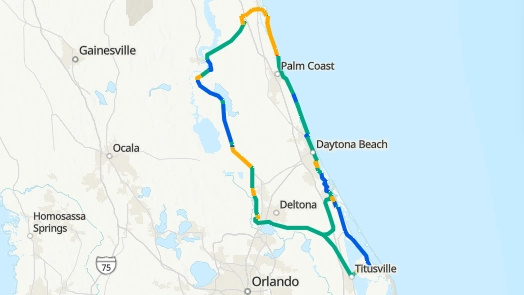
The 260-mile St. Johns River-to-Sea Loop walking and biking path got its start in 2008 when local governments in a handful of Central and Northeast Florida counties agreed to work together. Since then, portions of the loop running from Titusville to St. Augustine and back have been constructed, while other parts are still in the works.
Jacksonville Today thanks our sponsors. Become one.
Once it’s completed, 40 miles of the trail will be in St. Johns County, including a segment in St. Augustine Beach that has raised some residents’ eyebrows.
County officials say a planning study in 2019 determined the path, but recent concern about the 3-mile stretch in St. Augustine Beach prompted local governments to ask for an update on its progress.
Design of the St. Augustine Beach portion of the state-funded project is sitting around 60% completed, and construction isn’t expected to begin until next year. The Florida Department of Transportation has set aside some $5.5 million for that construction.


Jacksonville Today thanks our sponsors. Become one.
As it comes closer to becoming a reality, some residents have expressed worry about replacing a 5-foot-wide sidewalk with a 10-foot-wide shared-use path.
A sunny day on the SUN Trail
St. Johns County resident Brayan Krepley is not one of those people, though. He’s a frequent traveler along the A1A corridor, often riding his bike either by himself or with his 5-year-old son.
“The bike lane itself is not that great. It’s just a painted line, maybe 3 feet wide at most,” Krepley says. “And, you know, there’s a lot of distracted drivers. … One day I almost had my head taken off by somebody who had lumber sticking out.”
READ MORE: Divisive Shore Drive project in St. Augustine is dead
Getting further away from cars would make him feel much safer. It’s something that Krepley sees as a no-brainer.
“Cyclists don’t necessarily want to be on the road with cars, and cars don’t want to deal with cyclists on the road, so here’s a third option that should benefit everybody,” he says. “I would think everybody would be happy with it.”
But complaints about the proposed trail are wide-ranging.
Speaking during the presentation about the project this month, several people argued that cyclists would be better served with a trail elsewhere, and that Beach Boulevard already has bike lanes anyway. Other worries included the driveways that back up to the proposed trail, safety concerns for deaf and blind individuals having to contend with sharing a path with bicycles and e-bikes, and more.
“It’s not a greenway that could be beautiful and peaceful for people to ride,” Linda Hawver, who lives nearby, said. “Beach Boulevard is a highly active tourist corridor. … It in no way enhances … the safety of pedestrians and motorists.”
But according to FDOT, paved paths off the roadway are key to keeping bicyclists and pedestrians safe.
FDOT says cyclists must yield to pedestrians and audibly signal their passing. The same goes for e-bikes.
“Florida law currently affords properly classified e-bikes the same rights and responsibilities as traditional bicycles,” an FDOT spokesperson says. “Earlier this year the Legislature also passed SB 382, which would establish a statewide 10 mph speed limit for e-bike riders when within 50 feet of a pedestrian and require riders on shared paths to yield and signal before passing. That bill is currently awaiting the governor’s signature.”
But as far as navigating existing driveways, that’s something the county and the state both acknowledge isn’t going anywhere.
According to FDOT: “Drivers, pedestrians, and bicyclists should treat driveways along a shared use path the same as a normal intersection: Drivers are required to yield to those on the path, and pedestrians and bicyclists should slow down and make eye contact with the driver if possible.”
What’s in a name?
After receiving public requests, St. Johns County officials agreed to refer to their section of the 260-mile paved path differently than other parts of Florida, including the state government.
St. Johns County refers to the path as the SUN Trail, but the path is part of a wider trail network known as the St. Johns River-to-Sea Loop, a name that has been in use since the early days of the project.
“In St. Johns County, we are calling it the SUN Trail,” County Engineer Duane Kent says. “I’m not privy to what other counties are using for naming references.”
Back in March, County Commissioners Sarah Arnold and Ann Taylor said they had heard from “prominent members of the Jewish community” that the trail’s name “could be perceived as being offensive.”
The phrase “from the river to the sea” has been used by groups like the Palestinian Liberation Organization since at least the 1960s as a rallying cry for Palestinian self-determination. Major Jewish advocacy organizations like the Anti-Defamation League classify the slogan as antisemitic.
At the state level, SUN Trail refers to the program where state dollars are used to fund shared-use, non-motorized paths around the state. Funding for the program comes annually from a percentage of new vehicle tags sold.
Moving forward
While no changes are in the works for the proposed trail path at this time, Kent says “anything can change.”
Asked whether the Board of County Commissioners could vote to change the path of the trail, County Administrator Joy Andrews says there is no discussion or vote scheduled regarding the trail at this time.