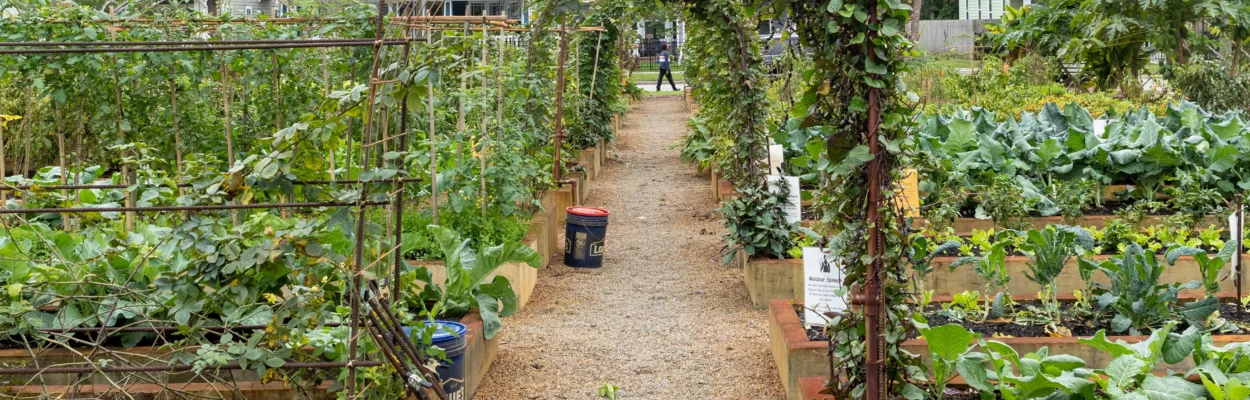
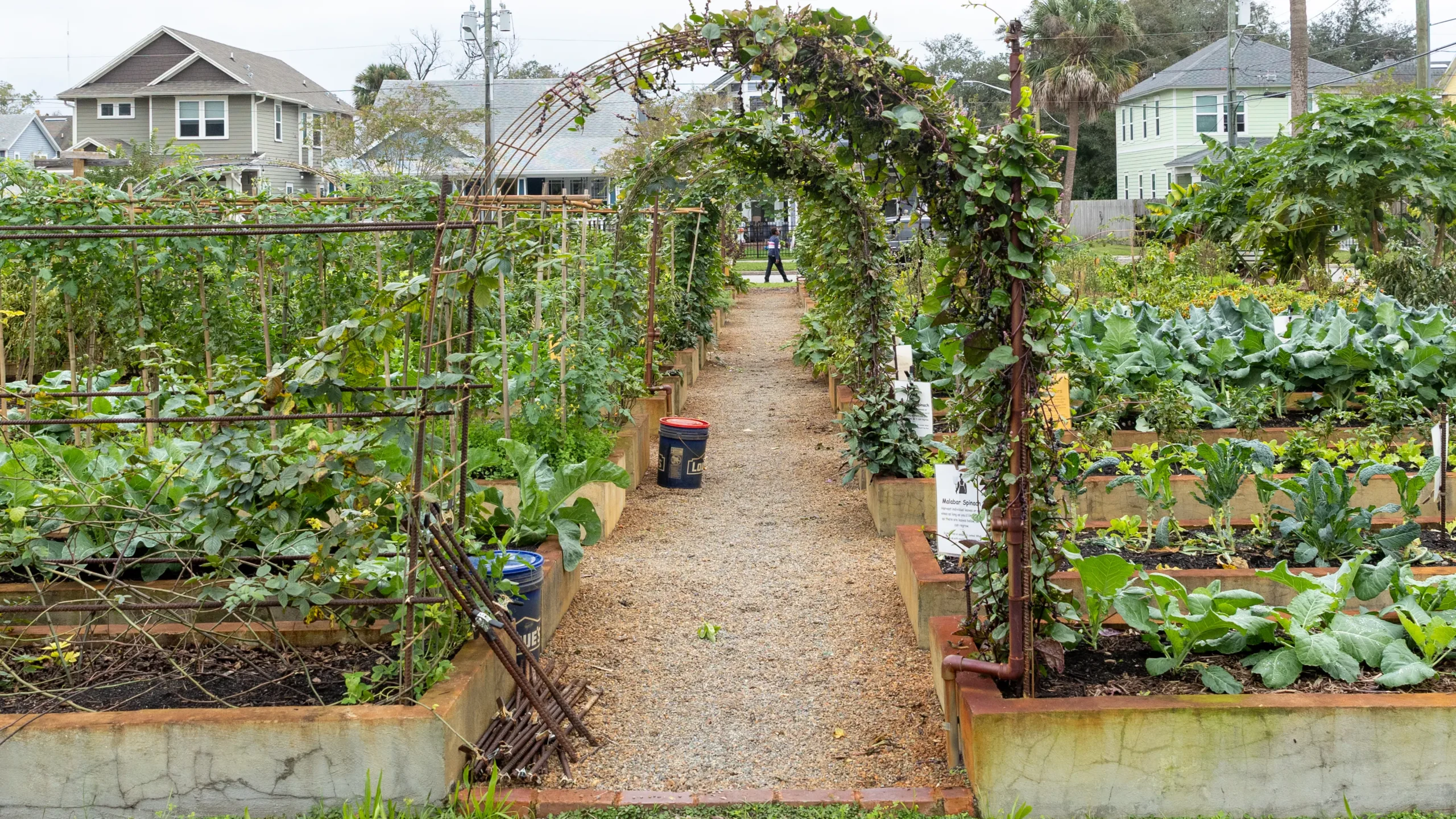
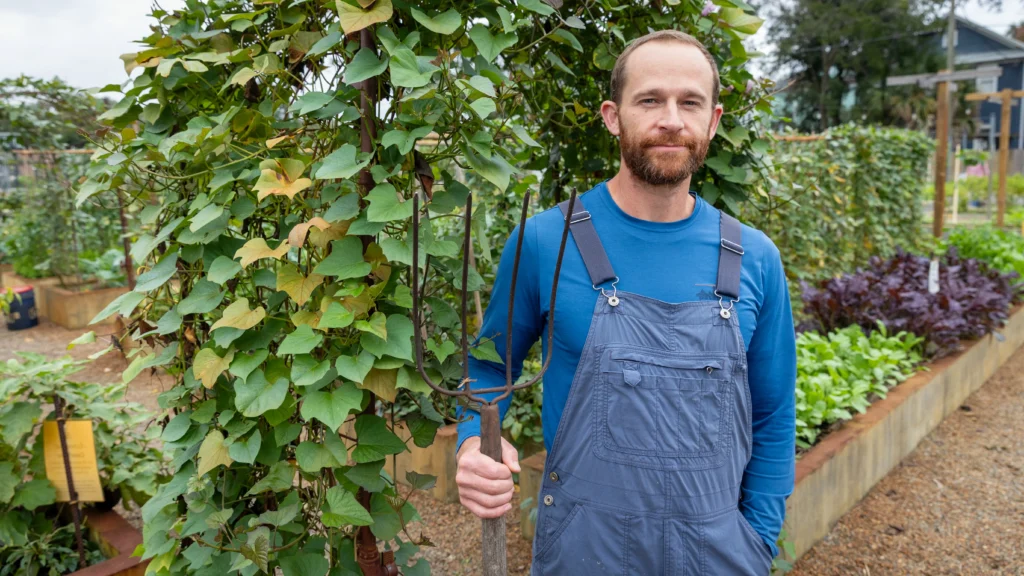
Overalls Farms is an urban farm in the heart of Jacksonville's Springfield community. Its owner, Nathan Ballantine, acquired the property in 2024; placed plant beds in the ground in January 2025 and witnessed its first harvest in May 2025. | Will Brown, Jacksonville Today
Published on November 24, 2026 at 8:55 pm
Free local news and info, in your inbox at 6 a.m. M-F. Sign up for the Jacksonville Today newsletter.
Every day, work on Overall Farms’ three plots in Springfield begins with a checklist.
Owner and operator Nathan Ballentine and his crew walk the beds, pull weeds and treat any pest problems. They remove crops that are past their prime, dress beds with fresh organic fertilizer and compost, and replant.
Jacksonville Today thanks our sponsors. Become one.
When the produce is ready to harvest, Ballentine puts out “U-Pick” signs so customers with a membership to the urban farm know what’s ready to take home.
Overall Farms began its first neighborhood farm in 2018 and began receiving citations from the city after it launched its third Springfield plot. Ballentine says, for years, neighborhood farms operated without clear local laws. But after a unanimous vote by the City Council Tuesday, urban farmers in Duval County can “sleep well at night.”
Years of community grassroots pressure paid off as council passed the Pathways to Urban Agriculture Ordinance, previously called the Free to Garden Act by supporters like Ballentine.

Jacksonville Today thanks our sponsors. Become one.
The bill adds community and market gardens and urban agriculture to the list of permitted uses in the city’s zoning code. (Previous city policy said “community gardens shall be encouraged” as part of the 2030 Comprehensive Plan.)
Ballentine, a leading voice in the Free to Garden Act coalition, says Jacksonville’s more than 100 market and community gardens had no legal guarantees to operate.
“We have at this point invested a couple hundred thousand dollars in our third farm, and because we had overwhelming community support, we felt confident enough to stick our necks out knowing that there was some risk that we could just have our whole investment ruined by the city coming down on us,” Ballentine tells Jacksonville Today.
“But by and large, people can’t afford to invest if they are operating in legal limbo because the threat is just too great,” he says.
Once signed by Mayor Donna Deegan, the new city law will allow urban farmers who grow produce on 2.5 acres or less to sell on property or at farmers’ markets to more easily apply for and obtain certificates of use.
The coalition, which formed its first urban agriculture working group in 2023 at Eartha’s Farm and Market, also lobbied and convinced city lawmakers to increase the number of days market gardens are allowed to operate, from 12 to 52 days. That opens urban farms to weekly on-site sales of fruits and veggies, plants and other agricultural products.
The new rule allows the community gardens already operating in Duval County to continue selling produce at weekly markets.
Advocates like Ballentine say it will give these community farms confidence that they can operate without fear of city fines. He says the zoning classification will also encourage investment in urban agriculture, growth of existing community farms and allow those operations to be more involved in local food security initiatives.
“On this meta level, gardening has been a way that communities have made themselves more food secure and resilient for eons, honestly,” Ballentine said. “The trick is that if communities encounter hard times, they don’t have to grow everything in order for it to matter.”
Council member Raul Arias, who co-introduced the bill with Jimmy Pelsuo, noted Tuesday that coalition members had attended the last 16 council meetings to urge city lawmakers to pass the bill.
“We do have a food crisis (and food) desert issue here in our city. We’ve had it for many years. But it’s legislation like this that actually helps us move the needle forward,” Arias said after the vote.
The bill also includes some restrictions, like farm structures cannot be more than 15 feet tall and cannot cover more than 25% of the lot. Urban farmers also cannot park heavy equipment visible from the street or neighboring properties.
Urban farms and food access
The Free to Garden Act was drafted by the nonprofit Duval Food Policy Council. City officials workshopped the draft and conducted research that led to Ordinance 2026-0807 that passed Tuesday.
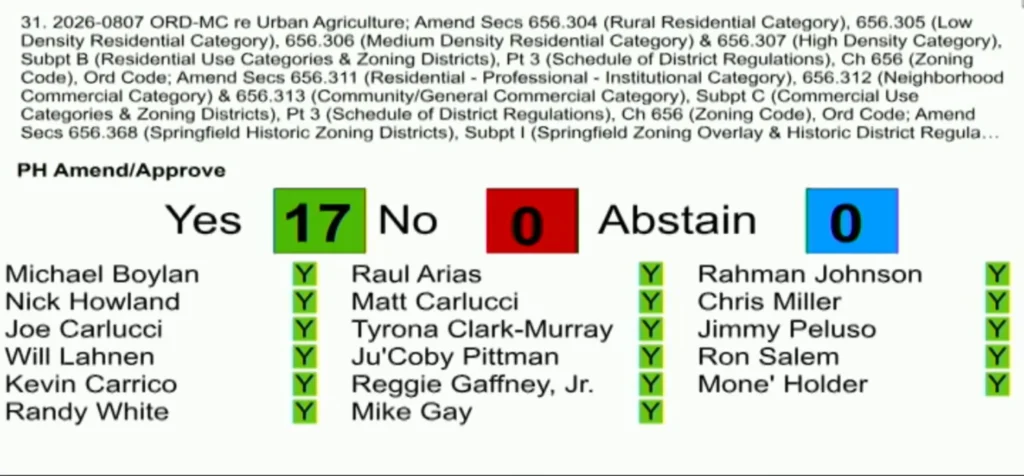
Council members Ken Amaro and Rory Diamond were absent for the vote.
Laureen Husband, chair of the Food Policy Council, tells Jacksonville Today there was a trend of citations against community market gardens in Jacksonville.
“People were coming to our table, asking us, ‘We’re getting all these code violations, how do we go around this?’ And so that’s how the conversation first started. How do we help our residents grow food safely without receiving citations and non-code compliance?”
When Husband spoke with Jacksonville Today on Tuesday, she was driving through neighborhoods in Jacksonville’s 32209 ZIP code, where the Food Policy Council recently led an effort to plant more than 90 gardens.
She says the law could also bring people income from what they grow in their backyard.
“It’s going to enable individuals who don’t have a lot of money to stretch their dollars by eating what they’re growing. But also as a neighborhood, you could be organized to decide what you all want to grow together so you can sell it together at a farmer’s market stand at the neighborhood level. You could have customers who come to your home, to buy whatever it is you’re growing,” she says.
Husband says her organization plans to connect local restaurateurs with urban farmers to build a farm-to-table pipeline.
The Food Policy Council launched in 2011 with grant funding from the Robert Wood Johnson Foundation to influence policy to combat chronic diseases like diabetes and cardiovascular disease.
Organizing around urban farming also led to the city’s creating and last month launching its inaugural food plan to address food insecurity.
In a statement after the council’s vote, Mayor Deegan said, “This bill will strengthen urban farming, increase access to food, and create more opportunities for local growers to sell their products. …Together, we are creating a future that is healthier, sustainable and more affordable.”