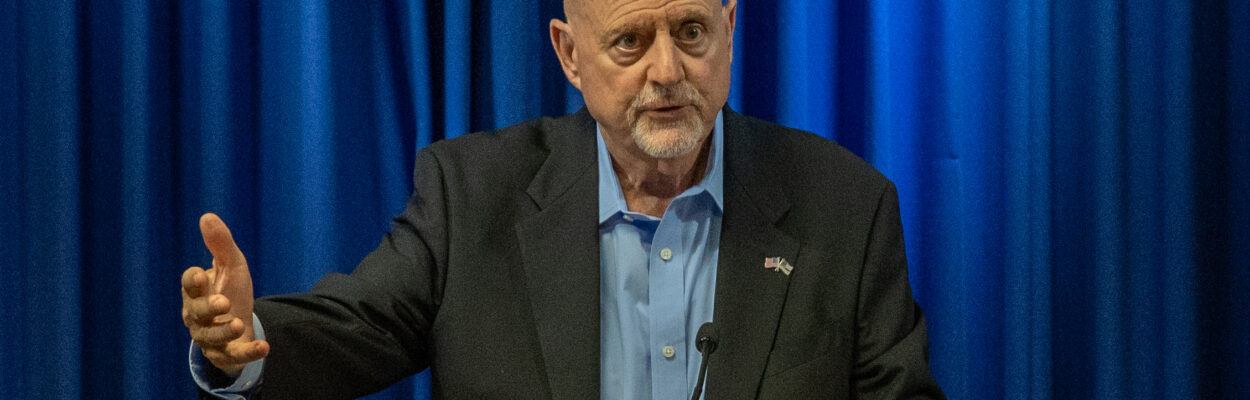
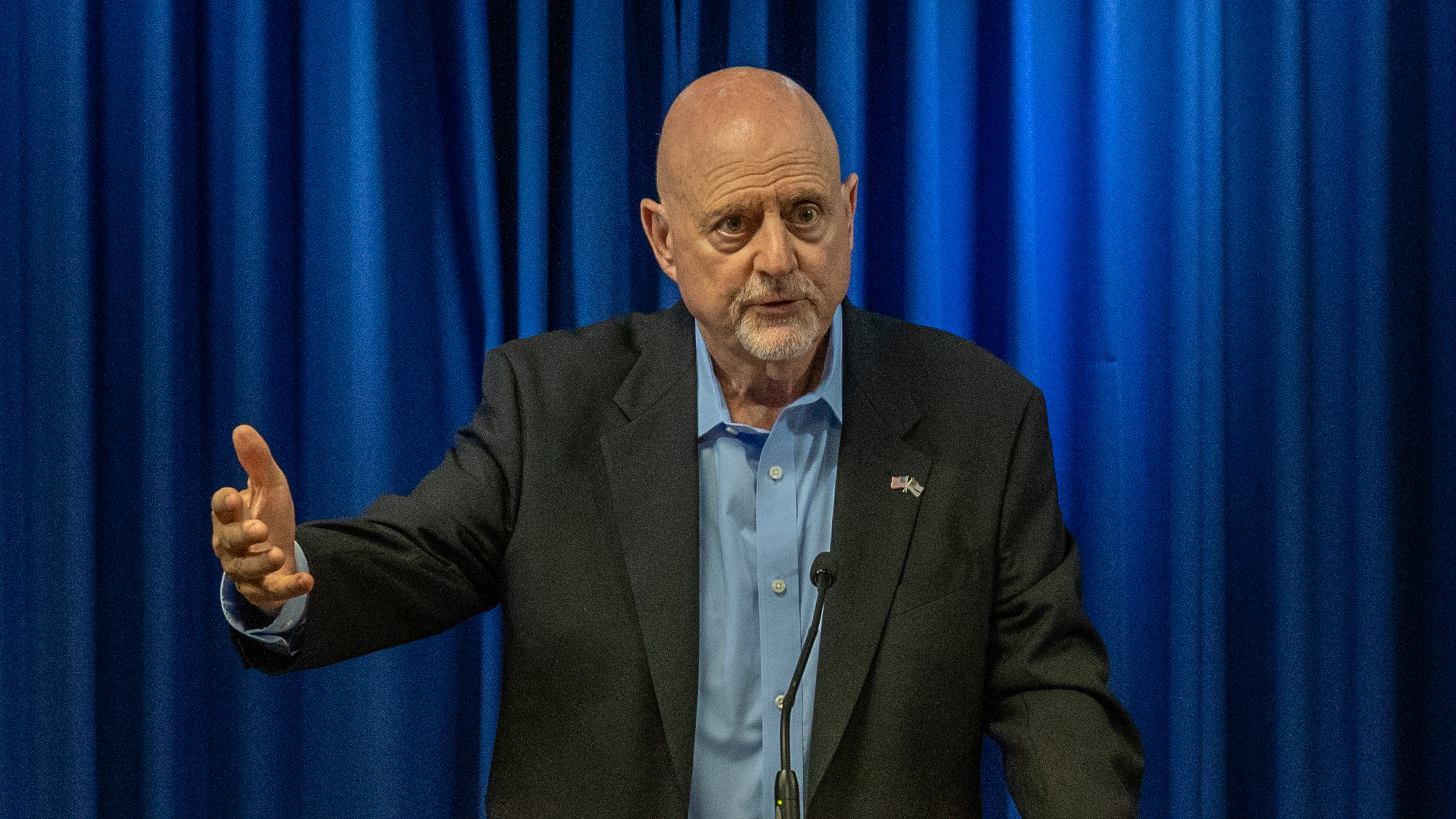
City of Jacksonville Chief Administrative Officer Mike Weinstein discusses Stadium of the Future financing at Jacksonville City Hall on Tuesday, May 14, 2024. | Will Brown, Jacksonville Today
Published on November 9, 2026 at 4:55 pm
Free local news and info, in your inbox at 6 a.m. M-F. Sign up for the Jacksonville Today newsletter.
Mayor Donna Deegan’s administration is not proposing any immediate cuts to city spending in response to the passage of Amendment 3, but she is planning across-the-board reductions in the next fiscal year’s budget, according to her appointed Chief Administrative Officer, Mike Weinstein.
Gov. Ron DeSantis says he’ll soon call a special legislative session to implement Amendment 3 — which will increase homeowners’ $50,000 homestead property tax exemptions to $150,000 in 2027 and then to $250,000 in 2028.
Jacksonville Today thanks our sponsors. Become one.
As homeowners see a drop on their property tax bills next year, local governments will contend with big losses in revenue. In Jacksonville, the City Council auditor projects a $300 million hit by the 2028-29 fiscal year.
Elected officials — including the Jacksonville City Council, Deegan and the city’s executive leadership — are grappling with what comes next.
Within hours of learning that Florida voters had approved Amendment 3 on Nov. 3, a few Jacksonville city lawmakers began calling for immediate budget cuts, even though the drastic tax revenue reduction won’t happen until the next year.

Jacksonville Today thanks our sponsors. Become one.
One of the council’s most conservative members, Beaches representative Rory Diamond, called for immediate salary reductions from the city’s top earners, cuts to incentives for developers and companies, and cutting the Downtown Investment Authority.
“Now we have a budget that is not ready for what’s coming,” Diamond said at the Nov. 4 Finance Committee meeting. “They played games, they ignored us. They pushed every spending item and now we’re stuck.”
Council approved Deegan’s roughly $2 billion proposed city budget in September with only a few changes. The plan left spending nearly flat from the 2025-26 budget, and several cuts that members proposed were voted down.
Council member Ron Salem, who voted for the budget, said in a Nov. 4 post on X, “I advocated for the Deegan administration to provide the city council a budget that placed 100 million dollars in a reserve if Amendment 3 passed. They provided no savings. We must begin work immediately to reduce spending in the 26-27 budget.”
Weinstein says the mayor is not agreeing to take up and change the current-year budget.
He predicts city positions will be reduced through attrition and retirements, not layoffs, and the city could move toward using more artificial intelligence to increase efficiency.
Public libraries could be open fewer hours on the weekends, he tells Jacksonville Today. And the city’s plans to build more libraries and fire stations could stagnate.
Weinstein sat down Thursday with Jacksonville Today for an interview on what a $300 million loss in ad valorem tax revenue will mean for city services like roadwork and mowing; development of Downtown; the police and fire departments; plans for a new jail; funding for the city’s nonprofits and arts community and more.
Editor’s note: This interview has been lightly edited for clarity and brevity.
Q: What is the exact loss that you are preparing for?
A: This year will have no impact— but the budget that’s presented next July would potentially be between $150 million to almost $200 million less than it would have been without this increased homestead exemption. The following year, 2028-29, the homestead exemption increases and that takes it to closer to $250 million to almost $300 million of a reduction. So it’s a two-step reduction to get to almost $300 million.
Q: The nonprofit Florida TaxWatch estimated Duval County could see as much as a $335 million drop. Do you think the revenue losses could get that large?
A: The appraisals are done (against) what happened with the economy that year. Sometimes if the office buildings are filling up and rent’s going up, then their taxes are going to go up. Basically, the business community, they’re not getting any reduction. So the value of their property goes up and down every year like homesteads do, home prices. So there’s no telling, but I’m sure it’ll be somewhere close to $300 million in the second year.
Q: Amendment 3 will limit cities’ spending “solely for public safety, education and schools, infrastructure, natural resources, bond debt service, retirement benefits for employees, and operations and administration.” City Council leadership started a conversation well before Nov. 3 about what they consider to be core services. How do you define essential city services?
A: The conversation in council was driven by maybe three or four of the 19 (members). And the others really didn’t pick up on it. The mayor looks at a lot of priorities all affecting the livelihood and the affordability and the safety of the people in Jacksonville. So she looks at much more than a few of the council members do when they just look at public safety and garbage pickup.
She feels the investments in children, the investments in health, the investments in affordability are equally important to try to take care of — public safety always being first. But they’re all connected. The better that we can raise children and provide good homes and jobs for people, the less crime. I mean, it’s all connected. So she sees core value and core responsibilities as very broad, where a couple of the 19 council members see it as very focused.
Q: Some on the Council Finance Committee are talking about reopening this year’s budget and starting to make cuts now. Is that something the administration is willing to do or would even consider doing? What’s your response to that?
A: I think the irony is that the council members that are screaming the sky is falling are the ones that promoted Amendment 3 to be passed. The ones that pushed it to be passed are the ones that are screaming panic. No, I think that in order to fix a budget that may be $100 million to $150 million less than we had anticipated, we have to fix the core of the organization.
So I think that the mayor’s budget that she produces and delivers July of next year to a new council, possibly with 10 to 12 new council members of the 19, will be balanced and will continue to illustrate the focus of the mayor and the priorities of council to a great extent as well.
But the budget will probably have fewer people as city employees, and it’ll probably have the services that we provide continue to be provided, but some of them may be a little bit less. Maybe the libraries will be open not quite as long. In the parks, maybe mosquito spraying is delayed. Maybe code enforcement is a day late to get out.
So I think we’re going to continue to do all the things and also still do health and affordability and literacy and those things, but maybe in a somewhat diminished capacity based on the revenue estimates. Probably in April or May, we’ll begin to get revenue estimates for next year. So in addition to property taxes, you know, we have a lot of other revenue streams.
Ad valorem property taxes make up about half of our budget. The other half is still unaffected by homestead exemptions. So we could very well have sales tax going up. Therefore, the budget deficit isn’t $150 million. It might be $150 million in property taxes, but another revenue stream increased, or it could have decreased.
So until we have all the revenue streams evaluated, we won’t know exactly what we’re going to submit in July.
But this year, the budget is sound, the revenue’s in. The homestead amendment doesn’t affect this year’s budget at all. But we’ll begin to hire fewer people. We’ll begin to look at how better to serve. Maybe to use AI a little more than we’ve been using.
Some of the council members look for a pot of money here, a pot of money there. But you can’t fix a budget deficit with one-time money. That’s what (the Jacksonville Transportation Authority) did. They had budget deficits and they used their reserves year in and year out.
We’re not going to do that. We’re going to fix the core organization to match the revenue.
Q: Do you expect layoffs?
A: We anticipate 100% of the reduction in staff to come through the next 12, 14, or 16 months of people retiring and people moving on.
Q: Council member Rory Diamond has started pushing salary cuts. Is that being considered?
A: We are anticipating nothing like that. As far as staffing, it’s only through vacancies that we will leave open and begin to shrink the staff. The council member in question lives in a multimillion-dollar home on the beach. He can afford to reduce his salary. The rest of many of the people working here, that would be a last resort. But we’ll look at all possibilities.
Q: You mentioned diminished services or delays. What services could be cut?
A: Cut is too strong. I don’t think any of the things that we do in servicing the community are going to be taken away. There’s a possibility that libraries won’t be open quite as long or maybe on weekends as long. And maybe every year we do millions and millions of dollars of resurfacing and sidewalks and all those things. Maybe fewer of those things.
There has to be an impact. You can’t take away 20%, 30%, 35% of discretionary dollars and not have an impact. So there will be less of many services, but not in a diminished way that they’ll be devastated. But maybe mowing in the public areas will be one less per year, that kind of stuff.
Q: The mayor expanded the city mowing budget this last year.
We expanded road resurfacing, sidewalks, mowing. We did all the quality of life and affordability and health and literacy in the mayor’s four years here. Her fifth year, because of the amendment, some of those may go back a little bit.
Q: There are a few libraries slated to get renovations and new construction. There’s the library expected in Brentwood. Will those projects be affected? There was some money in the Capital Improvement Plan for some of those projects this year. What about moving forward?
All the CIP projects — libraries, fire stations, all the things that are to be built— will have to be looked at. Not for the building cost, because that’s one-time spending, but it’s the staffing. You open up a new library, you have to staff it. You open up a new fire station, it requires 24 new firefighters.
So all those are going to be looked at, and some of those libraries are going to be delayed. Some of the fire stations may be delayed. There will be an impact to the services that we could provide, but we will continue our areas of specific responsibility, and we’ll deal with it.
Q: There’s been discussion with JTA’s financial issues about reopening the local option gas tax and reprioritizing some of the infrastructure projects funded in the city agreement with JTA. Is that going to be considered a possible area of revenue that could be reprioritized or rediverted?
A: The opening of a discussion to amend the interlocal agreement with JTA is purposeful to get JTA on a financially sound basis. It’s in no way to assist the city in the because of the impact of homestead exemption. We will deal with the amendment in a very deliberate, professional way, but JTA will not in any way be negatively impacted because of our change in budget structure.
Q: How does Amendment 3 affect the Emerald Trail?
A: Amendment 3 right now has really no impact on the Emerald Trail (project) at this point. Emerald Trail will come up for discussion in the negotiations with JTA, because the Emerald Trail obligation is on JTA through local option gas tax. The Emerald Trail is one of about 17 projects that are listed in the existing interlocal agreement, all of which will be discussed.
Q: The Jacksonville Sheriff’s Office and Jacksonville Fire and Rescue Department combined are the largest part of the city’s budget. Have you had a conversation with Sheriff T.K. Waters on potential cuts?
A: The mayor, in her priority of public safety, I can’t imagine any reduction in staffing in public safety. But in the speed of increases, the speed of turning over the 2,000 police cars into new police cars as necessary. It’s more the future growth of public safety. I don’t see anything being contemplated at all that would reduce the existing public safety structure.
Q: The city is currently doing site selection for a new jail. How does Amendment 3 affect that process?
I don’t anticipate a change in the timeline to get a new jail built, but that timeline is still four or five years away.
Q: The previous mayoral administration under Lenny Curry invested a lot in Downtown development. That’s continued under Deegan. What does Amendment 3 mean for Downtown projects as a whole and city investment specifically with the Laura Street Trio? Gateway has its Riverfront Plaza tower project and more investment in Pearl Square.
A: The mayor has no intention of stopping the momentum that has occurred in developing Downtown. It’s been terrific. We’ll keep it up as best we can. The projects may be a little slower coming online, but I don’t anticipate us being willing to stop the very successful momentum that’s been going on. And again, these are one-time costs, and it’s much easier to deal with one-time costs. I think we will continue to be aggressive in pursuing viable, logical, good finance deals Downtown. But we work through council, and they make the ultimate decision on those incentives.
Q: The Laura Street Trio and Gateway Jax Riverfront Plaza projects – those two incentive deals are imminent. Is there an effort to work with those developers on what incentives are going to be viable to council given the revenue environment?
A: The way the incentives work is that the developer comes in and says this is what we want to do and this is where we want to do it. And they come in with a pro forma as to the finances of that. Then the city and consultants review all that and see what’s necessary, if anything, to fill a (financial) gap. And if there is a gap and we really want the projects, then we discuss and contemplate filling that gap. But I don’t see— I see in the future, because of homestead, maybe the programs and projects being a little slower, being scrutinized a little more, although they’re scrutinized to a very great extent. But I don’t see them stopping from coming, and I don’t see us stopping from doing the important ones.
Q: The city does have the ability to increase and institute new fees. Does the administration anticipate looking at other sources of revenue, like increasing a JEA franchise fee, instituting an indigent care surtax, fire assessments, or increasing the bed tax?
A: Well, no. The answer is we’re not considering any of them. Two of them you mentioned are problematic. If you pass the fire one you’re talking about, you have to reduce your ad valorem. It has to be a wash. And the tourist development (tax) requires state (approval). So we’re limited. But there’s absolutely no discussion at this point, and I don’t see any in the near future, affecting fees or revenue streams or what have you.
Q: What does Amendment 3 mean for grant-funded nonprofits awarded through the Kids Hope Alliance, the Cultural Council of Greater Jacksonville?
A: I don’t think there’s anything that we do that’s not going to be affected by the homestead exemption. We’re still going to do Cultural Council grants, we’re still going to do KHA grants. But whether it’s a reduced amount or not, we’ll determine. But again, it’ll be determined a lot by other revenue streams as well.
Q: And reserves? Is that used as a cushion to kind of ease into these cuts as they go?
A: I don’t anticipate the mayor presenting a budget that relies on reserves to fill a budget hole. That’s what JTA did, and it got them into a terrible situation. We’ve been very good about submitting budgets without (using) reserves.