
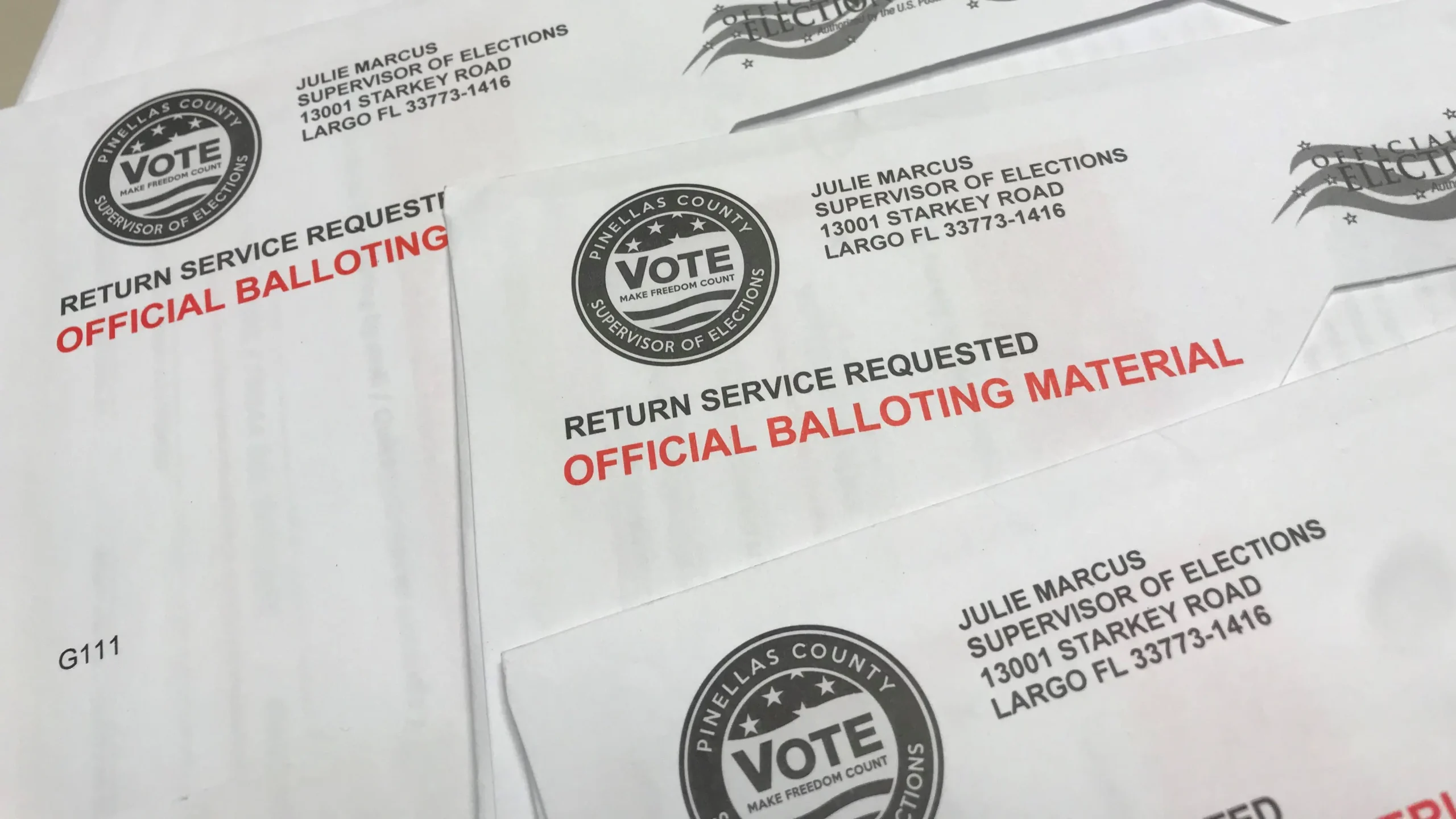
Election Day is Nov. 3, 2026. Voters can cast their ballots before by early voting or vote by mail. | WUSF
Published on October 15, 2026 at 10:59 am
Free local news and info, in your inbox at 6 a.m. M-F. Sign up for the Jacksonville Today newsletter.
Besides Amendment 3 — the proposed constitutional amendment to lower property taxes — the Nov. 3 ballot includes two other amendments.
Amendments 1 and 2 involve the state’s rainy day fund and property taxes on agricultural equipment.
Jacksonville Today thanks our sponsors. Become one.
The amendments must get 60% of the vote to become law. Here’s what Floridians need to know about the proposals:
Amendment 1
Florida has a budget stabilization fund, also called a rainy day fund, that helps the state in the event of budget shortfalls and other emergencies.
The state constitution says the overall size of that fund can’t be less than 5% or more than 10% of the previous year’s general revenue collections. The maximum right now is around $5 billion.


Jacksonville Today thanks our sponsors. Become one.
Amendment 1 raises the cap to 25%.
It also requires the Legislature to put $750 million into the fund every year — or a smaller amount if that’s all that’s required to bring the fund to that top threshold.
Lawmakers could suspend an annual transfer if money is pulled that same year to address a shortfall or emergency.
Additionally, if the Legislature determines there’s a “critical need” that costs more than $750 million, it can suspend a transfer by a two-thirds vote once every five years.
ALSO READ: What’s Amendment 3?
The Republican Party of Florida endorsed Amendment 1.
“Floridians work hard for what they have. Government should not spend it all and then come back for more,” Florida GOP Chairman Evan Power said in a statement. “Amendment 1 keeps Florida prepared for storms, emergencies, and downturns without raising taxes.”
But that puts the party at odds with Gov. Ron DeSantis, who went so far as to call the amendment “foolish.”
“We already have a maxed-out rainy-day fund and have run the largest surpluses in state history,” he wrote in a social media post.
“Any additional revenue should be used for lower taxes, including assisting local governments with grants so that homestead properties can be exempt from local property tax,” he continued. “Surplus revenue could also be used to remove tolls once the property tax issue is settled.”
U.S. Rep. Byron Donalds, the GOP gubernatorial candidate to replace DeSantis, is also a no, according to a campaign spokesperson.
Former congressman David Jolly, the Democratic nominee, says he supports it, according to Florida Politics. But he emphasizes the need for guardrails on the money.
That position isn’t consistent among Democrats either. Some local Democratic groups — including the Miami-Dade Democratic Party and the Palm Beach County Democratic Party — recommend Floridians vote against it.
“That would tie up about $16.4 billion over roughly 22 years that could fund schools, health care and housing now, and it writes budget policy into the Constitution, where it’s hard to fix,” the Palm Beach County Democratic Party wrote on its website.
Amendment 2
Amendment 2 would exempt agricultural equipment and other “tangible personal property” used for farming or agritourism from property taxes, if typically kept on land owned or leased by farmers.
Examples of exempted equipment include tractors and harvesting machines.
“It hits every farm in the state of Florida, big, small,” said Sen. Keith Truenow of Tavares, a farmer himself and a sponsor of the measure. “So every one of them is going to get a break on the cost of doing business, which is monumental.”
Truenow said the measure would help farmers struggling with high prices and would help level the playing field.
“We look at foreign produce or products coming from foreign places, and we’re having to compete with whatever it is that they can bring,” he said.
ALSO READ: Florida strawberry growers claim harm from unfairly low-priced imports
But critics point to a legislative analysis estimating the measure would reduce local property tax revenue by about $31 million annually starting in the 2027–28 fiscal year.
“That money would otherwise fund county and municipal budgets: fire and EMS, sheriff’s offices, parks, roads and other local services,” the Hillsborough County Democratic Party wrote on its website.
“It delivers its largest dollar benefit to landowners with the most equipment,” the party also wrote. “A modest exemption cap could have targeted relief to small and mid-size farms.”
Businesses, including farms, can already receive a property tax exemption on the first $25,000 of assessed tangible personal property.
If you have any questions about state government or the legislative process, you can ask the Your Florida team by clicking here.
This story was produced by WUSF as part of a statewide journalism initiative funded by the Corporation for Public Broadcasting.
Copyright © 2026 WUSF 89.7
Reader-supported election coverage
Help fund the next voter guide.
Every candidate on your ballot receives the same questions from us.
We publish their answers word for word.
We name the candidates who never respond.
Make a donation to support this work.