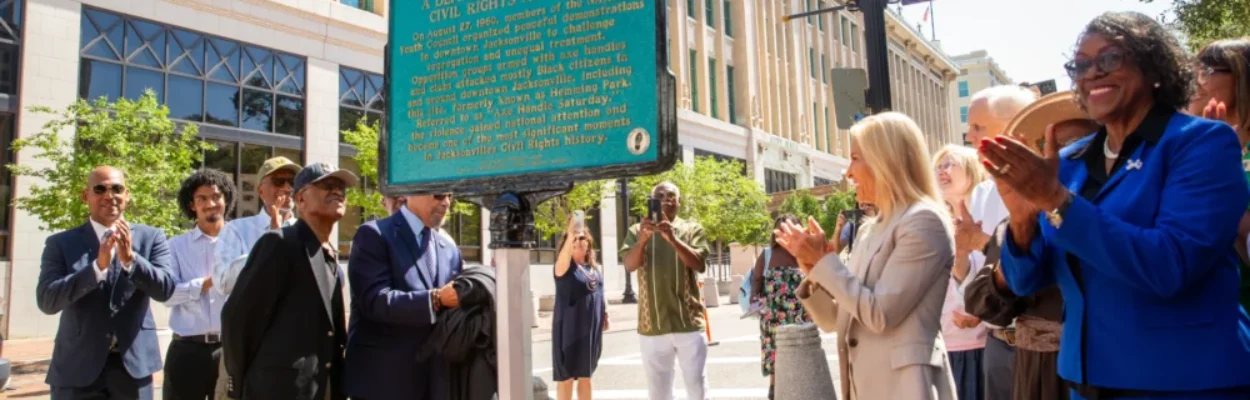
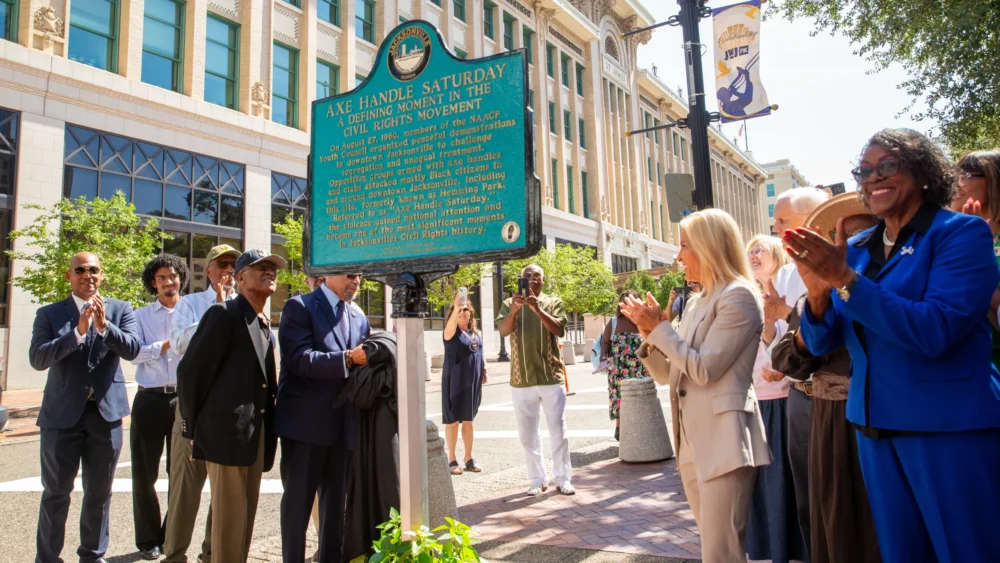
Jacksonville Mayor Donna Deegan, as well as retired Air Force Lt. Col. Alton Yates and Dr. Rodney L. Hurst Sr., helped unveil a marker to commemorate Axe Handle Saturday on Thursday, Aug. 27, 2026. Rodney L. Hurst Sr., one of the organizers of the civil rights demonstrations in 1960 says Deegan is the first sitting mayor to participate in the commemorations. | Will Brown, Jacksonville Today
Published on August 27, 2026 at 5:26 pm
Free local news and info, in your inbox at 6 a.m. M-F. Sign up for the Jacksonville Today newsletter.
An octogenarian in a sharp blue suit stood in the shade of a tree inside the park at the corner of Duval and Hogan streets Thursday morning. He hugged a petite white woman.
In 1960, a Black male hugging a white woman in Downtown Jacksonville might have been met with deadly consequence.
Jacksonville Today thanks our sponsors. Become one.
In 2026, it was the fulcrum of the commemoration of Axe Handle Saturday, one of the darkest days in Jacksonville history.
Thursday, the first woman to serve as Jacksonville mayor, Donna Deegan, hugged local civil rights legend, Rodney L. Hurst, at the park named after one of the city’s most famous sons on the 66th anniversary of Axe Handle Saturday.
The city of Jacksonville unveiled a historic marker in the corner of James Weldon Johnson Park.



Jacksonville Today thanks our sponsors. Become one.
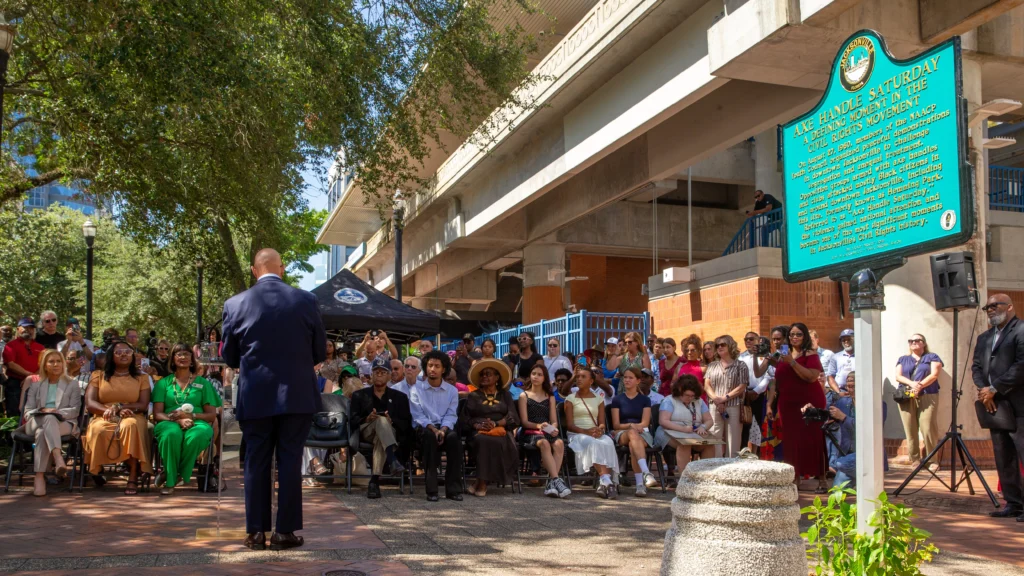
Axe Handle Saturday history
On Aug. 27, 1960, members of the Jacksonville NAACP Youth Council sought to desegregate lunch counters and Downtown department stores. An angry mob, trying to stop the teens from asserting their civil rights, beat the teens and chased them through what was then known as Hemming Plaza and out of Downtown.
“We sat in to dramatize our opposition to racism and for our Black human dignity and respect,” Hurst said Thursday morning. “We were attacked here in Downtown Jacksonville by 200 whites with axe handles and baseball bats after the (Ku Klux) Klan passed out free axe handles on this very corner. This commemoration is part of Jacksonville as a Civil Rights Trail city, tells the story of American history, Black history and civil rights history.”
“These are not urban legends. These events happened. And, they are part of my life and many lives here today. It was always about we and us, not me and I,” Hurst continued.
Hurst was the 16-year-old president of the NAACP Youth Council at the time. Back then, Deegan was months away from being born. Thursday, they embraced.
Deegan and retired Lt. Col Alton Yates helped unveil the sign. Hurst stood next to Yates with admiration etched onto his face. Hurst told Jacksonville Today years ago that Deegan was the first sitting mayor to attend an Axe Handle Saturday commemoration.
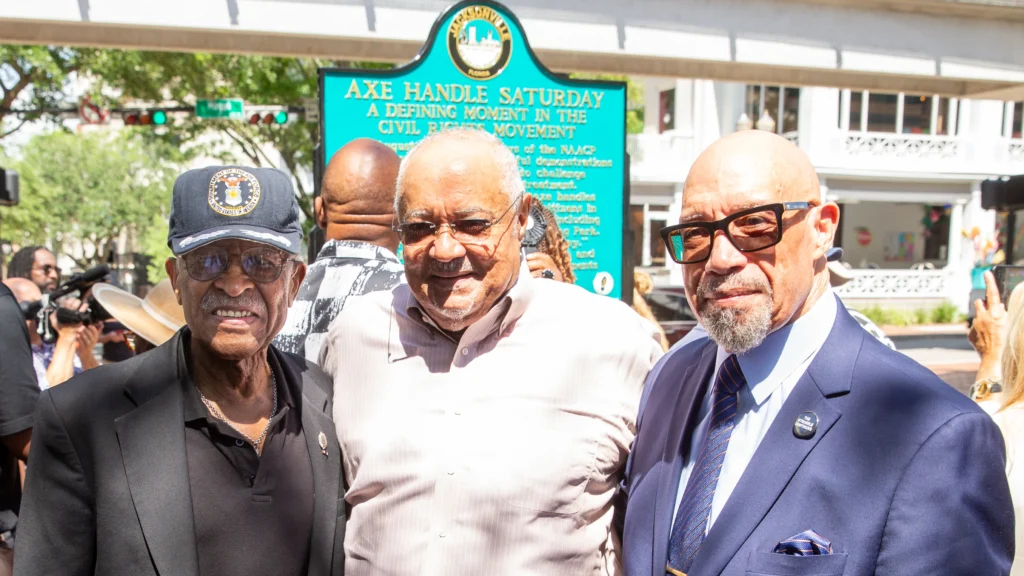
Yates, then a 23-year-old Air Force veteran, was hit in the back of the head on Axe Handle Saturday. Thursday morning, Yates applauded the advocacy from generations that followed him.
“Young people have played a defining role in some of the greatest civic and social movements of our time,” Yates said. “Again and again, they have demonstrated that meaningful change is possible when people are willing to pursue a cause despite the overwhelming odds. What makes their leadership so powerful is their refusal to be intimidated by the challenges standing in the way.”
Eyuel Belay helped the city of Jacksonville complete its application to be a part of the U.S. Civil Rights Trail as part of his undergraduate internship. Belay is Ethiopian and moved to Jacksonville in 2024 to be closer to family and study in college. Belay said the legacy of the American Civil Rights Movement intrigued him because Black Americans were able to set specific goals and achieve them through civil resistance.
Oceanne Major, Isabella Garcia and Ruth Anne Pajcic are even younger than Belay. The trio are eighth grade students who learned about Axe Handle Saturday in their African American history course.
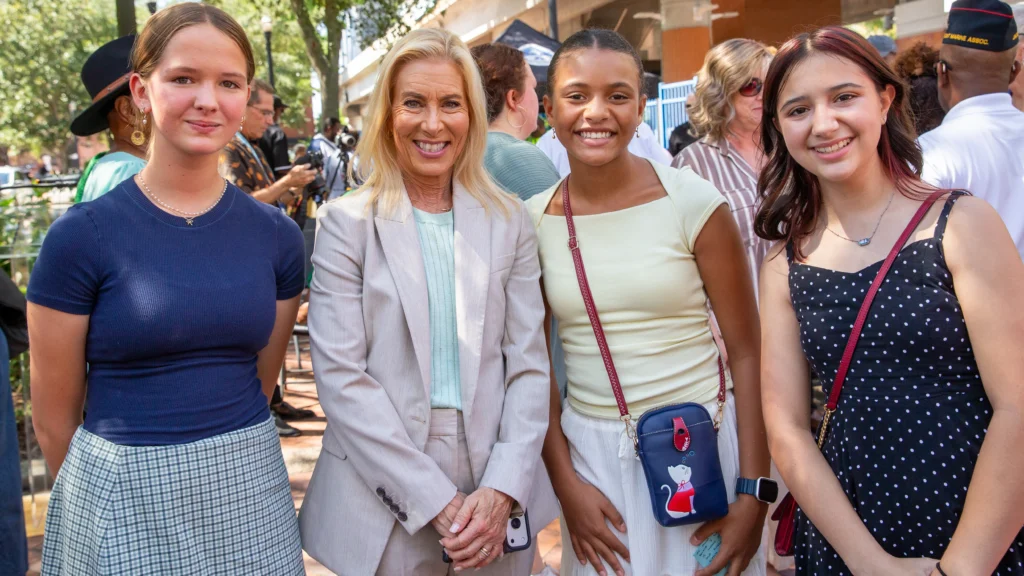
“Children who are not educated about their heritage may end up making the same or similar mistakes,” Garcia said. “This is why new generations need to become leaders and help fight discrimination. We should normalize children speaking up for what they believe in or believe is unjust.”
Pajcic says her grandfather grew up in Avondale but did not learn about the full scope of Axe Handle Saturday until her father wrote a collegiate essay about it. Major added that Axe Handle Saturday is an example of what not to do if everyone is to be treated with fairness, respect and kindness.
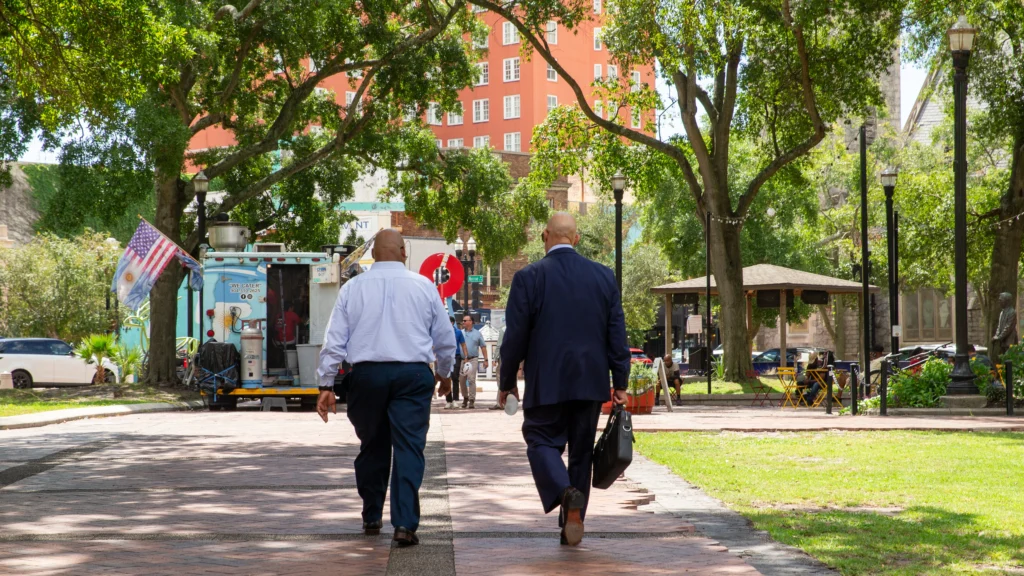
Hurst challenged people to not judge, unless they know; not underestimate unless they challenge and not talk about someone until they talk to them. He closed with a question:
“Are you part of the solution right now or are you part of the problem?”