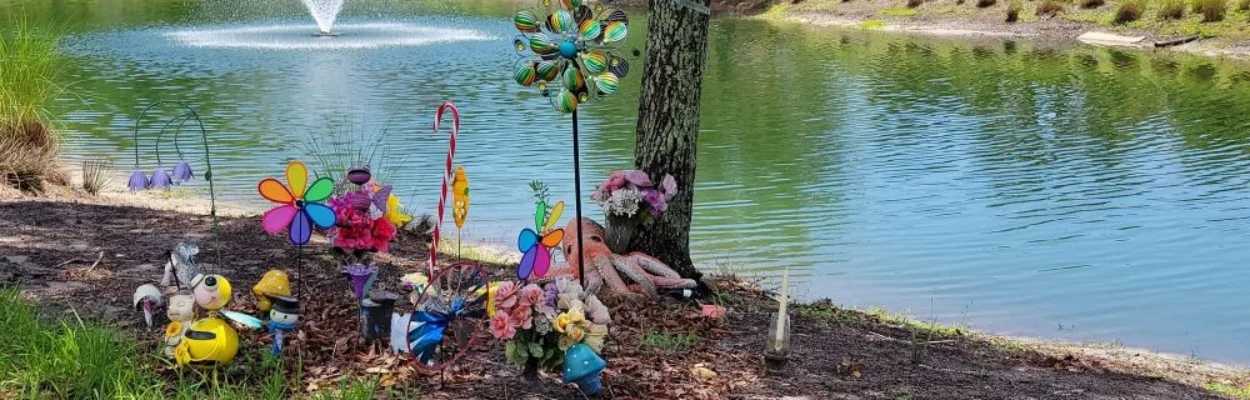
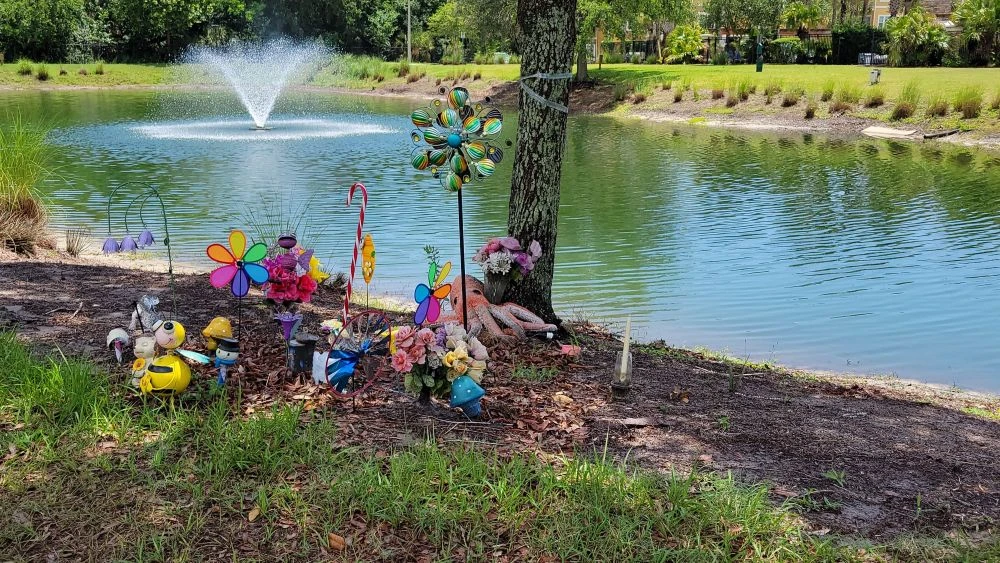
This retention pond at the Bennett Creek apartment complex off Salisbury Road is where 2-year-old Melani Ava Mixson drowned Sept. 18, 2024. A memorial to her remained earlier this year. | Dan Scanlan, Jacksonville Today
Published on August 26, 2026 at 3:32 pm
Free local news and info, in your inbox at 6 a.m. M-F. Sign up for the Jacksonville Today newsletter.
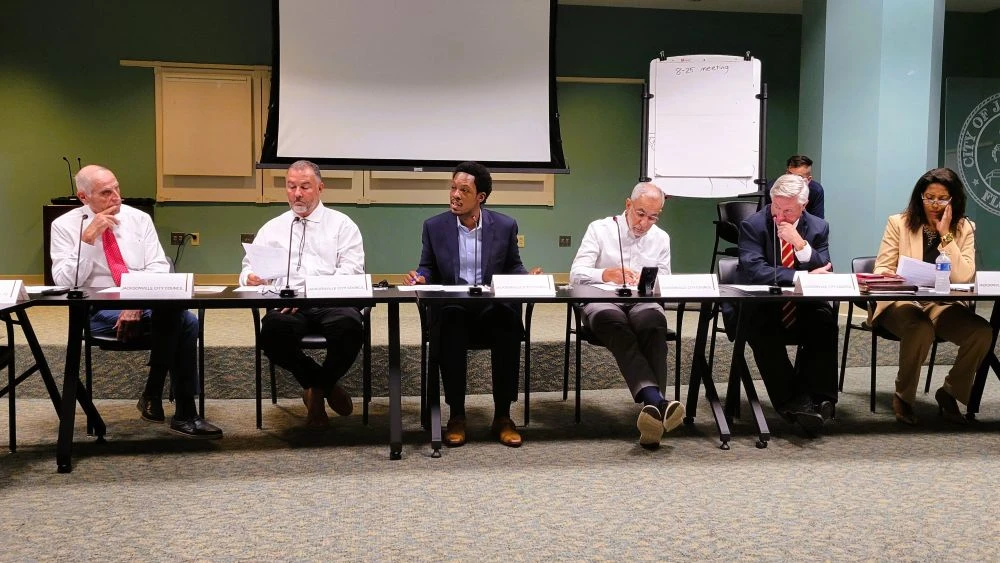
One day after a 3-year-old girl died after falling into a retention pond on North Main Street, and only 20 days after a 7-year-old boy drowned in another one in his district, Jacksonville City Council member Reggie Gaffney Jr. called a meeting this week to seek how to make sure it does not happen again.
As he opened Tuesday’s crowded meeting, Gaffney said he decided to work on preventative measures after the boy’s death. After Monday’s tragedy, he said it was really “time to take action.”
Jacksonville Today thanks our sponsors. Become one.
Both deaths on the city’s Northside this month involved children with autism. Drowning is also a leading cause of all child deaths in Florida.
During the 90-minute City Hall meeting, Gaffney heard from medical officials, as well as developers and landscapers, who have ideas on cordoning off drainage ponds. He also heard from parents of children with autism, worried about the draw that water has to their sons and daughters.
One of those is Oakleaf parent Shannon Hube, a safety advocate who has two children with autism. She said drowning prevention needs layers of protection that start with supervising children, plus locked doors and gates with alarms to keep them safe. Swimming lessons, and CPR training for the people who care for them, are part of those layers.

Jacksonville Today thanks our sponsors. Become one.
“We need multiple safeguards because no single layer is perfect,” Hube said. “And sometimes a barrier does not have to stop a child forever. Sometimes it only has to slow a child down long enough for an adult to catch up. That is especially important in children with autism, who may wander, be strongly drawn for water and have limited danger awareness or be unable to call for help.”
She said barriers like fences and shrubbery could prevent children from getting to water. Making shorelines less steep and adding warning signs for parents could add layers of protection, Hube and others said.
“A child who is drawn to water may still go directly toward it. That is why we have to focus on access barriers,” Hube said. “Young children can drown in as little as one to two inches of water. The issue is not simply how deep the pond is at the edge; it is whether the child has access to the water at all.”
Jamie Travis-Leonard, who helped search earlier this month for the missing 7-year-old who drowned near her Broward Road-area neighborhood, said water safety for children with autism is not a new issue. After they learned of the boy’s death, her HOA community decided its ponds should be fenced in.
“If my neighbors and I can come to that conclusion that easily, I don’t think it’s very hard for the rest of the communities to come to the same ideology, since Florida has regulations around residential pools,” she said. “There are avenues that can be taken that have not been taken by previous city councils to secure these residential retention ponds. … We need additional barriers to be put in place. Whether that is through hard legislation saying they are mandated, or through incentives that incentivize developers and HOAs to put them in, that is up to the City Council.”
After hearing from dozens including fellow council members and state lawmakers, Gaffney says he’s making progress toward retention-pond-safety legislation to prevent more tragedies. He says he’s also aware that previous city efforts in 2021, after similar drownings of children with autism, did not go far enough.
“I am going to make sure we get something done. This issue has been going on for far too long,” Gaffney said. “We have been talking about this for five years. We will get something done.”
Preventing more deaths
The Florida Department of Children and Families’ recorded 90 deaths by drowning statewide in through of June 30 of this year, four of them in Jacksonville. The department recorded 120 statewide drownings last year, three in Duval County. Florida loses more children under the age of 5 to drowning than any other state.
On June 8, a 1-year-old boy drowned after getting into a neighbor’s swimming pool after he got out of his Jacksonville home, according to DCF data. And on March 15, a 5-year-old boy was found dead in a pool while playing outside with a sibling, DCF said.
The three-year-old child who died on Monday was reported missing just after 7:30 a.m. from her home in the Waterside Townhomes at River City just north of Duval Station Road, according to the Jacksonville Sheriff’s Office. And on Aug. 5, 7-year-old Chace Brown was reported missing after leaving his home off Broward Road near I-95.
Gaffney, as well as other council members who joined him, questioned Jacksonville Public Works Operations Director Steven Long about ponds in the city. The city does not trim the grass around the rim of its pond, leaving a 6-foot-wide strip of vegetation around the shore, he said.
“It makes it unattractive to actually go in to or near the pond,” Long said. “I don’t mean the physical look of it, but wanting to go down and get near it.”
So what can be done to make sure developers develop communities with safe retention ponds, City Councilmember Tyrona Clark-Murray wondered.
“That is what we need to focus on, how the ponds affect children, because most adults have the commonsense to not walk into a pond,” she said. ” …. And is there an automatic city ordinance that there are signs posted that, for example, that wildlife may be near?”
Long said city ponds do not have signs like that. But a number of people suggested signs alerting neighbors that a child with autism lives in a community. And small fences and landscaping could be a barrier to access, longtime local developer Curtis Hart said.
Other speakers pointed out that state-funded swim lesson vouchers for young children at the First Coast YMCA are available through the Florida Department of Health WaterSmart Program for low-income Florida residents.