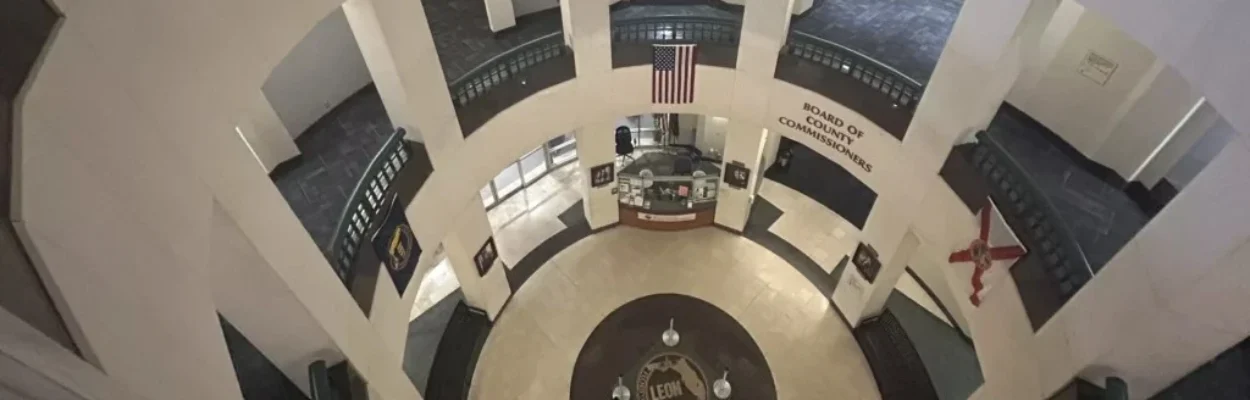
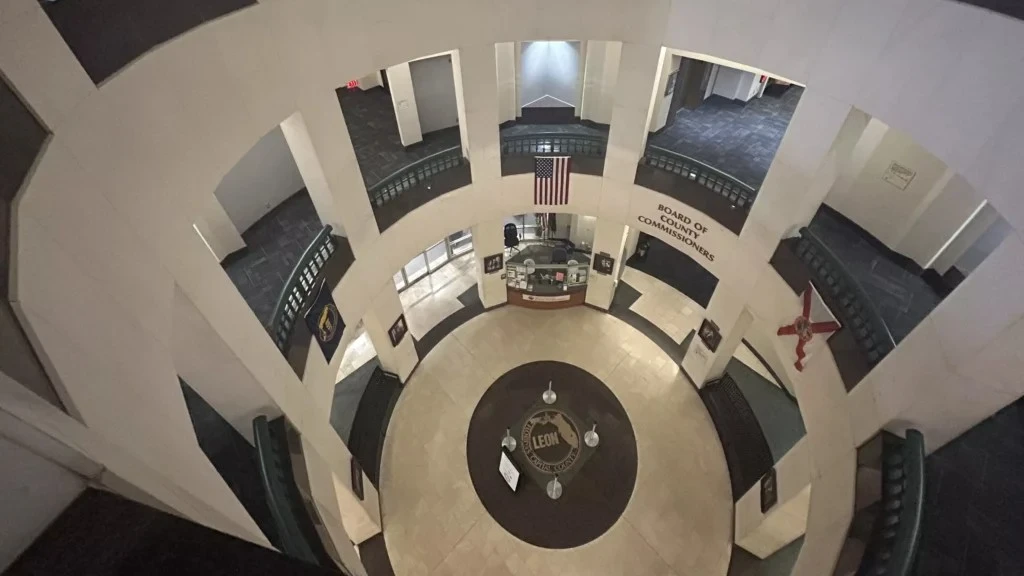
The rotunda of the Leon County Courthouse in Tallahassee. | Douglas Soule, WUSF
Published on August 4, 2026 at 12:39 pm
Free local news and info, in your inbox at 6 a.m. M-F. Sign up for the Jacksonville Today newsletter.
A Tallahassee judge has ordered the state to rewrite the ballot language for the proposed property tax reduction constitutional amendment.
“In summary, voters are entitled to a fair, clear, accurate and non-misleading ballot statement to assist them in making their critical determination,” wrote Judge David Frank. “The present ballot language would deprive the voters of the opportunity to make a meaningful decision.”
Jacksonville Today thanks our sponsors. Become one.
The ultimate ballot language will be seen by voters in the November general election. The amendment will pass if at least 60% of voters approve it.
The Legislature had a special session to create the proposed constitutional amendment.
It’s a big deal. Not just for homeowners who could save tax money, but for local governments that say the loss of revenue will make it harder to provide important local services.


Jacksonville Today thanks our sponsors. Become one.
ALSO READ: How far does Florida’s property tax proposal go? There are some questions
The ruling can be appealed, but the clock’s ticking, since the state says the ballot needs to be finalized by the end of this month.
A Florida Department of State spokesperson said the state doesn’t comment on pending litigation.
State Attorney General James Uthmeier has 10 days to revise the ballot language. Any legal challenge to the revised language would have to come within 10 days after that.
Uthmeier’s office didn’t immediately respond to WUSF.
“If this is an issue that everyone wants on the ballot, and I think it is, it should be fixed, and it should be fixed properly,” said Jamie Cole, an attorney for some of those suing the state over the original wording. “And there’s no reason we can’t get that done before the end of the month, so it gets before the voters.”
Plaintiffs include the group Save Our Voters From Misleading Ballot Language, two former mayors, former Democratic U.S. Rep. Al Lawson and former Florida Republican Sen. Jeff Brandes, who has since created a policy think tank.
ALSO READ: Judge weighs challenge to ballot language in Florida property tax amendment
In his ruling, Frank said the ballot title alone is problematic. It reads “Save Our Homes From Excessive Property Taxes”.
“The title is more akin to a political slogan,” Frank wrote. “It is not fair or neutral.”
He went on to identify a multitude of phrases he said needed to be changed for the ballot, including that it would lead to the full elimination of nonschool property taxes on homestead property.
That line has created a significant debate. Even top lawmakers said different things about whether this would allow lawmakers to require even greater property tax reductions without voters’ approval.
Frank had this to say: “But the actual proposed constitutional language does not require ‘full elimination,'” he wrote. “Rather, it would require the Legislature to establish procedures through which local governments may choose to grant additional exemptions in the future ‘up to’ the full assessed valuation.”
Frank also took issue with lines like “ensuring funding for core services,” “protecting small businesses” and “ensuring fairness for Florida residents.”
“The purpose of a ballot summary is to explain what an amendment would do, not to advocate for its adoption,” he said.
There’s more. Read the rest of Frank’s opinion below: