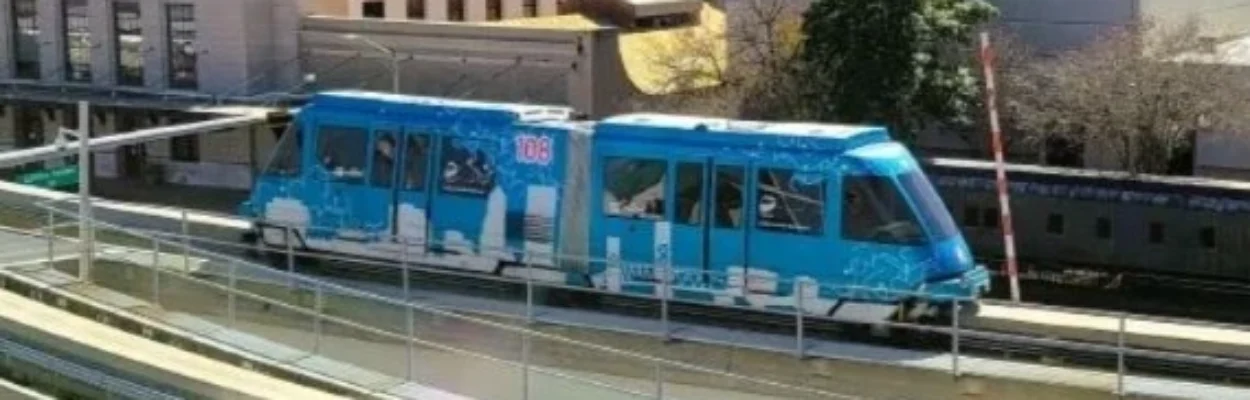
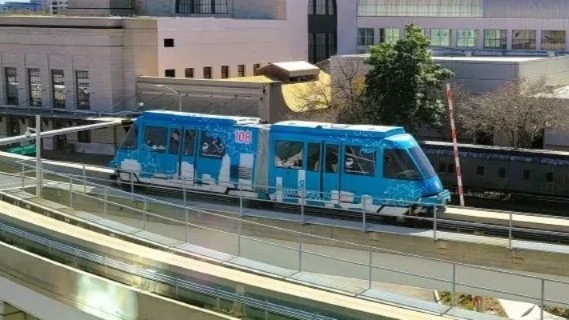
Skyway cars move into the LaVilla station of the Jacksonville Transportation Authority. | Dan Scanlan, Jacksonville Today
Published on May 5, 2026 at 2:44 pm
Free local news and info, in your inbox at 6 a.m. M-F. Sign up for the Jacksonville Today newsletter.
A second round of community meetings to discuss the future of the Jacksonville Transportation Authority’s aging Skyway system has been postponed.
So far, community feedback on possible Skyway redesigns shows the favorite is a desire to convert the overhead track into a pedestrian-friendly walkway as autonomous people movers stay on the city streets below.
Jacksonville Today thanks our sponsors. Become one.
Community meetings were originally set for next week to continue getting public input on ways to modernize the system and improve mobility in Downtown Jacksonville. The meetings will be rescheduled for this fall.
The first round of community meetings occurred in February and March when the authority unveiled a mix of old and new proposals for its Ultimate Urban Commuter system, known as the U2C. The system ultimately would include autonomous vans on city streets and the Skyway trains overhead in Downtown.
The decision to postpone community meetings comes as JTA “continues to evaluate feedback received during the initial round of public meetings and works to identify the most effective project alternative options for the Skyway,” a news release stated. “Based on public feedback, the Authority will also expand its review to include more traditional transit alternatives as part of the ongoing planning process.”
Jacksonville Today thanks our sponsors. Become one.
Birth of the Skyway
The JTA got more than $23 million in federal funds in 1985 to start the Skyway. The first 0.7-mile length opened in 1989. By 1998, the Skyway ran from James Weldon Johnson Park to Florida State College at Jacksonville and across the Acosta Bridge to San Marco. Its original 10-car fleet is down to two due to aging infrastructure and inability to get parts to maintain them, JTA said.
The plan now is to replace the Skyway as it exists with the Ultimate Urban Circulator, which would ultimately link the Northbank to San Marco, Brooklyn and Riverside at an estimated cost of $400 million. The first step in that was the autonomous shuttle vans now cruising through downtown, called NAVI, short for Neighborhood Autonomous Vehicle Innovation.
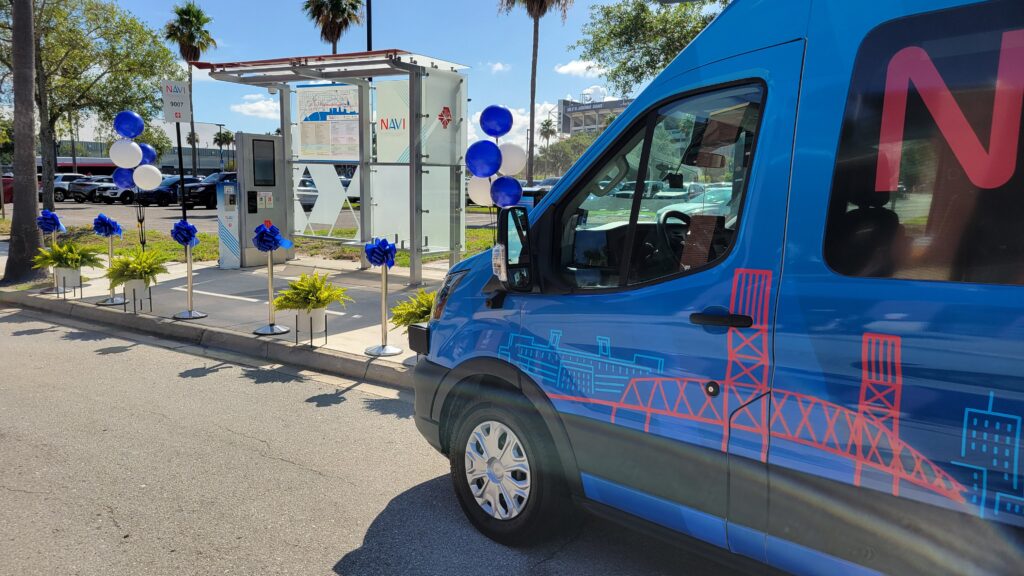
NAVI began July on a 3.5-mile loop between LaVilla and EverBank Stadium. A Jacksonville Transportation Authority staffer sits at the steering wheel, ready to take over if necessary.
The current NAVI shuttles cost $65 million. Fifteen-passenger Holon Urban electric vehicles will replace the Ford vans sometime in 2027. The Holon vehicles will be produced at the company’s first autonomous vehicle factory in Florida, soon to be built on Zoo Parkway on Jacksonville’s Northside.
The U2C’s second phase, as originally planned, would convert the existing 2.5-mile Skyway system in Downtown and San Marco into an elevated roadway for use by the Holons, with ramps to get them off Downtown streets. Four more Skyway stations would be added on the Downtown Northbank and three more across the St. Johns River into the Southbank.
Extension of the local option gas tax would have partly funded that phase’s estimated $300 million cost, JTA officials say. The U2C’s third phase would put the U2C on streets in the Brooklyn and Riverside areas, with an estimated cost of $100 million. No construction date had been set on either.
NAVI saw an average of just over 100 riders per day in its first three months, and the autonomous vans are now free to ride from 7 a.m. to 7 p.m. Mondays through Fridays, although the authority has extended that to some nights due to Downtown events.
JTA also made $14.2 million in expense cuts because sales tax money came in lower than expected, officials said. The cuts include lower pay for senior leaders and increased fares for its Connexion Plus service for people with disabilities — to $10 for the first 12 miles and $2.50 for each mile beyond that.
Skyway’s (possible) future
And as part of those modifications, JTA presented six future possibilities for the U2C during the first round of community meetings:
- No-build. Leave the Skyway as is.
- Rehab the existing Skyway trains.
- Replace the current Skyway trains with new ones.
- Upgrade Skyway tracks to handle the current NAVI vans and future vehicles, with ramps at Kings Avenue, Leila Street and the Rosa Parks station Downtown. (This was the original proposal.)
- Remove the overhead Skyway tracks and operate NAVI and future vehicles on Downtown, San Marco and Riverside streets only.
- Repurpose elevated Skyway tracks as landscaped walkways.
JTA says it has digested public comment from the first meetings and a public survey and has some initial rankings.
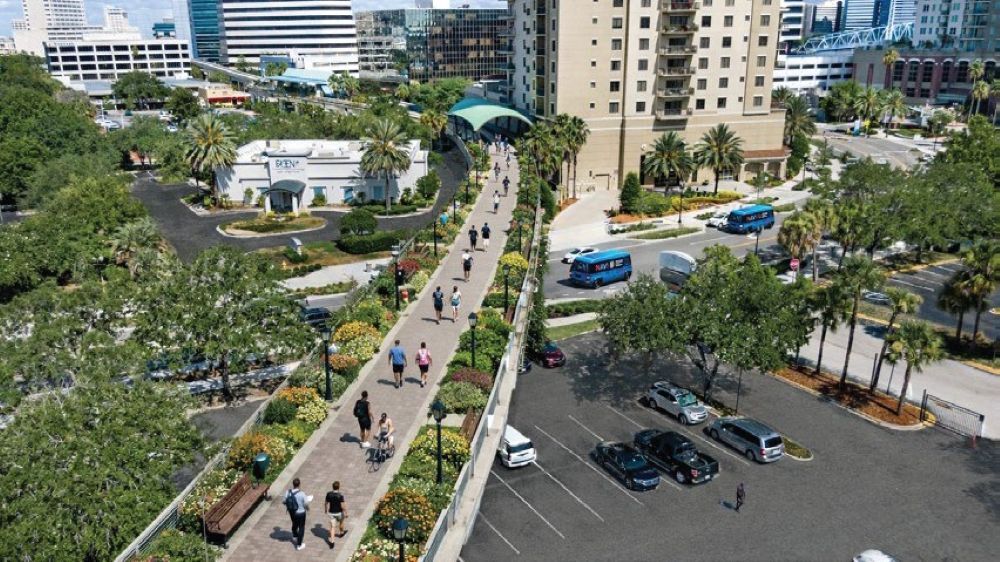
The most-supported one is to repurpose the overhead tracks as a multiuse public trail, not unlike New York City’s High Line, a 1.45-mile-long elevated public park on a converted old elevated freight rail line. This would provide for NAVI, then the HOLON people movers, to stay on Jacksonville’s Downtown, San Marco and Riverside streets.
The next most-approved proposals were the replacement of the current Skyway trains with new ones, followed by the JTA’s original plan — convert the overhead tracks to handle Holon people movers, with ramps to get on and off Downtown streets where the tracks do not run.
The fourth favorite was to retrofit the current Skyway trains, while the fifth-favorite was do nothing at all. The least favorite was to tear down the overhead tracks and stop running NAVI.