
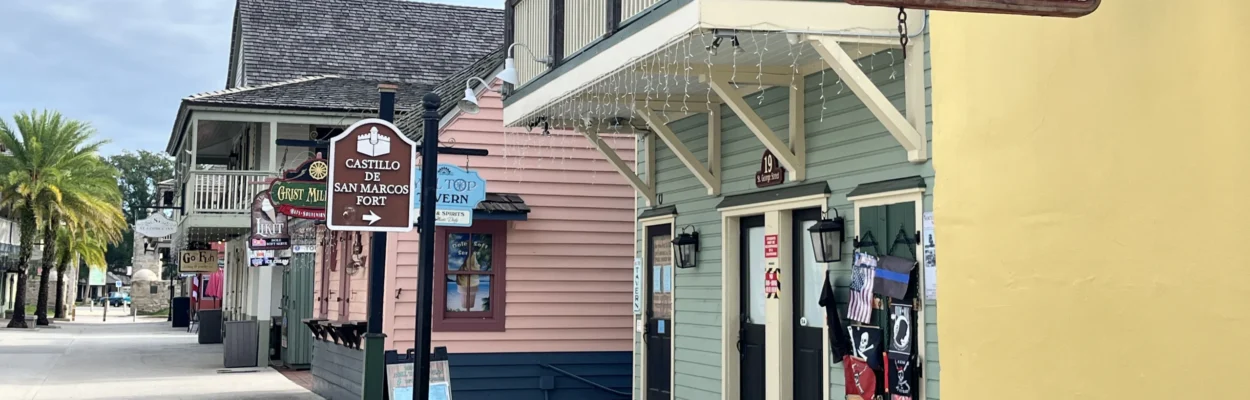

St. Augustine's St. George Street is one of the busiest streets in the historic downtown core. | Noah Hertz, Jacksonville Today
Published on February 24, 2026 at 1:05 pm
Free local news and info, in your inbox at 6 a.m. M-F. Sign up for the Jacksonville Today newsletter.
St. Augustine is among local governments bracing for impact while Florida lawmakers consider radically altering how property taxes are collected in the state.
City leaders say the bill in the lead so far this legislative session could seriously affect city services.
Jacksonville Today thanks our sponsors. Become one.
Gov. Ron DeSantis charged the Legislature with finding ways to ease the burden of property taxes on Florida residents, and a leading proposal, HJR 203, would completely axe nonschool property taxes on Floridians’ primary residences.
The House bill doesn’t have a Senate equivalent at this stage of the legislative session, but if it were to become law, St. Augustine city officials estimate it would result in a loss of about $7.8 million.
Property taxes, paid by owners based on property values, make up almost 60% of the revenue that pays for the city’s general fund. That’s the part of St. Augustine’s budget that funds everything from historic preservation efforts to the city’s police and fire departments.



Jacksonville Today thanks our sponsors. Become one.
No matter what departments were cut in St. Augustine’s budget, City Manager David Birchim said residents would feel it in the services they receive. All of the city’s departments are intertwined, he said.
“If we have to reduce the people who maintain trucks, then our utilities company who drives those trucks may have trouble getting and responding to their work environment,” Birchim offered as an example during a workshop Monday about the proposed changes. “I’m just saying it’s not black and white. There will be impacts to the system if there are (property tax) reductions.”
Solving the property tax equation
A $7.8 million cut represents a sizable chunk of the estimated 2026-27 general fund budget of about $51 million. To close the deficit, the proposed bill restricts municipalities from taking money out of their police or fire budgets.
Funding for St. Augustine’s public safety represents 20% of the city’s total budget, and the police and fire departments represent the majority of St. Augustine’s staff.
City Commissioner Jim Springfield said one way to close that gap could be to consolidate those departments with St. Johns County, although the current bill says city and county governments could not decrease public safety funding to less than they were budgeted for the prior fiscal year.
“We’re paying county taxes — we’re already paying for the Sheriff’s Department, we’re already paying for the fire department in the county — but if we have to cut a majority of our money, there’s a good chance that we would say, we need to consolidate our services and maybe police or fire is the way to go,” Springfield said.
City officials also acknowledged that raising taxes on everyone else was an option.
Not all of the city’s tax revenue comes from homesteaded properties, which is what the Legislature is aiming to eliminate.
If the city were to raise taxes to make up for a loss in revenue from those homesteaded properties, the rest of the city’s ad valorem property tax base, including commercial property owners and people who use property for short-term rentals like Airbnb, would feel the sting.
Easing property tax burden?
Although city leaders prepped for what Mayor Nancy Sikes-Kline called the “worst-case scenario,” reception from residents who spoke at Monday’s meeting was mixed.
Some speakers shared city leaders’ concerns that property tax cuts would reduce city services; others urged the city to tighten its belt and find more revenue sources that aren’t local residents.
City resident Jeffrey Leibovitz said seniors like himself need the relief.
“I have to live within my means. The city has to learn to live within its means,” he told the City Commission. “Those of us who have gotten to that point in our lives where we’re looking for some relief on taxes really would like to have some. “
The Florida Legislature is scheduled to wrap up its 2026 legislative session next month. With several competing property tax proposals on the floor, lawmakers have identified property tax relief as a key priority to work out before adjourning.