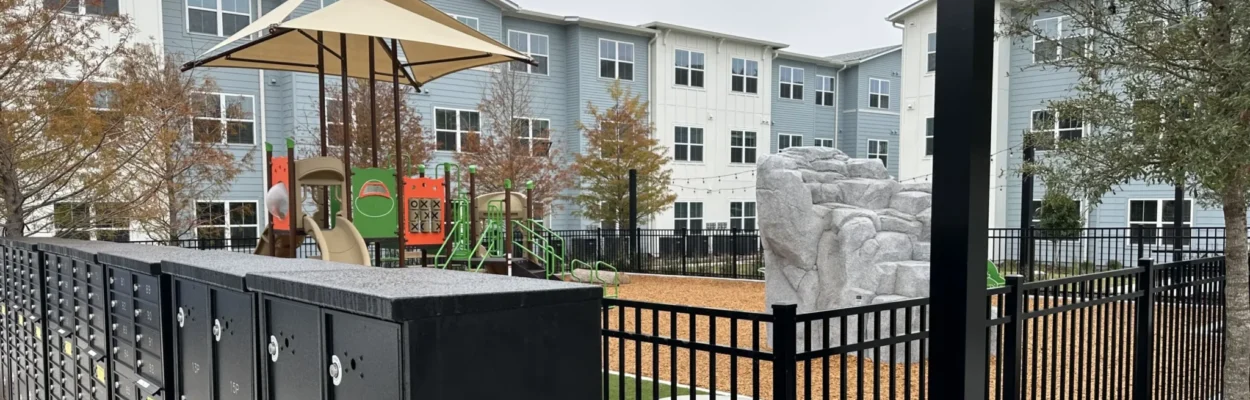
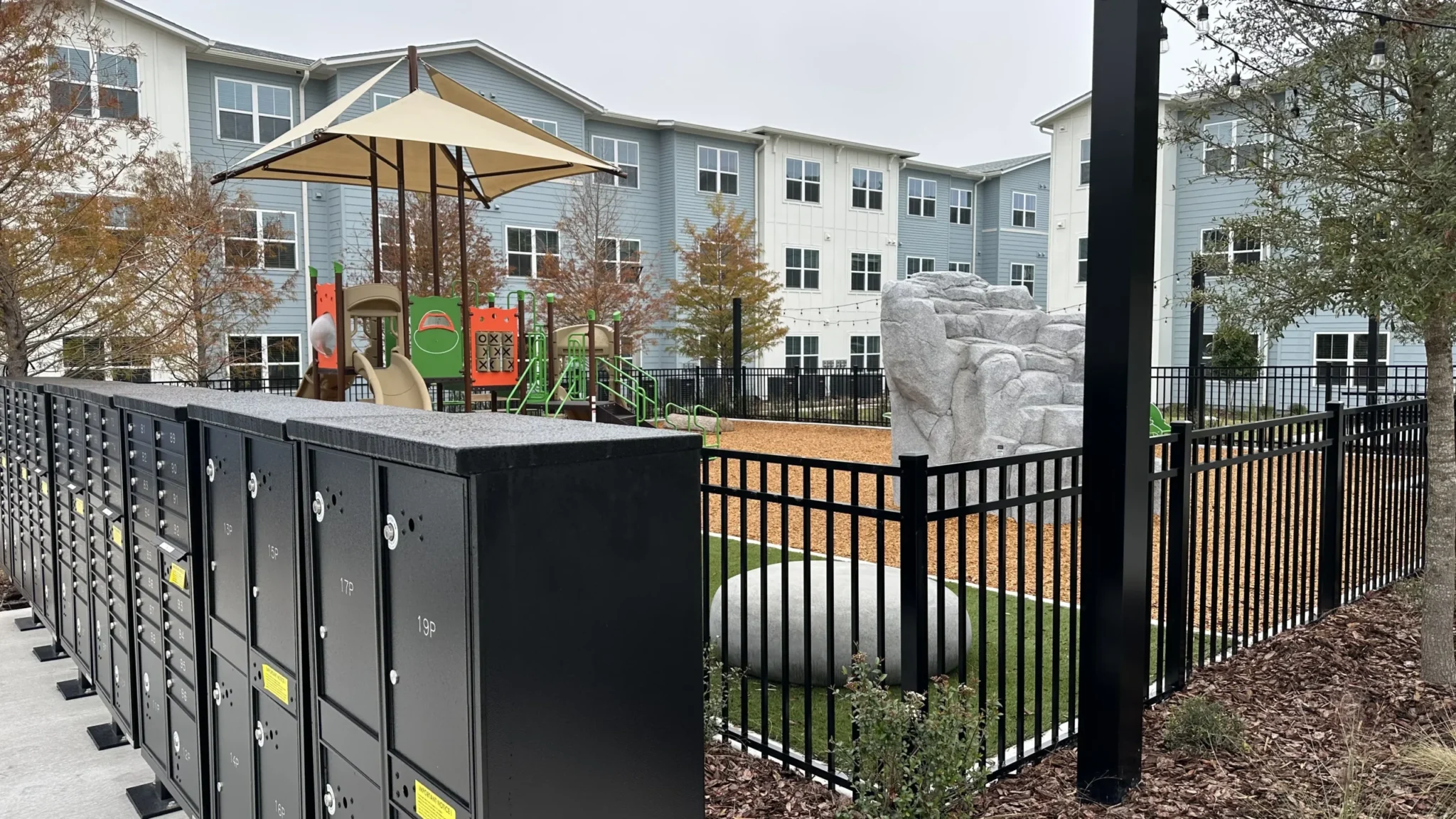
Ability Housing has opened Village at Cedar Hills, an affordable housing complex on Jacksonville’s Westside. | Michelle Corum, Jacksonville Today
Published on February 6, 2026 at 11:08 am
Free local news and info, in your inbox at 6 a.m. M-F. Sign up for the Jacksonville Today newsletter.
Q: Most everyone agrees: The lack of affordable housing for working people is one of the most pressing issues in Northeast Florida.
Last October, Jacksonville Mayor Donna Deegan and other city officials unveiled five new affordable housing units in the Durkeeville neighborhood. They are advertised at a rental rate of $1,332 per month, available to people whose household incomes do not exceed a certain amount.
Jacksonville Today thanks our sponsors. Become one.
Jacksonville Today reader Jennifer R. says she doesn’t consider that “affordable housing” to be affordable.
“Who in the world thinks $1,332 is affordable?” she asks.
“How is that defined in Jax?”
She writes: “This effort is still better than nothing, and I’m sure this whole program costs (a lot) given building costs. I still wonder who is deciding this is affordable, and also how that is calculated. At least be honest and say ‘kind of affordable housing’ instead.”


Jacksonville Today thanks our sponsors. Become one.
A: Even people who specialize in housing will admit that housing data and terminology isn’t always the easiest thing to understand. For example, there is a difference between housing that you or I consider to be affordable and what the law defines as “affordable housing.” State and federal governments have their own definitions.
Those determinations, which are updated every year based on income data, are where Jacksonville Affordable Housing Director Joshua Hicks admits that things get a little confusing.
“When you’re having readers reach out to you, say, ‘Hey, I can’t afford this affordable housing,’ it’s because everyone’s income is different,” Hicks says.
According to the U.S. Department of Housing and Urban Development, any household spending more than 30% of their annual income on housing expenses like rent or a mortgage are considered “cost-burdened.”
A report from the U.S. Census Bureau in 2024 found that nearly half of all renters in the country are considered cost-burdened, with people who identify as a race other than white disproportionately affected.
In Jacksonville, Hicks says more than 25% of households are past the 30% mark and are considered “severely cost-burdened.”
“That means they’re paying more than 50% of their income on housing,” he says. “So we have a housing crisis, and it’s identified in the numbers.”
The affordable housing sweet spot
Affordable housing directed at people in one income bracket is priced very differently than affordable housing targeted at a different income bracket. Every year, the federal government’s Department of Housing and Urban Development and then the state of Florida update their affordable housing regulations based on the area median income, or AMI, and household size.
Once that data is in, and rental rates are set for affordable apartments, that’s out of the local government’s hands.
“The city does not dictate the rents. I mean, we’re not builders,” Hicks explains. “So the rents are coming from the developers, and if they’re getting money from the city, and we’re calling it affordable, we use … the federal numbers and the state numbers to dictate affordability.”
Affordable housing programs exist to provide housing to people who are making less than (or just more than) the average income in a given area, but as reader Jennifer R. said, not all affordable housing is made equal.
How affordable is affordable housing?
What people commonly understand as affordable housing is actually a larger category. It makes up income-restricted housing for people making no more than 80% of the area median income, but it also includes housing designed for people making 30% of the area median income.
The area median income is calculated annually by metropolitan areas. In the Jacksonville metro area — which includes Duval, St. Johns, Clay and Nassau counties — the 2025 median income is $102,500. That means, to qualify for housing designed for people making 80% of the area median income, a family of four would have to have a combined income of $82,000 or less.
For someone making 80% of the area median income, or $82,500, their monthly housing costs (including utilities) would have to be less than $2,300.
Similarly, housing for people at the 30% area median income is designed for a family of four making around $32,150. To not be considered cost-burdened, that household’s monthly housing costs would look a lot different — around $900.
And someone’s experience may vary greatly if they are looking for housing for just one person, or for a family of four.
The same goes for location. The cost of affordable housing is determined by metropolitan area, not by county or ZIP code.
“$82,000 in St. Johns County versus $82,000 in Clay County or parts of Nassau County are two different sets of dollars,” Cody Spencer says. “We can quite clearly see that these counties have different socioeconomic statuses in them.”
Spencer is the program director for Ability Housing, an affordable housing development company with around 2,000 households across Florida, including in Duval and St. Johns counties.
“All of the housing that we produce comes from a variety of funding sources,” Spencer says. “The primary funding source is tax credits and affordable housing dollars that are directed to the Florida Housing Finance Corp.”
He says getting a piece of that funding is cutthroat, and with limited funds available and housing costs out of hand for many people, Florida can’t build affordable housing fast enough.
The Florida Legislature has tried to give further incentives for building affordable housing through initiatives like the Live Local Act. One provision of that law allows developers to build housing in areas where they otherwise would not automatically be able to, but the housing must be at least 40% affordable.
Housing experts and politicians across Florida doubt that taking power away from local governments to promote housing is a winning strategy.
Spencer at Ability Housing believes the change happens at the community level, when developers are seeking affordable housing incentives or approvals from municipal governments.
Whether it’s housing for people at the lowest income levels in a community, or teachers and nurses whose income doesn’t get them much higher than the area’s median, he says existing residents have to be open to affordable housing being built near them.
“Welcome affordable housing in your community,” Spencer says. “The teachers, the people who work at Starbucks, the people who work in your community and provide services to you deserve to live, to be your neighbor.”