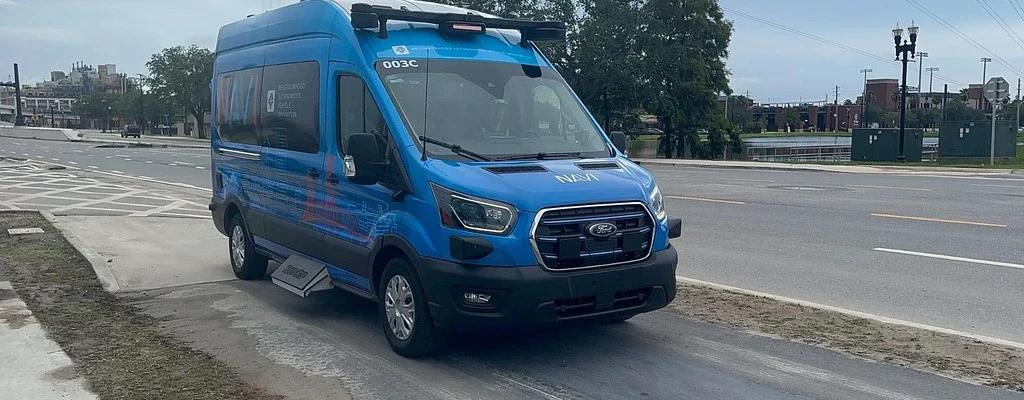
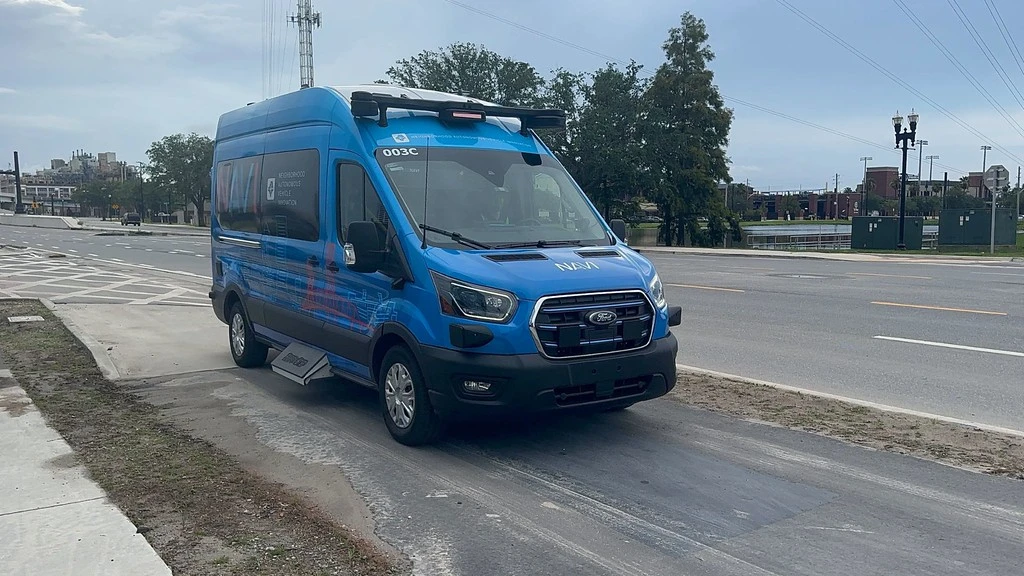
JTA’s NAVI shuttles currently have a capacity of carrying up to 8 to 9 passengers. However, this limited form of moving people is being considered as an alternative option for systems, such as modern streetcars, that have the ability to move more than 125 passengers per train. | Marcus Nelson
Published on September 9, 2026 at 10:45 am
Jacksonville Today seeks to include a diverse set of perspectives that add context or unique insight to the news of the day. Regular opinion columnists are independent contractors who are not involved in news decisions. Want to submit your own column on a matter of public interest? Email pitches to jessica@jaxtoday.org.
Jacksonville is once again being asked to decide the future of the Skyway.
The Jacksonville Transportation Authority is presenting the public with six alternatives for the aging Downtown transit system, with advertised capital costs ranging from $151.95 million to $565.44 million. The choices range from rehabilitating the existing monorail and replacing it with a modern automated people mover, to demolishing it, converting it into an elevated trail, building a modern streetcar or incorporating JTA’s Neighborhood Autonomous Vehicle Innovation (NAVI) program into its future.
Jacksonville Today thanks our sponsors. Become one.
As a professional transportation planner, I believe Jacksonville should be having this conversation. The Skyway is approaching the end of its original useful life, replacement parts are increasingly difficult to obtain, and Downtown Jacksonville is changing rapidly.
What concerns me is how the conversation is being framed. When alternatives involving fundamentally different modes, passenger capacities, service areas and purposes are placed side-by-side, while some cost estimates appear dramatically different from figures developed by other transportation professionals and potential suppliers, the public should ask questions.
That is particularly important because a December 2025 study prepared by Lea+Elliott reached conclusions that deserve considerably more attention in the current discussion. The firm examined five options after contacting Alstom, BYD, Mitsubishi Heavy Industries America and Schwager Davis Inc. (SDI).
Jacksonville Today thanks our sponsors. Become one.
Its conclusion? Refurbishing the existing Skyway vehicles and upgrading train control appeared to provide the best overall value. So before Jacksonville commits hundreds of millions of additional dollars, let’s look closely at what is actually on the table.
Demolition by neglect
Do (essentially) nothing | JTA Estimate: $15.15 million + $11.85 million annually

This should not be a serious option.
Two of Downtown’s largest development projects, Pearl Square and the University of Florida’s Jacksonville campus, are being developed at existing Skyway stations. At precisely the moment Jacksonville is pouring extraordinary public and private investment into Downtown, allowing its existing grade-separated transit infrastructure to deteriorate until it can no longer function would be remarkably shortsighted.
The Skyway itself is not insignificant infrastructure. It is a fully automated, 2.5-mile, dual-guideway system serving eight stations between Downtown and the Southbank. Its current fleet consists of ten two-car trains, and the system was originally designed to accommodate three-car trains. Running a raggedy old train (most of the fleet is currently inoperable) until the wheels fall off rather than responsibly maintaining and modernizing it is not fiscal conservatism. It is demolition by neglect.
And if federal useful-life requirements remain applicable to portions of the system’s historic federal investment, prematurely abandoning federally funded infrastructure could potentially create additional financial exposure to taxpayers. Before choosing this path, JTA should publicly explain exactly what, if any, federal repayment obligation would be triggered and under what circumstances.
The Skyway Monorail Alternatives
Rehabilitate the existing Skyway | JTA estimate: $276 million

Of all the alternatives presented, this is the one that should make taxpayers most skeptical of the numbers being placed before them. That’s because we have another professional study, completed a few months ago, suggesting something dramatically different.
Lea+Elliott’s December 2025 analysis contacted four experienced automated-transit manufacturers. SDI, a San Jose engineering company experienced in manufacturing and refurbishing automated monorail vehicles, expressed interest in refurbishing Jacksonville’s existing fleet. It was also the only manufacturer that expressed interest in both refurbishment and potentially adding a third car to the existing trains. The study’s initial cost estimate is approximately $60 million to $76 million. That is roughly $200 million below JTA’s $276 million figure.

And there is another important distinction. JTA describes its rehabilitation alternative as adding approximately 10 to 12 years of life. Lea+Elliott estimated a refurbished fleet’s design life at 10 to 15 years. Even better, the existing system was designed for three-car trains. Lea+Elliott concluded that expanding them from two cars to three could increase capacity from 56 to 84 passengers, approximately 50%.
If Jacksonville can responsibly squeeze another decade or more out of the Skyway for something approaching $60 million to $76 million rather than $276 million, the difference isn’t pocket change. Potentially $200 million could instead help improve transit throughout Jacksonville.
JTA needs to publicly reconcile these estimates.
Replace the Skyway with new APM trains and extend service to Brooklyn | JTA Estimate: $428 million

Unlike the rehabilitation estimate, JTA’s $428 million figure for a replacement automated people mover is at least in the general range of the outside engineering analysis.
New technologies considered by Lea+Elliott included Alstom’s Innovia APM 256 and Mitsubishi’s Japanese-standard vehicle. The study noted that these alternatives could provide greater passenger capacity and performance than the existing trains.
But they come with a major catch. Lea+Elliott found that replacing the monorail with the Innovia APM 256 would require demolition of the existing monorail beam and major infrastructure modifications. So the real question is not whether hundreds of millions can be spent replacing the Skyway. Obviously they can.
The question is what Jacksonville gets for that investment. If we’re spending $428 million, why stop with essentially replacing the existing Downtown circulator? At that price, Jacksonville should be discussing meaningful expansion toward the Sports and Entertainment District and surrounding urban-core neighborhoods.

There’s another oddity: the Skyway is already physically in Brooklyn. What it lacks is a passenger station there. In 2021, JTA was discussing adding Brooklyn service for roughly $1.2 million. That raises an obvious question: Why isn’t a Brooklyn station included in the much cheaper rehabilitation scenario as well?
Otherwise, we’re not comparing apples to apples.
The Random Modern Streetcar Alternative
Build a modern streetcar at street level | JTA Estimate: $565.44 million + $15.74 million annually

This one seemingly came out of nowhere.
The proposal would involve 12 street-level trains serving 12 stops in and around Downtown, with possible future expansion to Riverside and the Sports and Entertainment District.
I’m certainly not opposed to streetcars. Quite the opposite. A properly planned streetcar could be a valuable component of Jacksonville’s transit network. But $565.44 million for what route? Serving what destinations? And based on what underlying feasibility analysis?
For comparison, Tempe, Ariz.’s 3.44-mile streetcar opened in 2022 at a reported cost of approximately $200 million. El Paso opened a 4.8-mile streetcar loop in 2018 for approximately $97 million, creatively reusing restored PCC streetcars from its historic system. If we’re going to seriously study streetcars, why stop at one technology? Why isn’t a heritage or replica streetcar evaluated? Why isn’t the route itself studied first?

A legitimate streetcar analysis should determine which corridor best connects Downtown’s strongest ridership generators, neighborhoods and destinations. Only then can planners reasonably estimate capital costs, operating expenses and ridership. A streetcar might ultimately follow a corridor neither the Skyway nor NAVI could effectively replicate. That makes the current proposal something of an apples-to-oranges, last-minute addition to this alternatives discussion.
Why? JTA should explain.
The NAVI Alternatives

Here’s where the process gets particularly difficult to understand.
JTA has demonstrated a remarkable institutional commitment to NAVI and autonomous-vehicle experimentation despite mounting questions about cost, capacity and ridership. NAVI reportedly cost about $65 million for its initial 3.5-mile service. Ridership subsequently declined about 15% between its first and second six months of operation.
Then came the revelation that JTA employees, consultants and interns participated in an “ambassador” program in which they rode NAVI while on the clock. Action News Jax found more than 330 such rides included in JTA’s reported ridership over the period it examined. JTA disputed that employees were recruited to boost ridership, saying ambassadors were there to familiarize riders with the service and collect feedback.
Meanwhile, JTA is facing serious financial problems. City auditors projected a $31.8 million fiscal-year deficit, after the financial outlook deteriorated by $29.5 million between March 31 and June 30.
Against that backdrop, three of the six Skyway alternatives still involve NAVI.
Convert the Skyway for NAVI and add ramps | JTA Estimate: $294.23 million + $11.05 million annually

Jacksonville taxpayers would invest roughly $300 million to replace trains capable of carrying dozens of passengers with small autonomous vehicles. That raises a basic transit-planning question: What problem are we trying to solve?
The existing two-car Skyway train accommodates 56 passengers under Lea+Elliott’s capacity assumptions, while larger replacement technologies evaluated by the firm could accommodate substantially more. Why spend hundreds of millions converting dedicated transit infrastructure to accommodate substantially smaller vehicles?
And what happens when thousands of people leave a Jaguars game, concert or major Downtown event simultaneously? That’s not an academic question. It’s the fundamental purpose of mass transit: moving masses of people.
Demolish the Skyway and operate NAVI in mixed traffic | JTA Estimate: $151.95 million + $9.03 million annually

Skyway trains can possibly be modified to carry up to 85 passengers per vehicle while NAVI is basically a limited, less performing publicly-owned version of Waymo or Uber. One is a form of mass transit and the other is a form of rideshare. Demolishing the Skyway and operating NAVI in mixed traffic are two separate policy decisions that should be evaluated separately.
Think about that comparison. We have information suggesting the existing Skyway potentially could be comprehensively rehabilitated for approximately $60 million to $76 million. Yet another alternative proposes spending $151.95 million while demolishing the grade-separated transit infrastructure and expanding autonomous vehicles operating on ordinary streets.
Why? Once the elevated infrastructure is demolished, Jacksonville cannot cheaply recreate it. And even if JTA ultimately determines that removing the Skyway is appropriate, demolition should not automatically require spending millions more expanding NAVI. Those are two separate policy decisions that should be evaluated separately.
Turn the Skyway into an elevated trail and operate NAVI in mixed traffic | JTA Estimate: $260.10 million + $13.52 million annually

This may be the strangest alternative of them all. JTA says converting the Skyway into a mixed-use walking trail would cost $260.1 million, and attendees with dreams of the New York High Line, at earlier public meetings, reportedly showed the most interest in this concept. But the existing Skyway was built as a lightweight transit guideway, not something that could support the weight of a linear park.
Creating a functional elevated trail would require significant structural and accessibility work. At $260.10 million, Jacksonville would be contemplating an extraordinarily expensive elevated recreational facility built and maintained by an agency whose primary mission is transportation.
Meanwhile, why does selecting an elevated trail automatically mean Jacksonville also has to expand NAVI? Why not better bus service? A streetcar? Commuter rail? Light rail? Or simply reserve those transportation dollars until Jacksonville develops a comprehensive transit strategy? Again, two separate policy questions are being packaged together.
There’s A Seventh Alternative: Kill NAVI First

The biggest problem with JTA’s alternatives isn’t any individual option. It’s the framing.
We’re comparing modes that don’t necessarily serve the same purpose, don’t carry comparable numbers of passengers, don’t operate in comparable environments and don’t necessarily serve the same destinations.
At the same time, the public is being presented with a $276 million Skyway rehabilitation estimate when another recent professional analysis points toward a potentially dramatically lower cost. And somehow, three roads lead back to NAVI.
That makes it difficult not to wonder whether the alternatives have been structured in a way that fragments support among non-NAVI choices while preserving autonomous vehicles in multiple potential outcomes.
Jacksonville deserves a cleaner process.
Add a seventh alternative: Kill NAVI first. Then start over.
Determine what Jacksonville’s transportation needs actually are. Establish realistic ridership, capacity requirements and identify where people need to go. Examine how Downtown connects with the Sports District, Brooklyn, Riverside, San Marco, Springfield and the rest of the urban core. Determine what role buses, commuter rail, streetcars, light rail or an automated people mover could play. Furthermore, compare alternatives using consistent assumptions about geography, service levels, useful life, capacity and infrastructure.
Even JTA’s incoming interim leadership has said “everything is on the table” as the agency reevaluates the U2C amid its financial challenges.
Good.
Then everything should actually be on the table. Jacksonville doesn’t need another technology experiment looking for a transportation problem to solve. It needs a coordinated publicly supported transportation and implementation plan.
Make your voice heard
Fortunately, Jacksonville residents have an immediate opportunity to ask these questions themselves. JTA’s next round of public meetings will present the six alternatives and their associated costs. The meetings run from 11 a.m.–1 p.m. and 5–7 p.m. on each date:
- Sept. 10: DoubleTree Jacksonville Riverfront, 1201 Riverplace Blvd.
- Sept. 15: FSCJ Advanced Technology Center, 401 W. State St.
- Sept. 17: Jessie Ball duPont Center, 40 E. Adams St.
- Sept. 22: Ashley Square, 650 N. Newnan St.
Show up. Look at the numbers. Ask how they were developed. Ask why comparable alternatives aren’t being evaluated on comparable terms. Ask JTA to reconcile its $276 million rehabilitation estimate with the significantly lower professional estimate available from another recent study.
Most importantly, ask the question Jacksonville should have asked years ago:
What is the best mass transit investment for Jacksonville regardless of whether NAVI is part of the answer? That is the alternatives analysis we deserve.