Long before the modern Civil Rights Movement, Jacksonville attorney J. Douglas Wetmore was challenging segregation in courtrooms.
Published on September 2, 2026 at 2:32 pm
Free local news and info, in your inbox at 6 a.m. M-F. Sign up for the Jacksonville Today newsletter.
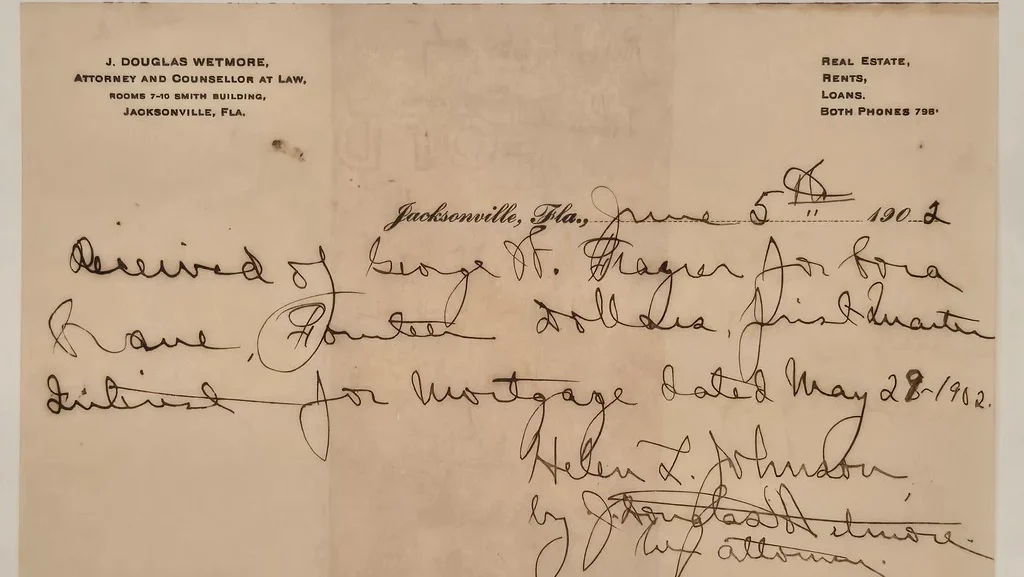
Long before the modern Civil Rights Movement transformed American law, Jacksonville attorney J. Douglas Wetmore was challenging segregation in courtrooms, confronting political power and building relationships with some of the nation’s most influential Black leaders.
Born Judson Douglas Wetmore in Tallahassee in 1870, Wetmore came of age in Jacksonville during an extraordinary period in the city’s Black history. His father, George Walter Wetmore, moved the family to Jacksonville and became deeply involved in public life. He served as a city clerk and postal carrier, was among Florida’s early African American police officers and represented Duval County in the Florida Legislature in 1883 and 1885. He was also prominent in Black Freemasonry.
Jacksonville Today thanks our sponsors. Become one.
The younger Wetmore, who generally dropped his first name and went by J. Douglas or J.D., grew up among a generation of Black Jacksonville residents who would eventually make their mark far beyond Florida. His childhood friends included brothers James Weldon and John Rosamond Johnson. Another acquaintance, John Scott Jr., became president of Edward Waters College. His mentor was Joseph E. Lee, Jacksonville’s first African American attorney and Florida’s first Black municipal judge. Wetmore attended Cookman Institute and later Atlanta University.
From LaVilla to the courtroom
Following his father into politics and public affairs, Wetmore studied law at the University of Michigan in Ann Arbor. In 1901, he and James Weldon Johnson formed the Jacksonville law firm of Wetmore & Johnson. That same year, the Great Fire devastated much of Jacksonville, including the heart of LaVilla, a center of Black political, business and cultural life.
Wetmore soon emerged as an important legal voice against Jim Crow. One battleground was public transportation. Black Jacksonville entrepreneurs had established the North Jacksonville Street Railway, Town and Improvement Company, an ambitious Black-owned streetcar enterprise. In 1905, Wetmore challenged Jacksonville’s ordinance mandating racial separation aboard streetcars. He prevailed, with the Florida Supreme Court upholding his legal victory, although city officials subsequently revised the ordinance to restore segregation under a different legal framework. Wetmore also challenged segregation in Pensacola and became associated with other important civil rights litigation.



Jacksonville Today thanks our sponsors. Become one.
His growing stature extended into politics. In 1905, Wetmore was elected to the Jacksonville City Council. But his success came amid a deteriorating racial climate. Political cartoons caricatured him, while racial hostility increasingly constrained Black political participation. His best friend, James Weldon Johnson, eventually left Jacksonville for New York. Wetmore’s career would increasingly become national as well.

A national civil rights advocate
In 1905, Wetmore joined the National Afro-American Council and served as legal counsel. Through the organization, he worked alongside Bishop Alexander Walters and developed relationships with W.E.B. Du Bois and Booker T. Washington. The connections placed a Jacksonville-trained attorney within the emerging national struggle over how Black Americans should confront segregation, disenfranchisement and racial violence.
Wetmore became involved in the infamous Brownsville Affair of 1906, involving Black soldiers of the 25th Infantry stationed at Fort Brown, Texas. After violence in Brownsville was blamed on the soldiers, President Theodore Roosevelt ordered the dishonorable discharge of Black troops.
Bishop Walters assigned Wetmore to the case. On September 3, 1906, Wetmore was denied access to interview members of the 25th Infantry. Wetmore and Du Bois subsequently spoke publicly against Roosevelt’s handling of the affair and later endorsed Democrat William Jennings Bryan for president.
Wetmore also participated in Booker T. Washington’s National Negro Business League. His interest in Black economic development was already evident in Jacksonville: he authored the Directory of Colored Businessmen of the City of Jacksonville, Florida. in 1900, documenting the city’s growing Black entrepreneurial class.
Yet Wetmore’s relationship with Washington became complicated as ideological differences emerged. He gravitated toward Du Bois and the more confrontational demand for equal rights associated with the Niagara Movement. Their correspondence reveals something deeper than political strategy.

Living across the color line
Wetmore was light-skinned enough to be perceived as White, an experience that gave him unusual access to spaces closed to most African Americans and exposed him directly to the contradictions of American racism.
Writing to Du Bois from Jacksonville in 1903 after reading The Souls of Black Folk, Wetmore praised the book and explained that being perceived as White had given him unusual opportunities to study race relations. He nevertheless identified himself unequivocally with the struggle for Black equality. When he traveled North, he wrote, he could “breathe free air, and be treated as a man.”
This dual existence forms one of the most intriguing elements of Wetmore’s story. The document suggests that the experiences of James Weldon Johnson’s childhood friend influenced Johnson’s 1912 novel, The Autobiography of an Ex-Colored Man, a story exploring racial identity and a Black protagonist who ultimately passes as white.
Wetmore eventually established himself in New York, where he practiced law and invested extensively in real estate. His holdings included property in Florida and New Jersey, and he maintained offices on Broadway and in New York’s World Building. In 1926, he even approached Du Bois about acquiring a large New Jersey property as a potential artistic and educational center for African Americans.

A legacy nearly forgotten
Wetmore’s later years were difficult. Financial losses during the Great Depression compounded personal struggles, and he eventually died by suicide. His remarkable career subsequently faded from public memory. Yet his influence survived.
Jacksonville civil rights attorneys D.W. Perkins and Samuel Decatur McGill were among those influenced by Wetmore. McGill recalled receiving a letter from Wetmore while he was a student at Edward Waters College encouraging him to devote himself to his studies. McGill would later submit more than 50 opinions to the Florida Supreme Court and argue civil rights cases before the United States Supreme Court.
Wetmore also remained connected to James Weldon Johnson through friendship, law and Freemasonry. The two helped found Jacksonville’s Paul Laurence Dunbar Lodge #219.
Seen from the perspective of the 21st century, Wetmore belongs to an important but often overlooked generation of Black attorneys who fought Jim Crow decades before Brown v. Board of Education. His battles stretched from Jacksonville streetcars to the treatment of Black soldiers in Texas and into the national organizations laying the groundwork for the modern Civil Rights Movement.
He could cross the color line, but he repeatedly chose to challenge the system that created it. J. Douglass Wetmore’s story is therefore more than the biography of a forgotten Jacksonville attorney. It is a reminder that the legal struggle for civil rights did not suddenly emerge in the 1950s. Its foundations were being laid generations earlier, in places like Jacksonville, by attorneys willing to enter hostile courtrooms, confront entrenched political power and insist that equal citizenship meant exactly what it said.