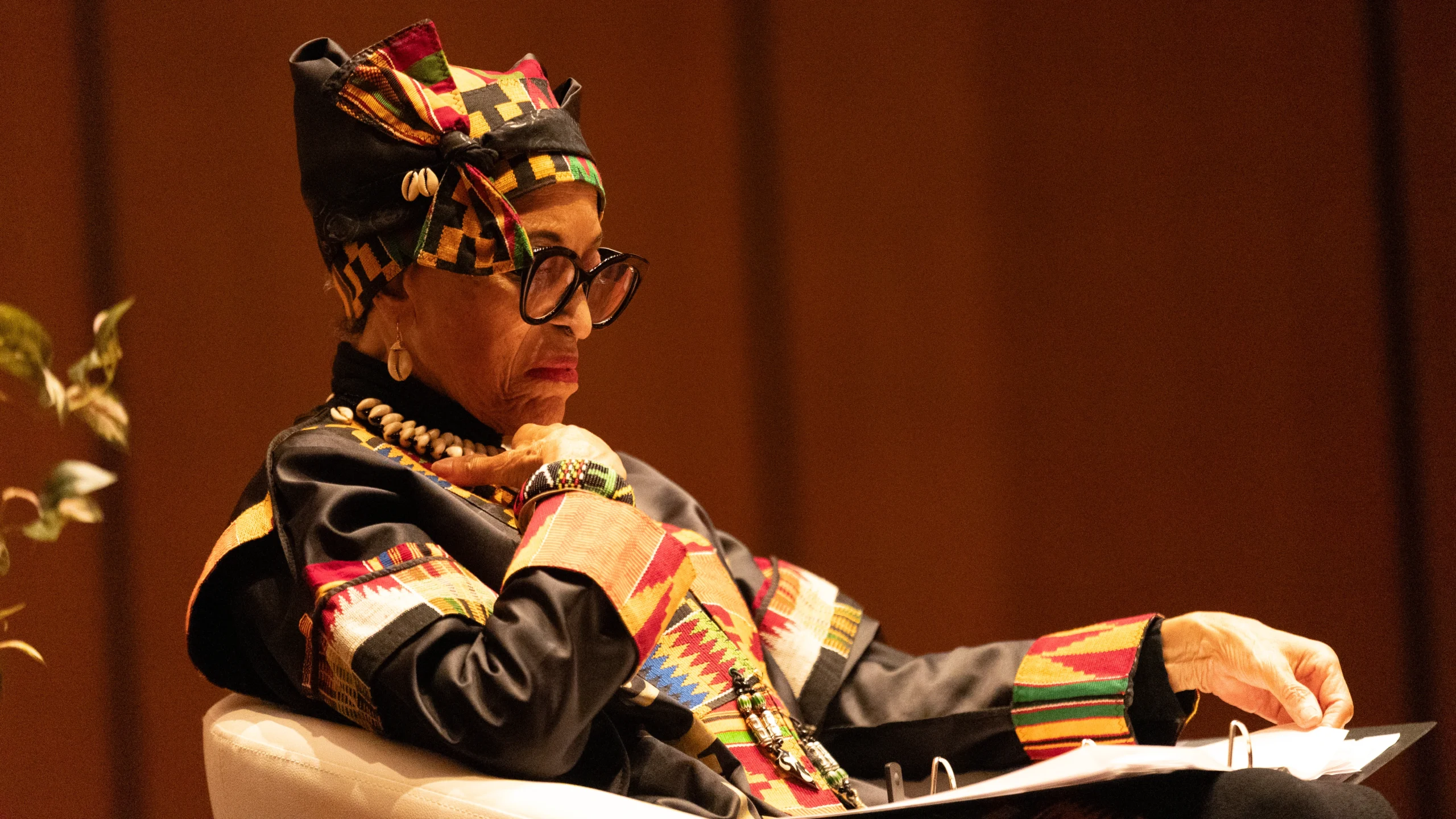
Johnnetta Betsch Cole, Ph. D., narrated a performance of the Ritz Chamber Players’ commemoration of Juneteenth and celebration of Black Music Month on Saturday, June 20, 2026. “Free at Last: The Evolution of the American Spiritual” was a 20-song performance to the music that honed and energized enslaved people. | Will Brown, Jacksonville Today
Published on June 30, 2026 at 3:13 pm
Free local news and info, in your inbox at 6 a.m. M-F. Sign up for the Jacksonville Today newsletter.
As the U.S. celebrates the anniversary of the signing of the Declaration of Independence, some Black people across Northeast Florida question whether the country is living up to the ideals the signees evoked 250 years ago.
‘All men are created equal’
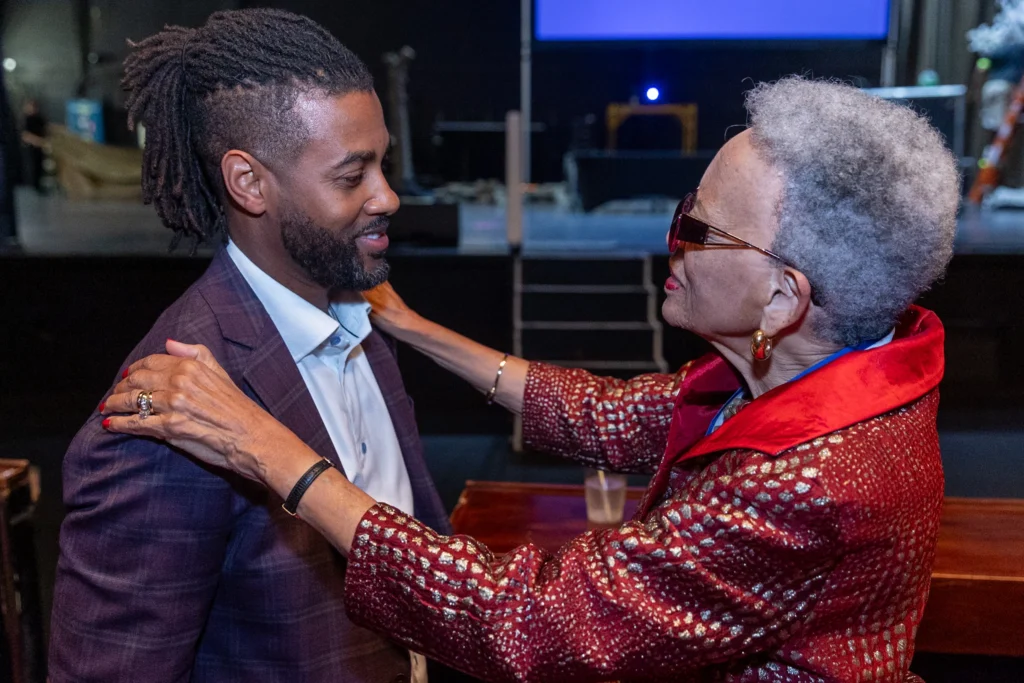
Anthropologist Johnnetta Betsch Cole, a Jacksonville native who is president emerita of both Spelman College and Bennett College, has seen plenty over the last 90 years but no period as distinct as this, she says.
Jacksonville Today thanks our sponsors. Become one.
“I think it’s not an overstatement that we are in a period right now, all over the United States of America, where freedoms that were declared for us are continuously being removed,” Cole tells Jacksonville Today. “This is a period like nothing we have seen before. Have we seen struggle? Yes. Have we seen challenges to our civil rights? Yes. But, today, across our country, the very tenets of democracy are being chipped away.”
Black people have been central to American public policy and freedom since before July 4, 1776.
An earlier draft of the Declaration of Independence contained a clause that decried slavery in the British colonies.


Jacksonville Today thanks our sponsors. Become one.
It alleged Britain’s King George III “has waged cruel war against human nature itself, violating its most sacred rights of life & liberty in the persons of a distant people who never offended him, captivating & carrying them into slavery in another hemisphere to incur miserable death in their transportation thither.”
It was removed from the final draft.
South Carolina — a colony that was dependent on agriculture produced at forced labor camps — was among two colonies that voted against the declaration on July 1, 1776.
Pennsylvania was the other. Delaware was undecided, and New York abstained.
A day later, on July 2, 1776, 12 of the 13 colonies approved the declaration. New York, once again, abstained.
It was approved July 4.
Today, Cole says, the ethos that men like Thomas Jefferson, John Adams, Benjamin Franklin and Eldridge Gerry — for whom the term gerrymandering is named after — committed to when they signed is being systemically attacked in Florida.
“Contradictions are not new to us,” Cole says. “Thomas Jefferson, who signed that Declaration of Independence, had enslaved people. Contradiction is a mild term to use. We, as a people — and I would say all marginalized people, whether based on their race, their gender, their sexual orientation, their religion, their age, their ability or disability — contradictions are not new to us.”
Peacefully assemble and redress of grievances
Cole’s sentiment has been echoed from many corners of Jacksonville.
In recent remarks to Jacksonville’s Daniel W. Perkins Bar Association — a bar association of primarily Black law professionals — federal Judge Brian Davis said, “Our democracy is at risk.” Last year, former Florida Supreme Court Chief Justice Peggy Quince, in remarks to the same group, questioned whether the tenets of democracy are being upheld.
Throughout the Jacksonville area, many Black residents are voicing concerns in private about what they see as the erosion of American democracy, the fracture of voting rights protections and attacks on civil liberties. Many of them declined to be directly quoted or identified in this story for fear of personal and professional repercussions.
It’s the public policy professional who stays silent in public, after watching a colleague lose their job over criticism of Charlie Kirk — the conservative podcaster who had a history of racist and homophobic statements — hours after his death.
It’s the recently naturalized citizen who is afraid after immigration raids on a Southside school where a third of the students are English Language Learners.
It’s the longtime educator who quietly endures what they believe is the erosion of public education because they would like to maintain their pension after devoting more than three decades to Duval County Public Schools.
It’s the activist who believes the Florida Democratic Party is marginalizing and ignoring Black voters, but says they mention these things only around trusted individuals.
Grace Willis says being a Black person in Jacksonville, in Florida and in the United States in 2026 is a constant battle with microaggressions.
“America was pretending before, we are not pretending now,” Willis says. “This mask is off. The veneer of equality and the idea we are an example to the world has been removed.”
ACLU Florida Executive Director Bacardi Jackson says the voting rights and civil liberties of Floridians are under attack.
“Everybody doesn’t have to march or show up at the No Kings marches, but every single one of us must and can do something!” Jackson said during a virtual town hall in May that focused on redistricting, voting rights and equal representation.
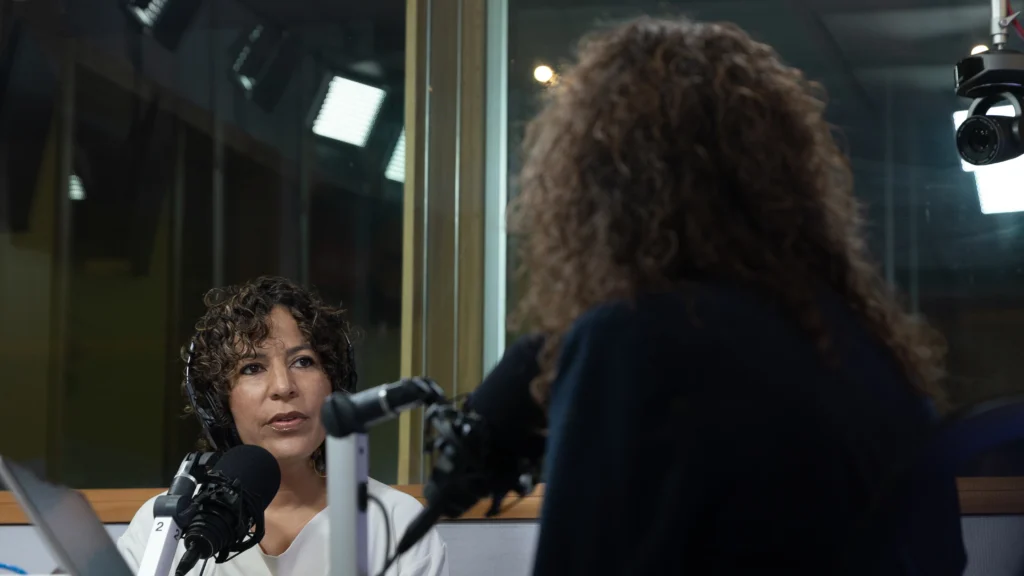
Last October, Jackson was the keynote speaker for the Jacksonville NAACP’s Freedom Fund luncheon. In her remarks, she directly compared President Donald Trump to Britain’s George III and asserted that Florida is a “petri dish of regressive policies.”
Inside the Hyatt Regency, in front of members of the Duval County School Board, Florida Legislature and Jacksonville City Council, Jackson said the “we hold these truths” clause in the Declaration of Independence are the most important words ever printed.
“It’s not the 56 who make me proud to be an American; but, the unknown foot soldiers who help us understand the meaning of those words,” Jackson said.
Political power and who wields it
When the Florida Legislature approved mid-decade redistricting in April — hours after the U.S. Supreme Court ruled states are able to draw districts based on nonracial factors, including partisan advantages — Jackson was among those who excoriated both the court and the Legislature.
Republican Gov. Ron DeSantis’ office drew Florida’s new map — and shared it with FOX News before the Florida Legislature. The recently upheld map could return Florida’s congressional delegation to the type of one-party control not seen since the Jim Crow era.
Minority advocacy group Florida Rising’s chief advocacy and political officer, Moné Holder, tells Jacksonville Today she was outraged but not surprised that Florida seeks to redraw its congressional maps six years early.
Florida Rising, as well as the Florida NAACP, Dream Defenders and other voting rights organizations, filed an amicus brief with the Florida Supreme Court hours after the 2026 maps were upheld.
Holder says Florida’s redistricting discussion was another example of legislative policies that targeted communities of color. She has since filed to run for a vacant seat on the Jacksonville City Council.
Fifty years ago, Earl Johnson Sr. became the first Black person to lead the Jacksonville City Council. To this day, only four people have been voted council president — Sam Newby is one of them.
This month, Newby told Jacksonville Today he has mixed thoughts about the 250th anniversary of the Declaration of Independence.
“I wasn’t included in that at first. African Americans, we didn’t get our freedom until over 150 years later,” says Newby, who ran for his at-large council seat as a Republican.
At the same time, America is a country that allowed someone who grew up in poverty on 45th and Cleveland Street in Northwest Jacksonville to assume one of the most powerful positions in the city. Newby notes that his late mother, Mildred Brown, was once forbidden from shopping at May Cohens, the department store that was once located where City Hall stands today.
“In Jacksonville, we have come a long way; but we have a long way to go,” Newby says. “It shows me that in one generation we come from not coming into a building, to her son having an office in the building.”
Education, Newby believes, is the equalizer for people of all backgrounds.
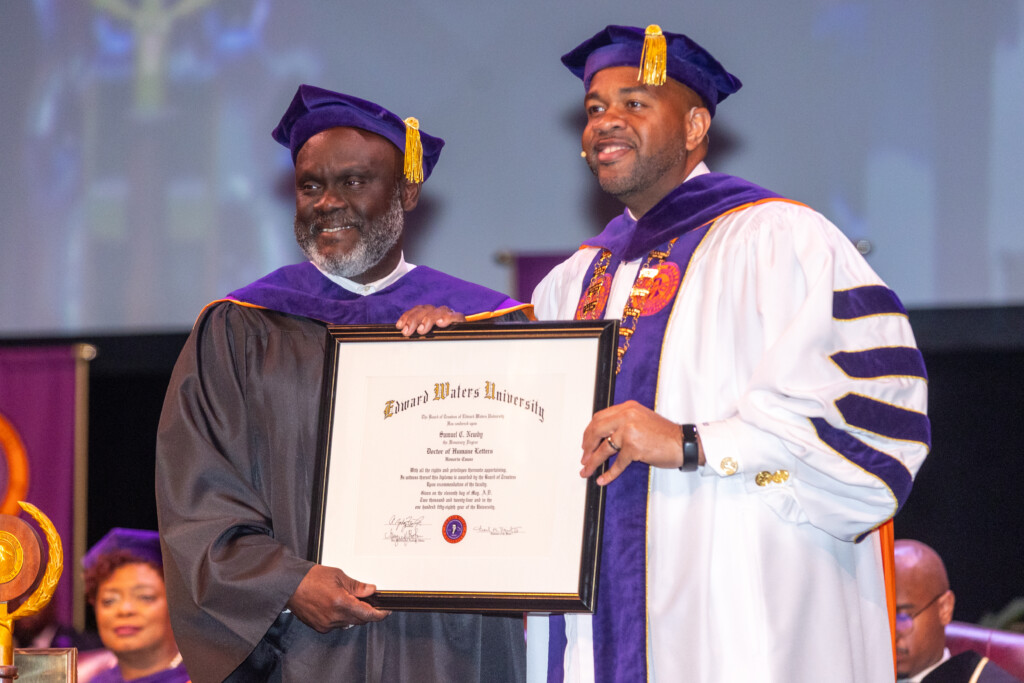
“This is the best country in the world, but we still have to understand there are challenges,” he said.
Pursuit of happiness?
The St. Augustine Art Association cultivated an exhibit, When In The Course of Human Events, to celebrate the 250th anniversary of the Declaration of Independence.
More than three dozen artists shared their definition of life, liberty and the pursuit of happiness through their photographs, their poetry, their paintings and other mediums.
Richlin Burnett-Ryan and her husband, Weldon Ryan, were among those who submitted pieces for the St. Augustine exhibit. Burnett-Ryan produced a mixed media piece that featured the Statue of Liberty and was inspired by immigration, civil rights and the end of slavery.
“When we think about how African Americans, Blacks, people of color were considered in this document, we were not considered whole,” Burnett-Ryan says. “The 250th anniversary has its bittersweet moments because with the election of (President Barack) Obama, a lot of us thought, ‘Oh, it’s the country finally, finally living up to its creed.’ But, with this contractive political system, it’s a scary time to be living. Our son left the country.”
Burnett-Ryan immigrated from Guyana as a child. Ryan immigrated from Trinidad & Tobago during his childhood. They live in Palm Coast.
The Ryans say the pursuit of happiness is getting further away for the generations that have followed them.
Data from the Federal Reserve backs up the Ryans’ analysis.
In its annual Survey of Household Economics and Decisionmaking, 60% of Black respondents in 2025 stated they were “doing okay or living comfortably,” the lowest rate since 2015.
Last year, 62% of Hispanic respondents, 79% of white respondents and 82% of Asian respondents told the Federal Reserve they were living comfortably.
The survey has been conducted in each of the last 12 years. The high point for all four racial backgrounds was in 2021 when 68% of Black respondents, 71% of Hispanics, 81% of whites and 88% of Asians said they were living comfortably.
Ryan says being retired gives him the financial flexibility to speak out.
“It’s not a safe time to be an American, whether you are Black, white or whatever,” Ryan says. “The fact is that civil liberties are curtailed. You can’t say what you want. You can’t post anything. You can’t do art. The moment that you do, it seems you are a target. … You have to be reserved. There is a whole lot of danger in expressing yourself, whether on a bumper sticker or otherwise.”
Free at Last?
America’s founders wrote that governments derive their powers from the consent of the governed. However, one spring day in Jacksonville might have illuminated how numerous Black Jaxsons do not feel their elected officials are representatives of them.
In the afternoon, Gov. Ron DeSantis signed a law in the Sandalwood community that banned local governments from devoting dollars to diversity, equity and inclusion. In the evening, more than 200 people listened to civil rights attorney Ben Crump call out white supremacist ideologies from “national leadership” as well as some Jacksonville policy leaders.
Crump said at the time that Jacksonville residents are routinely subjected to violations of their First Amendment, Second Amendment, Fourth Amendment, Fifth Amendment and Eighth Amendment rights.
“Jacksonville, we gotta speak up,” Crump said this spring. “We gotta always remind them of what Dr. (Martin Luther) King said in his Letter from a Birmingham Jail. We gotta remind them. Everybody remembers ‘injustice anywhere is a threat to justice everywhere.’ Just as profound as that statement is, he (also) said ‘Just because they tell us it’s legal, that don’t make it right.’”
Inside the Legends Center, dozens voiced their agreement with their applause.
Fighting for freedom
A decade after the Declaration of Independence was signed, James Madison wrote in The Federalist Papers the objective of every political constitution ought to be to place “men” who possess wisdom and virtue to pursue the common good of the society.
This month, while commemorating Juneteenth, Cole told hundreds of people inside the Terry Concert Hall at Jacksonville University that history reminds generations “that freedom proclaimed and freedom delivered have never been the same thing in America.”
“Here in Florida, we know this truth in our very bones,” Cole said.