Published on June 10, 2026 at 1:53 pm
Free local news and info, in your inbox at 6 a.m. M-F. Sign up for the Jacksonville Today newsletter.
In the final decades of the 19th century, the city of Jacksonville became one of the most important crossroads between the American South and the Caribbean world.
Steamships crowded its docks, railroad lines connected it to the interior South, and immigrant communities transformed parts of the city into multilingual districts shaped by commerce, exile politics, and revolutionary activism. Long before the U.S. formally declared war on Spain in 1898, another war had already begun inside Jacksonville’s cigar factories, political halls, hotels, warehouses, and waterfront docks. Cuban immigrants living in Jacksonville and elsewhere in Florida were organizing expeditions, raising money, shipping supplies, and sustaining a revolutionary movement dedicated to ending Spanish rule in Cuba.
Jacksonville Today thanks our sponsors. Become one.
To most Americans, the Spanish–American War appeared to begin suddenly with the explosion of the USS Maine in Havana Harbor. Newspaper headlines exploded with calls for intervention, politicians debated military action and volunteers rushed to enlist.
Jacksonville’s Cuban community viewed the events differently. They had already spent years fighting the war at home. The cigar workers, businessmen, ship captains, attorneys and political organizers living in Jacksonville understood that Cuba’s struggle for independence had been unfolding for decades, long before the U.S. entered the conflict.
Among the most important leaders in this movement was José Alejandro Huau. Born in Matanzas, Cuba, on April 6, 1836, Huau came from a family with both Cuban and American roots. His father, José Hipólito Huau, was born in Baltimore to a family of French ancestry before relocating to Cuba, where he became a respected physician and chief surgeon at the Matanzas Hospital. José Alejandro studied English in Norwich, Connecticut, and later studied civil and mechanical engineering in New York before returning to Cuba and working for the Matanzas railroad.
Jacksonville Today thanks our sponsors. Become one.

When the Ten Years’ War erupted in Cuba in 1868, Huau joined the revolutionary cause as a member of the Matanzas Revolutionary Committee. Spanish authorities arrested him, imprisoned him in Havana’s Morro Castle, and expelled him from Cuba in 1869. After brief stays in Baltimore and Paterson, New Jersey, where he worked at the Roger Locomotive Works, Huau moved permanently to Jacksonville in 1870.
Jacksonville already possessed a small but growing Cuban population by the time Huau arrived. Members of his own family soon followed. His sister Matilde and her husband Henry M. Fritot settled in Jacksonville, while another sister, Enriqueta, married Gabriel Hidalgo-Gato in the city on April 24, 1874. His father later established a medical office on the second floor of a building located at 31½ E. Bay St.
Huau initially worked for the Florida Central Railway before opening a sawmill on Washington Street in East Jacksonville. Soon afterward, he entered the cigar business alongside Henry M. Fritot. The cigar industry rapidly transformed Jacksonville’s economy during the 1870s and 1880s, linking the city directly to Cuba through tobacco production, labor migration and revolutionary politics.
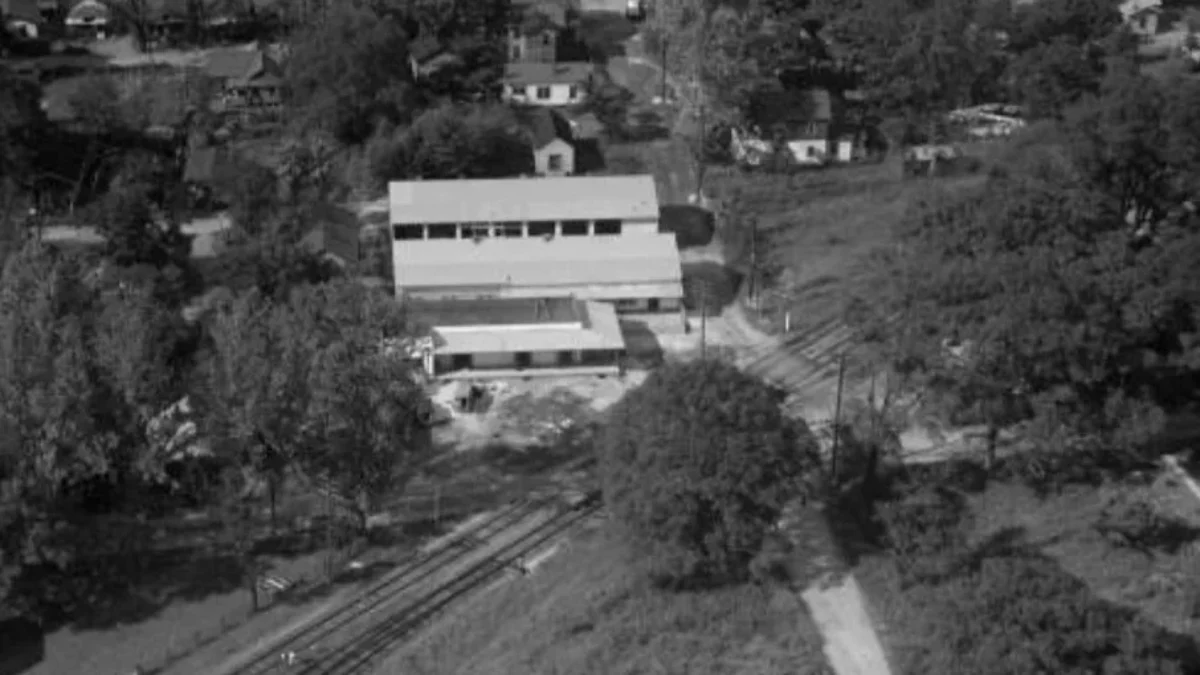
Among the most important industrial centers in this network was the El Modelo Block, owned and operated by Gabriel Hidalgo-Gato at the northeast corner of West Bay and Clay streets. El Modelo employed approximately 225 workers and became one of the largest cigar factories in Florida. Huau’s own company, first operating under the name Huau & Co. and later C. M. de Huau & Co., occupied portions of the Abell Block at 32–40 W. Bay St., with additional annex operations located at the corner of West Bay and what was then called Pine Street, now Main Street.
Huau also maintained a tobacco shop and soda fountain near the corner of Bay and Main streets. Journalist Ralph D. Paine later recalled frequenting the establishment as a young man and remembered Huau as “gentle, benevolent, and mild-mannered” with a remarkably quick mind. These businesses became more than commercial enterprises. They evolved into gathering places for Cuban exiles, political organizers, and revolutionary supporters.

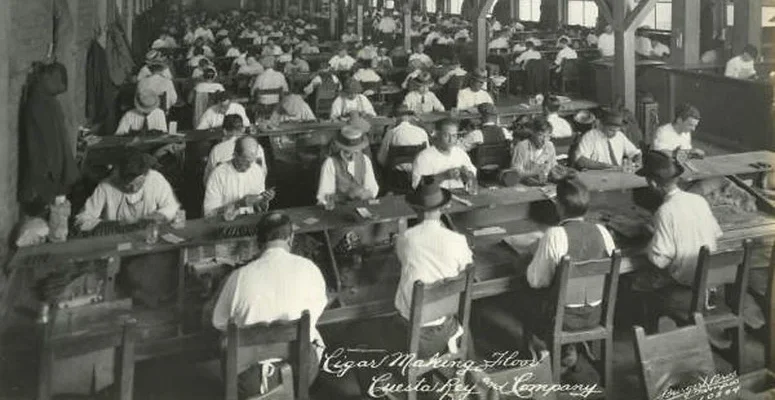
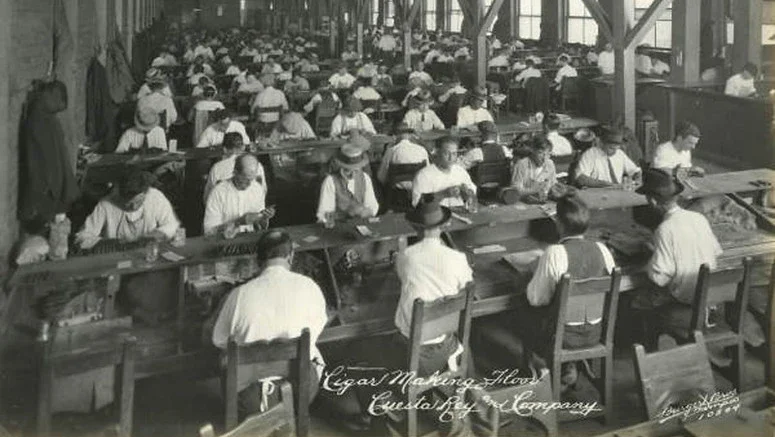
Inside Jacksonville’s cigar factories, labor and politics blended together. Workers rolled cigars while speeches about Cuban independence echoed across factory floors. Discussions about revolution, Spanish repression and fundraising campaigns became part of daily life. Contemporary descriptions noted that the upper floors of the factories housed departments for stripping, sorting, packing and manufacturing cigars, while stores and tobacco shops occupied the lower floors.
By 1884, Jacksonville contained 14 cigar factories employing hundreds of Cuban workers. Skilled laborers earned between $9 and $35 per week depending on their experience and craftsmanship. The city’s Cuban districts became vibrant communities shaped by labor activism, exile politics and Caribbean culture. Yet the cigar industry also experienced instability tied directly to events unfolding in Cuba.
Newspaper reports from the late 1890s documented labor unrest and economic uncertainty throughout Jacksonville’s cigar industry. A Florida Times-Union article published July 5, 1897, reported the discharge of 20 cigar makers amid declining business conditions. Another article from September 14, 1897, documented a major strike involving approximately 150 workers at El Modelo. These events demonstrated how deeply Jacksonville’s economy had become tied to the political crisis in Cuba and the uncertain future of the tobacco trade.

Unlike many immigrant communities of the era, Jacksonville’s Cuban residents quickly entered public life. Huau himself won election to the Jacksonville City Council in 1881 and later served multiple terms, receiving some of the highest vote totals in municipal elections. He supported ordinances involving sanitation, street paving, ferry service, lighting improvements, public hospitals, markets and fire protection. His political success revealed the growing influence of Cuban immigrants within Jacksonville’s civic structure.
Even while serving as a respected councilman, however, Huau became increasingly active in revolutionary organizing. In December 1891, José Martí arrived in Jacksonville during the first of several visits intended to rally support for Cuban independence. Martí recognized that Florida’s Cuban communities were essential to the success of the revolution. Jacksonville, Tampa and Key West were home to workers, businessmen, shippers, and financial networks capable of sustaining the struggle against Spain.
Martí’s speeches electrified Jacksonville audiences. In July 1892, approximately 1,500 Cubans, Spaniards, and Americans gathered at L’Engle Hall to hear him speak passionately about the Cuban cause. On another visit, Martí addressed workers directly inside El Modelo. Later writing in Patria, the official newspaper of the Cuban Revolutionary Party, Martí described the emotional response he received from the cigar workers there.
Organizing for Cuban independence
The revolutionary movement operating in Jacksonville soon developed into a sophisticated clandestine network. Meetings frequently took place in the rear of Huau’s cigar store, where Cuban patriots raised funds and organized expeditions destined for Cuba. Among those connected to these efforts were future Florida Gov. Napoleon Bonaparte Broward, attorney John M. Barrs, W. A. Bisbee, owner of the vessel Dauntless, and Capt. John “Dynamite” O’Brien.
The waterfront became central to the revolutionary effort. Ships such as the Three Friends, partially owned by Broward and George DeCottes, transported arms, supplies and revolutionaries toward Cuba. Newspaper reports from October 6, 1898, discussed concerns surrounding the Three Friends and its dangerous voyages tied to the Cuban struggle.
One of the most dramatic episodes occurred in January 1895 with the planned Fernandina expedition. Revolutionaries prepared three ships carrying soldiers, 800 rifles, and 600,000 rounds of ammunition for Cuba. Before departure, however, U.S. authorities uncovered the operation and halted the expedition. News of the failure spread rapidly throughout Jacksonville, where outraged Cuban residents flooded the streets, condemning the betrayal.
Despite such setbacks, the movement persisted. Camouflaged crates containing rifles, ammunition, food and medicine continued arriving in Jacksonville. Huau and his nephew Alfonso W. Fritot supervised the transfer of these supplies onto chartered vessels bound for Cuba. Spanish authorities monitored the operations constantly. Spanish vice-consuls Enrique de Mariátegui and Juan Potous tracked revolutionary activities in Jacksonville, while Pinkerton detectives investigated Cuban organizers throughout the city.
Jacksonville’s political establishment increasingly sympathized with the Cuban cause. On April 5, 1895, a major rally at Metropolitan Hall brought together Cuban patriots alongside Jacksonville Mayor Duncan U. Fletcher, U.S. District Attorney Frank Clark, Postmaster Harrison W. Clark, Judge H. Cromwell Gibbons, and City Attorney John M. Barrs. The gathering adopted resolutions calling for official recognition of Cuban belligerency against Spain. Later that same year, the Jacksonville Board of Trade passed similar resolutions supporting the Cuban revolutionaries.
Florida newspapers increasingly portrayed Tampa and Jacksonville as major centers of Cuban political and economic activity. A Florida Times-Union article from December 3, 1898, referred to Tampa as “the largest cigar center,” while emphasizing the importance of Florida’s Cuban communities more broadly. Another article from December 15, 1898, discussed Jacksonville’s waterfront development and debates involving the future location of El Modelo and nearby cigar factories.
When the explosion of the USS Maine pushed the U.S. toward war in 1898, Jacksonville’s Cuban residents mobilized immediately. Public fairs, patriotic rallies and fundraising events were organized throughout the city. Huau’s wife, Catalina Miralles, along with her daughter Catalina and niece Theresa Fritot, helped organize fundraising activities held at the John Clark Building and the Armory Building in April 1898.

The war years
The war years intensified economic instability within Jacksonville’s cigar industry. Labor disputes and layoffs continued affecting Cuban workers. At the same time, civic leaders debated the future of riverfront development and industrial expansion. These discussions revealed how deeply the Cuban struggle had become intertwined with Jacksonville’s economic identity.
After Cuba achieved independence, Huau briefly returned to the island he had spent decades helping liberate. Yet the complicated identity of Cuban exiles remained unresolved. Newspaper reports from July 12, 1902, described controversy surrounding Huau’s unsuccessful attempt to secure appointment as director of Cuba’s Official Gazette under President Tomás Estrada Palma. Although he had sacrificed greatly for the revolutionary movement, Huau refused to renounce his American citizenship, preventing him from holding certain official positions within the new Cuban republic.
By the time of his death in 1905, Huau’s health and finances had deteriorated significantly. Despite once operating prosperous cigar businesses, he reportedly left behind an estate valued at only $500 because so much of his wealth had been devoted to the Cuban cause. Jacksonville newspapers reported extensively on his death and funeral. A Jacksonville Journal article published April 5, 1905, described him as a prominent Cuban citizen whose passing marked the end of an important chapter in Jacksonville’s Cuban history.
Funeral services took place at St. John’s Episcopal Church before burial at the Old City Cemetery in East Jacksonville. The ceremony drew civic leaders, Masons, Cuban patriots, businessmen, and longtime friends from both Florida and Cuba. Honorary pallbearers included George R. DeSaussure, T. Wilson, John T. Gaffney, T. J. Stockton, A. Dzialynski, C. Benedict, J. C. L’Engle, H. Bisbee, and M. Lorimer. Active pallbearers included Paul Saunders, Mac Mayson, Dr. M. Dunham, W. R. Ware, C. S. Hamilton, T. G. Hutchinson, Thomas Hillier, and J. S. Hume.
Today, much of this history survives only in scattered newspaper clippings, archival records, and the fading memory of Jacksonville’s once-thriving Cuban districts. Yet the story of Jacksonville’s Cuban Americans reminds us that the Spanish–American War was never simply an overseas conflict fought in Cuba and the Philippines.
In Florida, the struggle unfolded inside cigar factories, political halls, warehouses, hotels, and immigrant neighborhoods where ordinary men and women sustained a revolution from exile. Long before American troops marched into Cuba, Jacksonville’s Cuban community had already spent years fighting the war at home.