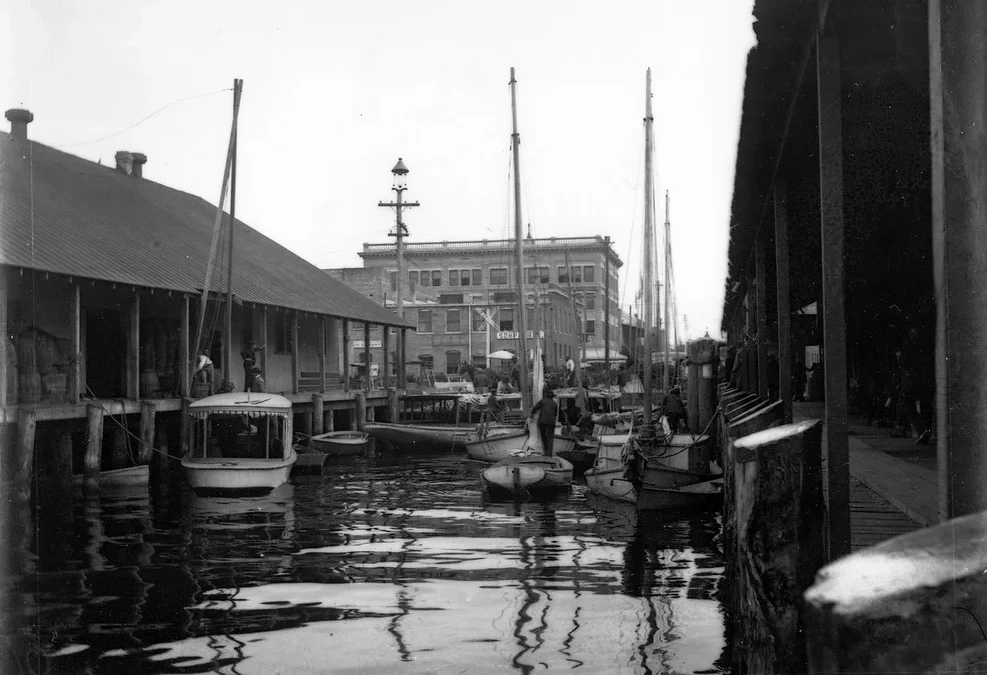
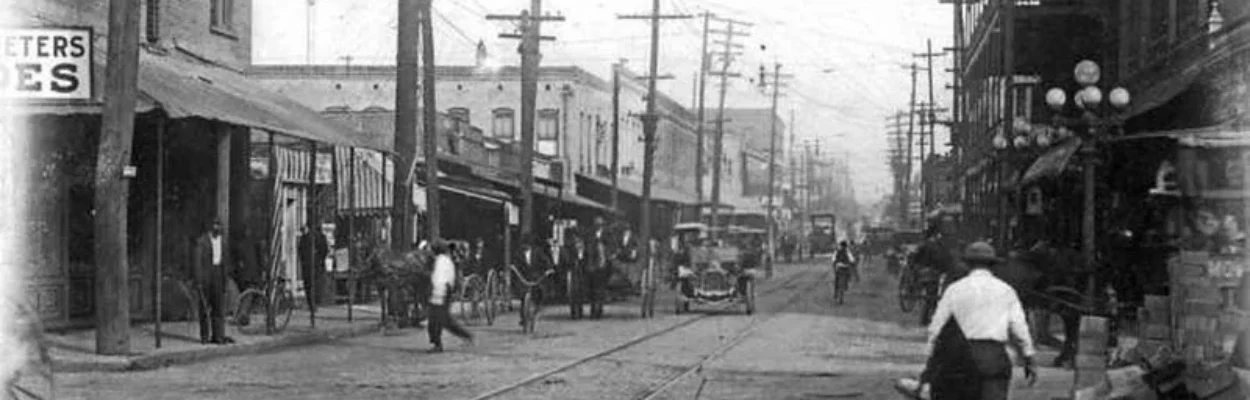
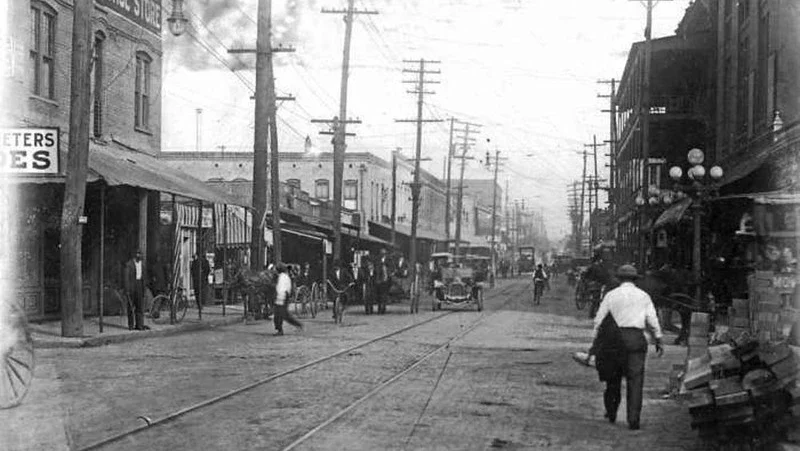
A view down Bridge Street, which was part of Jacksonville's small Chinese laundry commercial corridor in the late 1800s
Published on May 13, 2026 at 10:59 am
Free local news and info, in your inbox at 6 a.m. M-F. Sign up for the Jacksonville Today newsletter.
In the spring of 1895, a Chinese laundryman named Soon Lee lay dying in a small room behind his Jacksonville shop near the corner of Main and Ashley streets.
For weeks, tuberculosis, then known simply as “consumption,” had hollowed his body while trains rattled nearby and customers continued walking past the storefront where he had spent years washing and pressing clothing by hand. According to local newspapers, Soon Lee was one of only a handful of Chinese residents living in Jacksonville at the time. His death was the third within the city’s tiny Chinese community in less than a decade.
Jacksonville Today thanks our sponsors. Become one.
In death, there was uncertainty. Friends debated whether his remains should be returned to China for burial, a common practice among Chinese immigrants who hoped to rest beside their ancestors despite living an ocean away.
Today, there is no marker for Soon Lee. No plaque. No preserved storefront. No public memory of the laundryman who once worked long hours along Jacksonville’s busy commercial corridor during the city’s rise as a Southern railroad hub.
Yet men like Soon Lee helped build Jacksonville.
And during Asian American and Pacific Islander Heritage Month, their story deserves to be remembered.

Jacksonville Today thanks our sponsors. Become one.
From Southern China to the American South
Chinese migration to the U.S. accelerated during the mid-1800s after war, poverty, and economic upheaval destabilized southern China. Most immigrants came from Guangdong Province, leaving villages already strained by famine and political unrest.
Many first arrived in California during the Gold Rush and later worked on the construction of the transcontinental railroad. But after the railroad was completed, as anti-Chinese violence spread across the American West during the 1870s and 1880s, many Chinese laborers searched for safer opportunities elsewhere. A small number eventually arrived in Jacksonville.
At the time, Jacksonville was booming. By the 1880s, the city had become Florida’s most important railroad center and a major port city connected to national trade routes. Hotels, boarding houses, rail depots, lumber mills and shipping businesses fueled a rapidly growing service economy. That growth created opportunities for immigrants willing to do difficult work.
For Chinese newcomers who faced discrimination and exclusion from most industries, the laundry business offered one of the few paths toward economic independence. Laundry work required little startup capital. It did not depend heavily on English fluency. And it allowed immigrants to operate their own businesses instead of relying on employers who often refused to hire Chinese workers. Across America, Chinese laundries became fixtures in urban neighborhoods.
Jacksonville was no exception.
The men along Bridge Street
Unlike San Francisco or New York, Jacksonville never developed a Chinatown. The city’s Chinese population remained extremely small. Census records show only 27 Chinese residents in Duval County in 1890.
But their visibility far exceeded their numbers.
Chinese laundries appeared along Main Street, Adams Street, and especially Bridge Street, a working-class corridor near rail lines, warehouses, and boarding houses serving Jacksonville’s industrial economy. Bridge Street became the center of the city’s earliest Chinese commercial community.
In 1900, federal Census records documented a Chinese laundry operator named Hop Ting living and working at 24 Bridge St. Soon afterward, city directories listed another operator, Hop Sing, only a few doors away.
Nearby, other Chinese merchants, including Sam Lee and Wey Lee, operated similar storefront businesses catering to railroad workers, sailors, hotel guests, and laborers who depended on affordable weekly laundry service. Their shops were modest.
Most combined business space with living quarters. Laundrymen often slept in cramped back rooms behind the pressing tables and steaming wash basins where they worked from early morning until late at night. The labor itself was grueling.
Clothing was washed by hand, dried indoors, starched, and ironed using heavy charcoal-heated presses that required constant tending. The work stained hands, damaged lungs, and filled the air with steam and soot. Still, Chinese laundries thrived because they offered something Jacksonville’s growing workforce needed: reliable service at affordable prices.
For many working-class residents, these laundrymen became familiar faces in the rhythm of everyday life.
Jacksonville’s “Laundry Wars”
But success also brought hostility.
By the 1890s, industrial steam laundries began expanding across Jacksonville. Unlike hand laundries, steam laundries used mechanized equipment capable of processing garments in large quantities. Their owners promoted their businesses as modern, sanitary and efficient.
Chinese laundries suddenly became competition. Soon, newspapers began publishing alarming claims that clothing cleaned in Chinese laundries could spread contagious skin diseases. The accusations echoed anti-Chinese rhetoric already circulating across the U.S. during the era of the Chinese Exclusion Act, the federal law passed in 1882 that severely restricted Chinese immigration and denied Chinese immigrants the possibility of citizenship.
In Jacksonville, these accusations fueled what became known locally as the “Laundry Wars.” Chinese businesses were publicly scrutinized. Newspaper articles grouped multiple Chinese laundries together as sanitation concerns. City inspectors investigated establishments. Rumors spread that Chinese methods of washing clothes were unsanitary.
The attacks were about more than health. They were about competition. Steam laundry owners wanted customers to abandon Chinese hand laundries in favor of industrial operations. But the campaign largely failed. Jacksonville’s working-class customers continued using Chinese laundries because they trusted the people behind the counters. Customers knew the operators personally. They depended on them weekly. Relationships mattered more than headlines.
And the laundrymen themselves refused to disappear.
”Colonel” Wey Lee
Among the most visible members of Jacksonville’s early Chinese community was a merchant known as Wey Lee. Local newspapers sometimes called him “Colonel Wey Lee,” a nickname reflecting the Southern habit of giving prominent local businessmen honorary military-style titles.
Wey Lee became something of a public spokesman for Jacksonville’s tiny Chinese community.
During the First Sino-Japanese War in 1894, Jacksonville newspapers interviewed him about events unfolding overseas. Reporters treated him as someone capable of explaining Chinese public opinion to local readers.
That alone was remarkable. At a time when Chinese immigrants were frequently portrayed as outsiders, Wey Lee emerged as a recognizable public figure within Jacksonville’s commercial districts. Like other Chinese laundrymen, he operated along Main Street before later relocating toward Adams Street and the LaVilla rail corridor, where demand for laundry services remained strong. His visibility helped humanize a community otherwise reduced to stereotypes. But life remained precarious.
Chinese immigrants in Jacksonville possessed little political protection. They could not vote. They faced discriminatory laws and widespread suspicion. And their economic survival depended entirely on maintaining public trust. So they leaned on one another.
Though Jacksonville’s Chinese population was too small to support formal associations like those found in larger Chinatowns, the laundrymen formed informal support networks built through proximity, friendship, and shared experience. Bridge Street became more than a business district. It became their lifeline.
Chinese laundrymen: Resistance through survival
What makes Jacksonville’s early Chinese community remarkable is not its size, but its endurance. These men survived in a city where they were highly visible yet politically vulnerable. They built businesses despite exclusion laws, racial suspicion, and economic pressure. And they did so quietly.
They did not leave behind large organizations, temples, or community halls. Instead, their legacy survives only through city directories, Census records and fragments of newspaper coverage scattered across Jacksonville’s archives. But those fragments tell a powerful story.
They reveal immigrants who carved out economic independence through relentless labor. Men who endured isolation and discrimination while helping support the daily life of a rapidly growing Southern city. Their work touched nearly every layer of Jacksonville society, railroad workers, hotel guests, merchants, boarding-house residents, dock laborers, and travelers arriving by train or ship. Yet today, few Jacksonville residents know they existed.
Asian American history is often told through the lens of the American West: California railroads, San Francisco Chinatowns or Hawaiian plantations. But Asian American history also unfolded in Southern cities like Jacksonville.
The Chinese laundrymen along Bridge Street were among the city’s first Asian immigrant entrepreneurs. They participated in a national story of migration, exclusion, resilience, and survival that shaped communities across the U.S. during the late 19th century.
Their presence reminds us that Jacksonville has always been more diverse, more interconnected and more global than many people imagine. And their story resonates today.
At a time when immigrant communities continue shaping American cities while navigating questions of belonging and identity, the experiences of Jacksonville’s first Chinese residents feel strikingly contemporary.
They arrived seeking opportunity.
They faced hostility.
They built businesses anyway.
And through persistence alone, they became part of the city’s foundation.
Remembering the men of Bridge Street
Walk through Downtown Jacksonville today and you will find little evidence of the Chinese laundry corridor that once stretched through Bridge Street, Main Street and West Adams Street.
The rail yards have changed. The boarding houses are gone. Entire blocks have been redeveloped or erased. But history still lingers beneath the pavement.
Somewhere near the old intersection of Ashley and Main, Soon Lee once stood pressing shirts late into the evening while trains thundered toward the St. Johns River. A few blocks away, Wey Lee discussed world events with newspaper reporters while defending his livelihood against public suspicion.
Along Bridge Street, Hop Ting and Hop Sing operated storefront businesses that anchored Jacksonville’s first identifiable Chinese commercial corridor.
They were immigrants. Workers. Entrepreneurs.
And they were Jacksonville residents.