
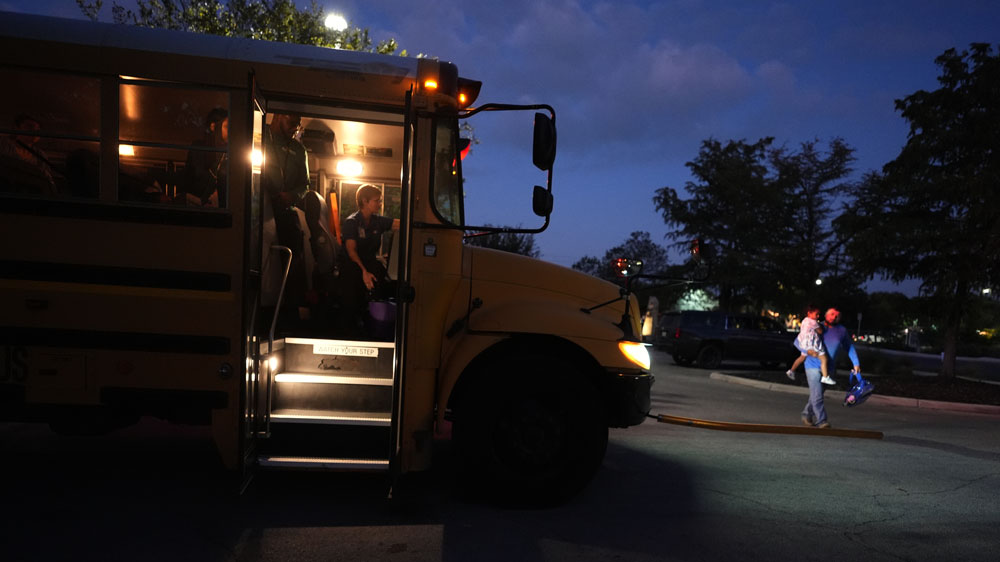
Students arrive to catch an early morning school bus, Oct. 9, 2025, in San Antonio, Texas. | Eric Gay, AP
Published on May 6, 2026 at 8:04 pm
Free local news and info, in your inbox at 6 a.m. M-F. Sign up for the Jacksonville Today newsletter.
Most Jacksonville high schools will add about a half hour to their school day when the new school year starts in August.
In addition, the district will rearrange how classes are scheduled throughout the day in an effort to give teachers more planning time.
Jacksonville Today thanks our sponsors. Become one.
The school day will start five minutes earlier — at 7:10 a.m. — and end 20 minutes later, at 2:05 p.m. To create daily planning time for teachers, the district will stop using block scheduling, where students attend half their classes for longer periods every other day. Students will instead attend each class every day.
The changes, approved by the Duval County School Board on Tuesday, follow a decision last year to reduce Duval’s secondary schools to a seven-period day from eight. Superintendent Christopher Bernier said at the time that the change would save the district at least $7 million a year.
Some teachers say the savings came at the expense of teachers’ planning time, though.



Jacksonville Today thanks our sponsors. Become one.
With eight-period block scheduling, students attended four classes each day for extended, 90-minute periods. Under that system, many teachers had a six-course load — allowing them to teach three classes and have one 90-minute planning period each day. This year, most high schools are still doing block scheduling, but with six classes. That means two sets of three classes meet on alternating days for 100-minute blocks, and a seventh, shorter, class meets each day for 55 minutes. Teachers have one 100-minute planning period every other day.
A district spokesperson tells Jacksonville Today that Duval Schools is making the change to a more traditional seven-period day — something teachers colloquially call a “straight seven” — for the coming year in response to feedback from teachers. Students will attend all seven classes each day, and periods will be 50 minutes long.
Magnet high school schedule
The district’s magnet high schools — Douglas Anderson, Paxon, Stanton and Wolfson — successfully lobbied to keep their eight-period block schedules this year, even as the traditional high schools changed to seven-period days.
District spokesperson Laureen Ricks says the magnet high schools will stay on the eight-period days for the coming year, too.
Numerous teachers, students and parents have complained to the school board throughout this school year that allowing the magnet high schools to keep eight-period days is unfair.
The eight-period schedule is perceived as better because it results in students earning more credits during high school: Four years of eight classes yields 32 credits instead of the 28 credits seven-period schedules provide. Florida requires students to have 24 credits to earn a high school diploma. Practically, this translates to students having the opportunity to earn extra college credits and explore more electives. It can also effectively cost the district money if students choose not to fill their schedules as they near the end of their time in high school and already have enough credits to graduate.
Board members debated the difference while discussing start times at a workshop last month, saying it was unfair — or even inequitable — for the magnet schools to retain the heavier class load.
Several board members worried about the message it sends to teachers and students — to let the academically rigorous magnet schools keep the perceived advantage while requiring traditional schools to do without. Beyond teacher planning time, the longer blocks are also useful for interventions when students need extra help, teachers argue.
District 7 rep Melody Bolduc said she worries the district isn’t giving “equal opportunities” to all students to earn college credits and scholarships.
“I really feel like the schools that need it more aren’t getting it, and that we are adding privilege to privilege, and I don’t think it’s acceptable,” she said. “To be frank, if our school grades go down, I’m going to have a hard time not pointing to this as a reason. You can’t take away time and support and access and expect the outcomes to remain the same.”
Tony Ricardo, who represents District 1, said he “echo(ed) the same sentiment that inequity in the scheduling” provided more opportunities for some schools and less for others.
“I’m not against students having a lot of opportunities, but they should be across the district,” Ricardo said.
Superintendent Chris Bernier told the board he would prefer for all schools to be on the seven-period schedule, but he listened to principals at the magnet schools when they asked to keep eight periods.
“I’m going to say this honestly, and I will probably get in trouble with at least one board member,” Bernier said. “I didn’t build Wolfson, Paxton, Stanton and Douglas Anderson. But the reality is they’re here … and you get there by being a well-informed parent choosing an elementary school.”
Duval Schools allows parents to choose any elementary school as long as there is enough room. And admission into the magnet schools is more likely when students follow a particular path through elementary and middle “feeder” schools — something the district calls “continuity.”
“With continuity, a certain elementary will get you to a certain middle, and only being in a certain middle will get you to one of those environments, with a rare exception,” Bernier said. “I mean, if we really want to tear apart equity and access, then we’ve got a lot to examine.”
John Meeks, vice president of Duval Teachers United, the teachers union, says scheduling changes aren’t unusual. “History doesn’t repeat itself — it rhymes,” he said.
“Any attempt to not properly fund our schools is setting up a situation that Tallahassee is watching from afar — and that’s divide and conquer,” Meeks said. “Because as long as you have the teachers and education staff professionals fighting against each other over schedules, they’re not gonna point the finger where the true blame lies — and that is, we’re not being adequately funded.”
Other changes for next year
Elementary and middle school start times won’t change, but four more Duval County elementary schools will close at the end of this month: Don Brewer, George Washington Carver, Hidden Oaks and Hyde Grove.
The first three were approved in 2024 to close at the end of this school year. Hyde Grove was treated as a boundary change. Its pending consolidation with Hyde Park Elementary was part of a vote last August to change attendance zones for several schools.
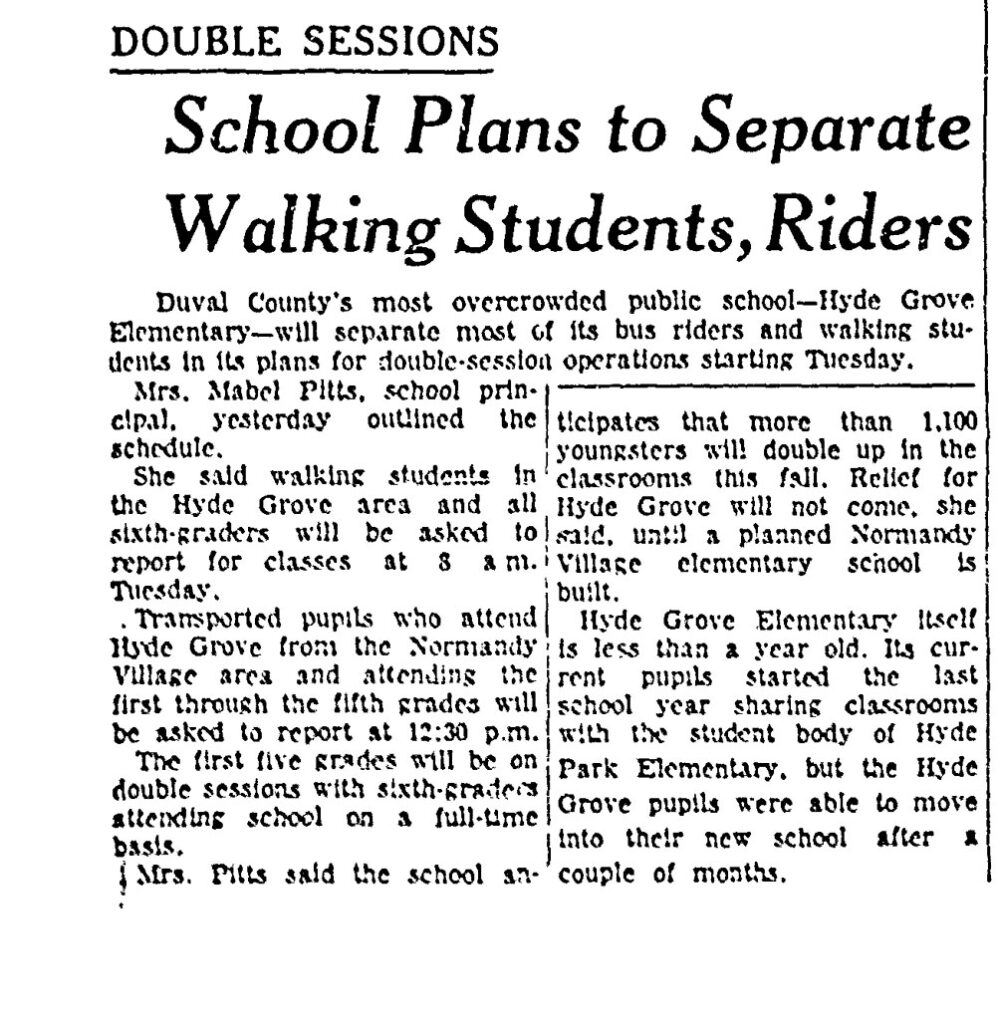
Once dubbed the county’s “most overcrowded public school” according to The Florida Times-Union in 1961, Hyde Grove Elementary opened in 1960 — during a period of post-war population boom that saw Jacksonville open dozens of schools — with nearly 1,000 students. Hyde Grove currently has about 360 students enrolled.