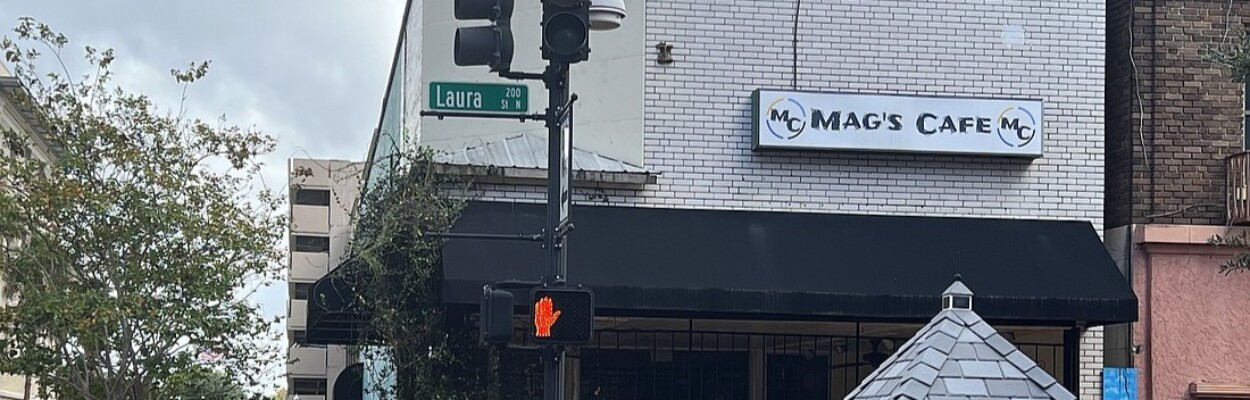
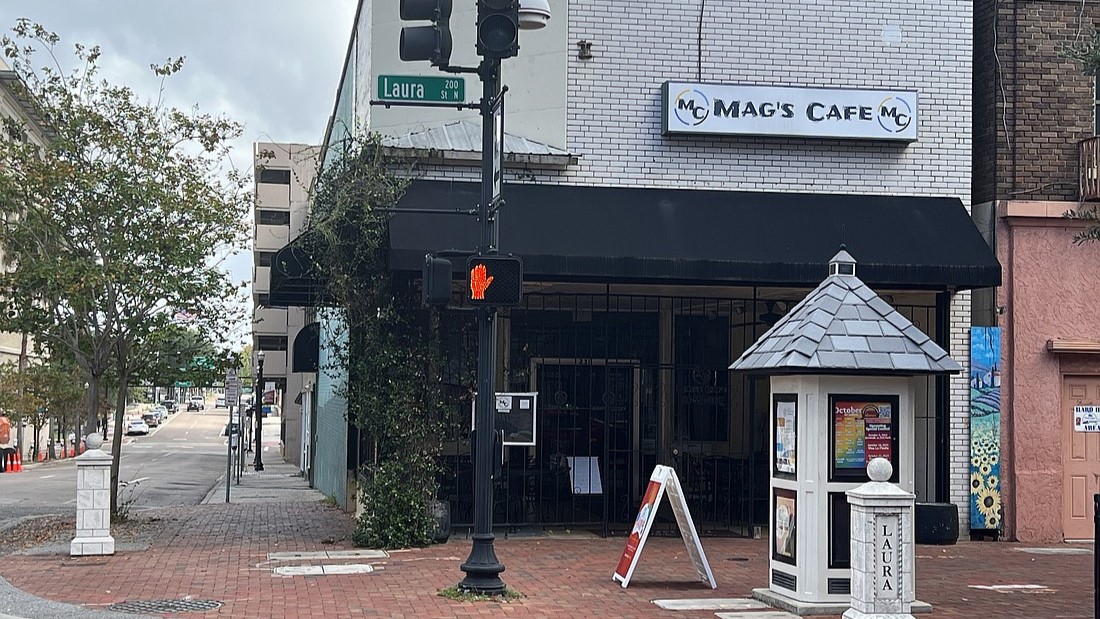
The Mag’s Cafe building is one of two historic building renovations projects the Jacksonville City Council awarded incentives on Tuesday. | Dan Macdonald, Jacksonville Daily Record
Published on April 29, 2026 at 5:34 pm
Free local news and info, in your inbox at 6 a.m. M-F. Sign up for the Jacksonville Today newsletter.
The Jacksonville City Council approved taxpayer-backed incentive packages for three real estate development projects Tuesday night totaling $3.53 million in cash and $12 million in tax breaks.
In a 16-0 vote, city lawmakers approved $12 million in city property tax rebates to Johnson & Johnson Vision Care Inc. for a proposed $550 million investment and expansion of its manufacturing facility at 7500 Centurion Parkway.
Jacksonville Today thanks our sponsors. Become one.
Council members also signed off on nearly $3.53 million in forgivable and deferred interest loans for a pair of historic restoration projects in the Downtown core — but with more dissent.
The votes awarding city financing for the renovation of the former Mag’s Cafe building at 231 N. Laura St. and for plans to restore and build out restaurants and retail space at 38 Monroe St. — both historic properties — were 14-4 for each deal.
The string of incentives packages Tuesday came as the council has been working to fund unbudgeted cash completion grant commitments that had built up to $74 million in 2023. That’s down to about $50 million today, according to council member Will Lahnen.
Jacksonville Today thanks our sponsors. Become one.
And as council will face another vote in a few weeks on a $12 million incentives package for The Winn-Dixie Co. LLC’s proposed expansion in Jacksonville, which includes a $6.5 million retention grant.
The number has brought some City Council members cash incentives fatigue and started to favor targeted property tax incentives to keep Jacksonville’s market in and outside of Downtown attractive to investment.
Lahnen has been working, along with others on the council and Mayor Donna Deegan’s administration, to find ways to pay for the unfunded completion grants.
Lahnen introduced Ordinance 2026-213, a bill that would direct more money to the outstanding completion grants. It would commit any extra general fund balances above the levels of Sept. 30, 2024, after the city’s operating, emergency and replacement reserves are stable. The bill passed 18-0 on Tuesday.
The first-term council member says he had no problem with the financing for the two historic projects. Council previously used those dollars as part of the Downtown Investment Authority’s 2025-26 budget. He said the money also came from tax increment financing dollars generated by Downtown property owners, not from the city’s general fund.
“These two loans are something we previously approved, so we can’t just say no on the other end when the appropriation in the contract comes up for these projects,” Lahnen told Jacksonville Today. “The projects I have the most concern on is when we look at these grants that are simply cash from taxpayers to a developer to make their capital project work on their end.”
Downtown historic incentives
Council’s move to advance development agreements for two Downtown historic renovations projects will provide $1.907 million in forgivable and deferred interest loans to the former Mags Cafe site at 321 N. Laura St. and $1.62 million for the project at 38-44 W. Monroe St.
According to documents filed with Ordinance 2026-0218, building owner Historic Urban Core LLC plans 2,700 square feet of leasable commercial retail and restaurant space and four one-bedroom apartments on the second floor.
Ordinance 2026-2019 will provide city incentives to Global Solution Partners Inc. to restore the Laura Street property to its historic standards and retrofit it with 2,800 square feet of leasable retail and restaurant space, as well as two one-bedroom apartments.
The two projects are the latest round of cash awarded from the DIA’s Downtown Preservation and Revitalization Program, created in 2020 to encourage more developers to renovate dilapidated or vacant historic structures to modern code compliance and put them back into use.
Council members Michael Boylan, Rory Diamond, Terrance Freeman and Mike Gay voted against both bills.
Boylan, who has historically voted in favor of such project incentives, said at a council committee meeting April 20 that he didn’t like that the city was absorbing 64% of the projects’ cost.
Philip Peterson, deputy City Council auditor, told the committee in April that the incentive was designed for the city to take on a larger financing role so the developer can make restoring historic properties more financially viable.
“Almost never will you be able to bring a historic property into compliance under historic preservation guidelines (at a low cost) due to the amount of money that is required to be invested into a property like that,” he said.
Downtown momentum without incentives?
DIA CEO Colin Tarbert told Jacksonville Today in January that the litmus test for weaning or changing how the city incentivizes Downtown development is “coming sooner than later.”
Council members and the mayor’s office are working to find cash in the city to pay for $44.61 million in completion grants due in the next fiscal year, according to the Jacksonville Daily Record, a Jacksonville Today news partner.
That includes grants for Jacksonville Jaguars owner Shad Khan’s Four Seasons Hotel and Residents project on the Shipyards.
Is the recent development momentum in Downtown Jacksonville sustainable without the city’s financial backing? According to Tarbert, “not yet.”
“The short answer on incentives is you need rent to cover the cost of construction plus a reasonable rate of return. In markets that are unproven like here — this is a new thing for Downtown Jacksonville — they’re looking at lenders, they’re looking at investors, they’re going to want a higher return or your cost of capital is going to be higher because the perceived risk is higher,” Tarbert said. “Once that gets dispelled, then it will be less risky and the projects will become less expensive”
Council leans on tax breaks
City lawmakers have been urging the city’s economic development officials to use targeted property tax incentives as the go-to tool to incentivize businesses to expand or relocate to Jacksonville.
On Tuesday, council members voted 16-0 on Resolution 2026-285 to award Johnson and Johnson a $10.5 million city property tax refund over six years and a $1.5 million, five-year property tax refund for its expansion.
According to the legislation, the vision care manufacturer will build new packaging and logistics facilities in Jacksonville. The expansion will produce 10 permanent full-time jobs at an annual salary of at least $65,000 by December 2028, according to the city.
The deal negotiated by the city’s Office of Economic Development uses two Recaptured Enhanced Value Grants — a refund on a portion of the new city property tax revenue generated from the expansion.
According to the bill’s summary and economic development agreement filed with the legislation, Johnson & Johnson will receive a $10.5 million REV grant over six years for expansion of the Centurion facility and a $1.5 million REV grant over five years for additions to its space on Pecan Park Road.
Many council members prefer REV grants because they don’t take money out of city coffers — although the city doesn’t see the full amount of property tax revenue on the development until the REV grant expires.
“This is a targeted tax cut. No taxpayer dollars are going out of your pocket into some company,” Diamond said Tuesday. “Literally, it’s just saying you guys are investing a bunch of money and you get to keep some of the tax dollars that you are generating with your investment.”
That philosophy could soon see a test. In a couple weeks, council members will hold hearings on another incentives proposals meant to retain Winn-Dixie’s headquarters in Jacksonville and promote its expansion.
Resolution 2026-326 — which would approve the development agreement with the grocery store chain — was introduced Tuesday night.
The company tells the city the headquarters investment would also add 200 full-time jobs. The deal includes a 20-year, 50% REV grant with a maximum property tax refund of $5.5 million. If approved, the $6.5 million retention grant would be paid in $1.3 million installments over five years.
The bill says the total capital investment in that deal would be $65 million, and the 200 jobs would be in place by December 2031 with an average salary or $100,000 per year.