
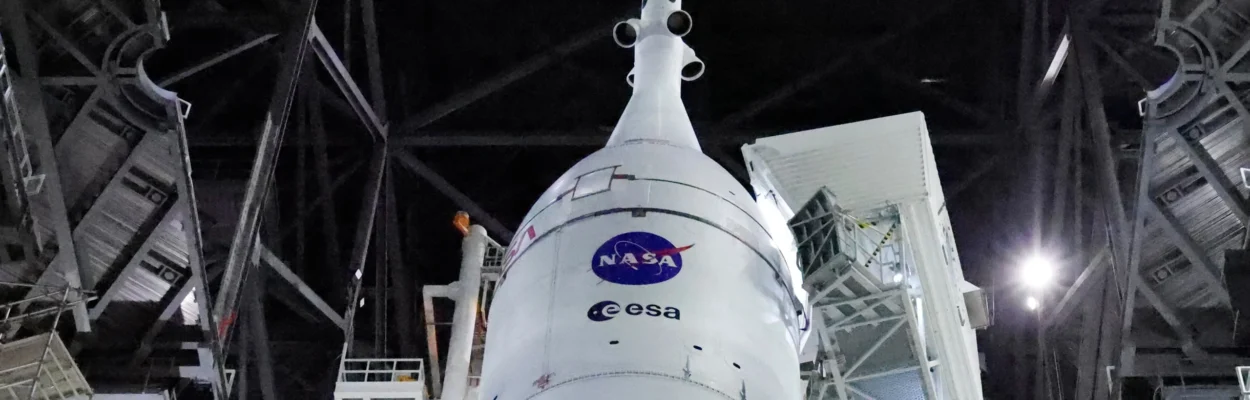
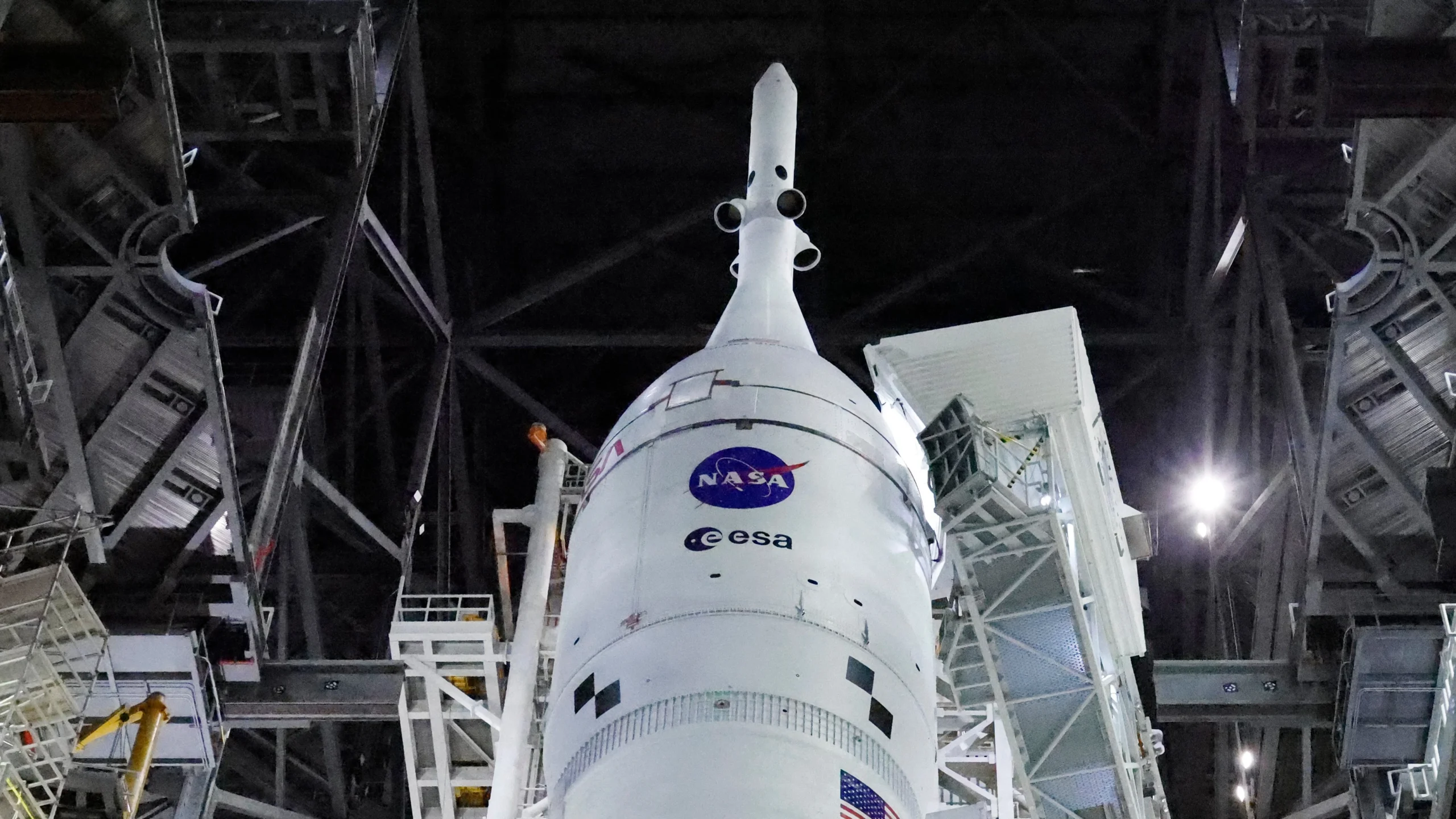
The Orion spacecraft sits on top of the NASA Artemis II rocket in the Vehicle Assembly Building before rollout to pad 39B at the Kennedy Space Center in Cape Canaveral on Thursday, March 19, 2026. | Terry Renna, AP
Published on March 20, 2026 at 10:28 am
Free local news and info, in your inbox at 6 a.m. M-F. Sign up for the Jacksonville Today newsletter.
For the second time this year, NASA moved its moon rocket from the hangar out toward the pad Friday in hopes of launching four astronauts on a lunar fly-around next month.
If the latest repairs work and everything else goes NASA’s way, the Space Launch System could blast off as early as April 1 from Florida’s Kennedy Space Center. The Artemis II crew went into quarantine this week in Houston.
Jacksonville Today thanks our sponsors. Become one.
The 322-foot rocket began the slow 4-mile trek in the middle of the night, transported atop a massive crawler used since the 1960s Apollo era. It was expected to take 12 hours. The trip was held up for several hours by high wind.
The three Americans and one Canadian will zip around the moon in their capsule and then come straight home without stopping. Their mission should have been completed by now, but hydrogen fuel leaks and clogged helium lines forced two months of delay.
While technicians plugged the leaks at the pad, the helium issue could be fixed only in the Vehicle Assembly Building, forcing NASA to roll the rocket back at the end of February.



Jacksonville Today thanks our sponsors. Become one.
The last time NASA sent astronauts to the moon was during Apollo 17 in 1972. The new Artemis program aims for a two-person landing in 2028.
The Associated Press Health and Science Department receives support from the Howard Hughes Medical Institute’s Department of Science Education and the Robert Wood Johnson Foundation. The AP is solely responsible for all content.