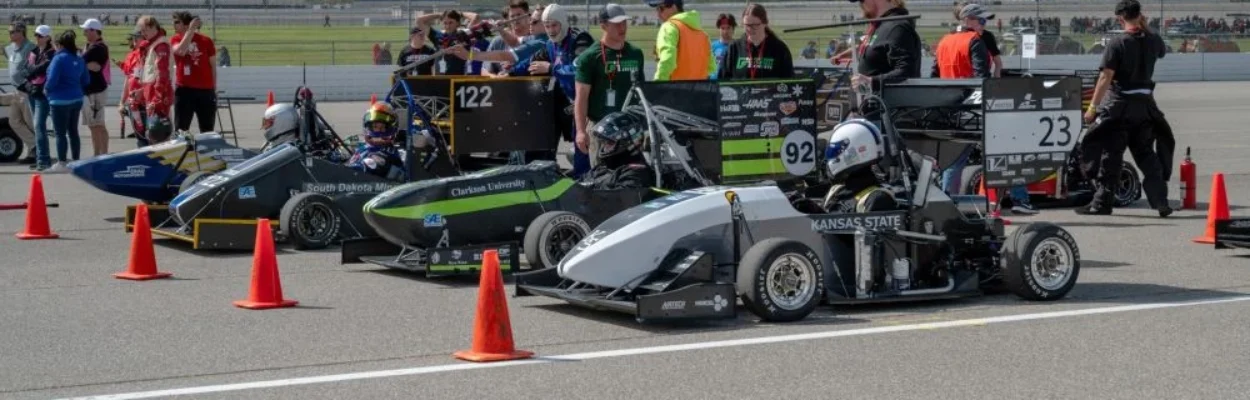
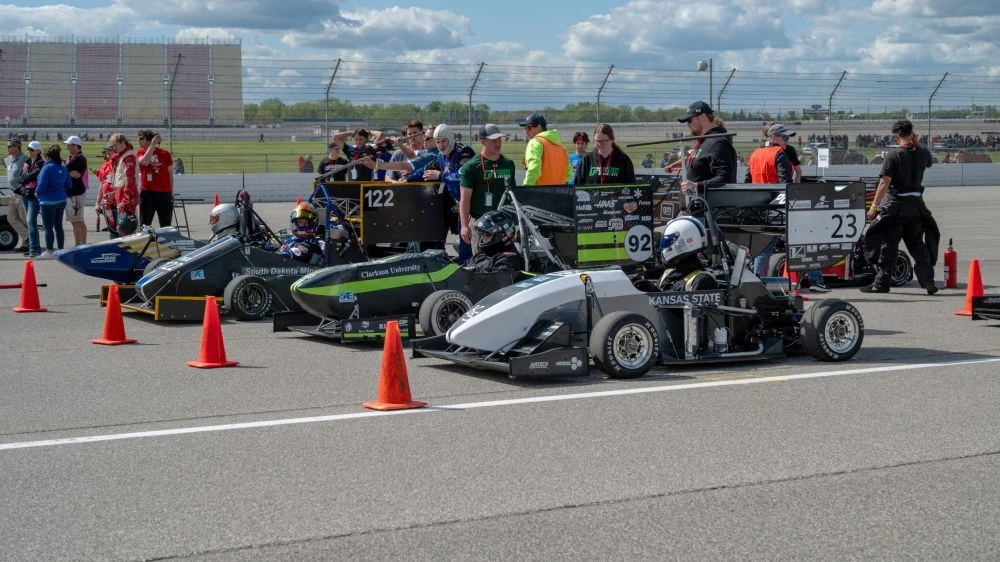
Single-seat race cars built by universities around the world line up during a recent national competition at Michigan International Speedway. | Formula SAE
Published on March 2, 2026 at 12:18 pm
Free local news and info, in your inbox at 6 a.m. M-F. Sign up for the Jacksonville Today newsletter.
One weekend next year, Jacksonville University students will test their engineering, construction and driving skills with a race car they have designed and built for a national competition.
They will compete against 100-plus colleges in the Formula SAE Championship at Michigan International Speedway.
Jacksonville Today thanks our sponsors. Become one.
Jacksonville University is the newest competitor in the 47-year-old collegiate racing series and becomes the second collegiate team in town, 16 years after the University of North Florida’s Osprey Racing team started.
JU’s nascent Formula SAE team already has 40 members and a goal to have its race car in the May 2027 race.
Junior honors engineering student Stephen Coleman, a lifelong racing fan who worked last summer as an assistant engineer for NASCAR Xfinity Series team Alpha Prime Racing, predicts the team will be competitive when it debuts at Michigan in 15 months.

Jacksonville Today thanks our sponsors. Become one.
“I believe we have a serious advantage here at JU with our hands-on design program with engineering, and really brilliant businesspeople, and all of our other majors here,” Coleman said. “I think we have a very large program that will work to our advantage too. We don’t expect to be at the very, very top the first year, but we will aim for it and we will see where we end up.”
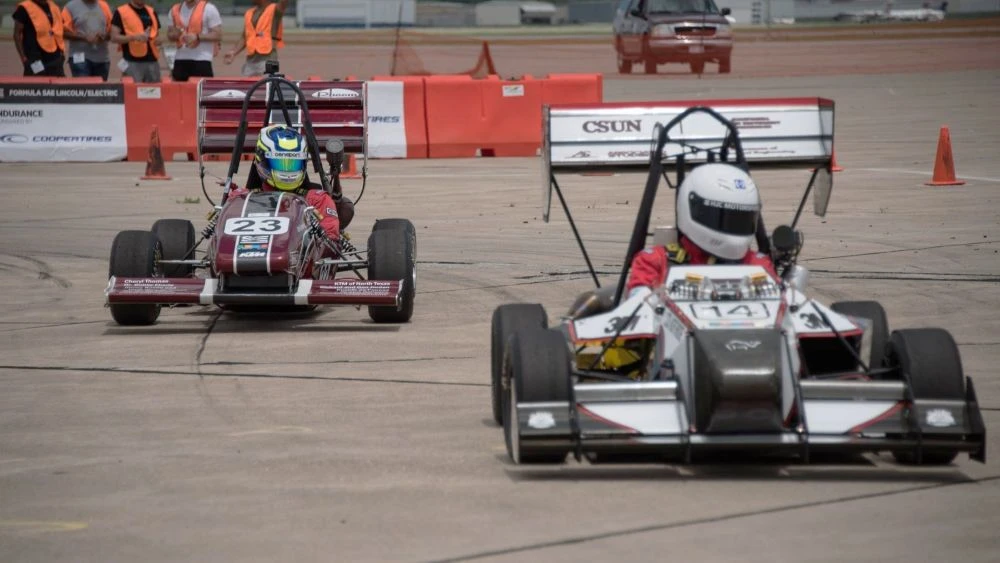
The Society of Automotive Engineers’ Formula SAE program tasks university engineering students with designing, building and driving one-seat race cars at competitions all over the world.
Each design is judged and evaluated against others in static and performance tests to determine which best meets the design goals and could be profitably built and marketed. The cars also face speed and handling runs and a 13-mile endurance test.
The single-seaters can have no more than a maximum 710cc engine or up to a 600-volt DC electric motor. Each must weigh under 400 pounds including driver and be no more than about 107 inches long. The gas-powered race cars can do 70 mph or more on a straightaway,
A total of 144 teams entered last year’s race in Michigan, some from Mexico, Central America, Canada and Spain, as well as six Florida schools. This year’s event, with a $2,900 entry fee per team, is May 13 to 16.
Coleman said he wanted to fill the motorsports club vacuum he found on the Arlington campus. Then he found an article about how to start a Formula SAE program, written by UNF Osprey Racing founder Justin Tussey. UNF’s Osprey Racing started in 2009 when Tussey suggested that his engineering classmates compete in Formula SAE.
“He had contact info at the bottom to ask about what it takes to start a chapter for real, and he was very helpful,'” said Coleman, who began go-kart racing at 5. “He put me in contact with the people with SAE Florida. We talked about starting a chapter, and we worked toward getting approval, and here we are.”
Once JU got its official approval from SAE International to set up its collegiate racing team, the university set up a site to house the race team and equipment.
“We are working towards starting this team and getting to competition,” Coleman said. “We have a lot of different teams here that we set up for suspension, chassis and aero, as any SAE team has. Right now we are in the design process, and at the same time, we are fundraising, and we have had a lot of help so far.”
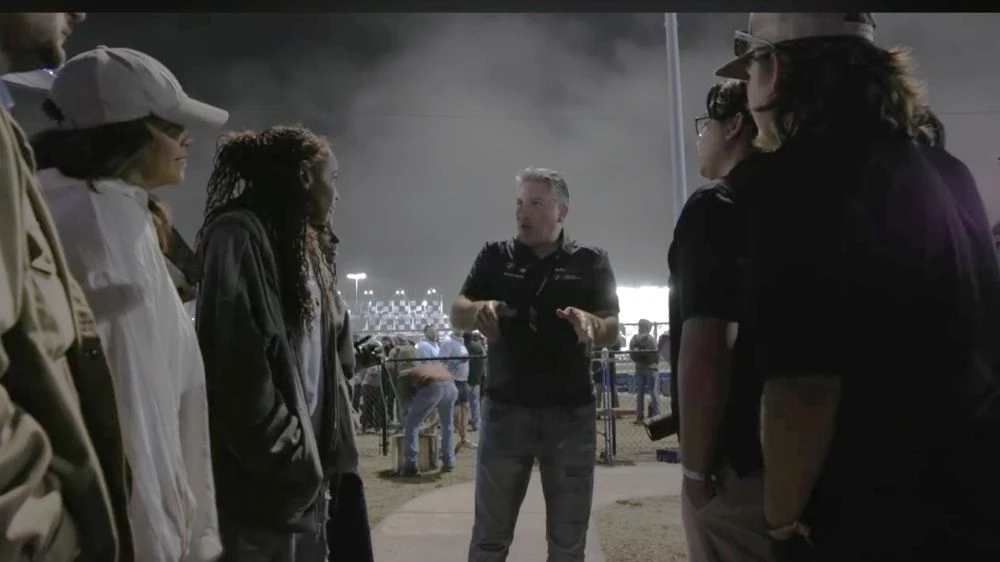
Major help comes from Kinne Society member Mac McGehee, and Porsche Club Chief Driving Instructor Richard Exline, Coleman said. JU alumnus and race car driver Tiger Tari also helped develop a comprehensive plan with students and recently took some of the SAE team to the Rolex 24 at Daytona endurance race.
“Formula SAE is so much more than engineering — it is about building a complete organization,” Tari said in a news release. “From design and prototyping to manufacturing, testing, marketing, sales, and data analysis, these students gain hands-on experience. … This is a powerful way to give students real-world experience they can apply after graduation.”
JU’s racing team has no car parts ready yet. But Coleman said the team will start with basic design and components found as digital files on computers, then fine-tune them before they are built.
“We have been talking to other teams like at UNF, and professionals, about things we want to look for in our design, and just using these simulation tools that we are getting,” he said. “We are working on getting a full (computer-aided design) model of everything first, then as you get something that works in CAD, you go from there are do all your calculations and make sure it will work in real life.”
Once refined in computer simulations, Coleman said, the team will have components made, then begin assembly in the fall semester so driving tests can begin.
“Testing is probably one of the most important phases in Formula SAE that people overlook because they don’t have enough time,” he said. “And going to Michigan, you don’t want to show up with something untested, right? So we are going to have to do a lot of our build next semester, then rework and redesign.”
Driving tests could be done somewhere on a campus parking lot or a local go-kart track. They might do joint testing with UNF’s Osprey Racing team, which see’s JU’s team as a “crosstown rival/teammate,” Coleman said.
So far, there’s no official name for JU’s team. Dolphin Racing or Phin Racing are suggestions, he said.