Federal officials are considering the sale of the Charles E. Bennett Federal Building due to low occupancy and high maintenance costs. | Dan Scanlan, Jacksonville Today
Published on February 2, 2026 at 2:18 pm
Free local news and info, in your inbox at 6 a.m. M-F. Sign up for the Jacksonville Today newsletter.
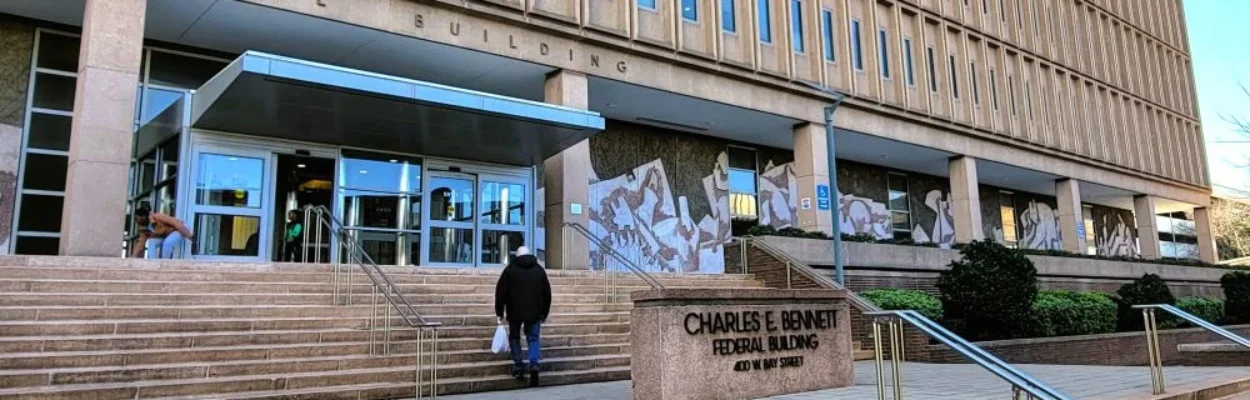
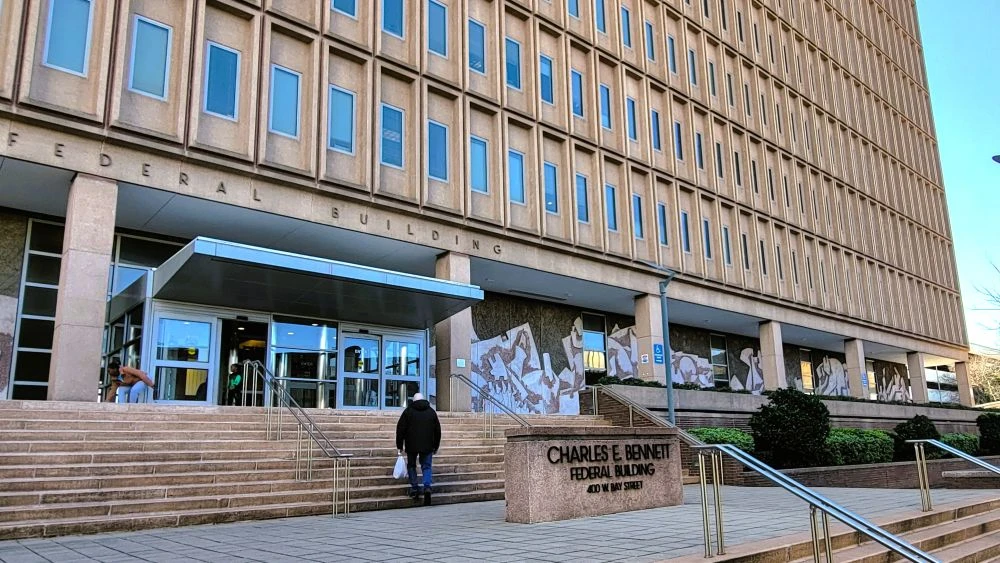
Downtown Jacksonville’s oldest federal office building could be for sale.
A six-member government panel will look at the benefits of selling the Charles E. Bennett Federal Building and nine other older structures across the Southeast to private developers. The move would save the government millions of dollars in estimated repairs.
Jacksonville Today thanks our sponsors. Become one.
Any decision about the building at 400 W. Bay St. would not happen until at least the end of this year, after the Public Buildings Reform Board discusses all 10 federal properties in Jacksonville; West Palm Beach; Savannah, Georgia; and Charleston and Columbia, South Carolina.
The reform board’s job is to provide expertise and recommendations on how to reduce the costs of federal real estate. The “Use It Act,” passed by Congress a year ago, demands that federal buildings have at least 60% use or the General Services Administration must sell them.
The 10 buildings now assessed for possible sale all have low use and high required maintenance costs, the Public Buildings Reform Board says.
Jacksonville Today thanks our sponsors. Become one.
“We have noticed the same issues cropping up time after time — the lights are on, but nobody’s home,” board member Nick Rahall said during a meeting Thursday in Charleston. “The federal inventory of office space is open for employees, but few are returning to work. This means that taxpayers are paying enormous amounts of dollars to provide for the few who do come to work.”
History of the federal building
The 11-story Bennett Federal Building was built in 1966 and last renovated in 2004. It houses several federal agencies including the Department of Labor, the IRS and the Department of Housing Urban Development, according to the Downtown Jacksonville Inc. website.
The building was named after Charles Bennett, a state lawmaker and U.S. representative from 1949 to 1993. His congressional office was in the building at one point.
Bennett moved to another site in Jacksonville after leaving the West Bay Street building.
From 1984 until he left Congress in 1993, Bennett’s Jacksonville office was in the Old St. Luke’s Hospital Building on Palmetto Street, now home to the Jacksonville Historical Society. His family has given the desk and filing cabinet he used then to the Jacksonville History Center.
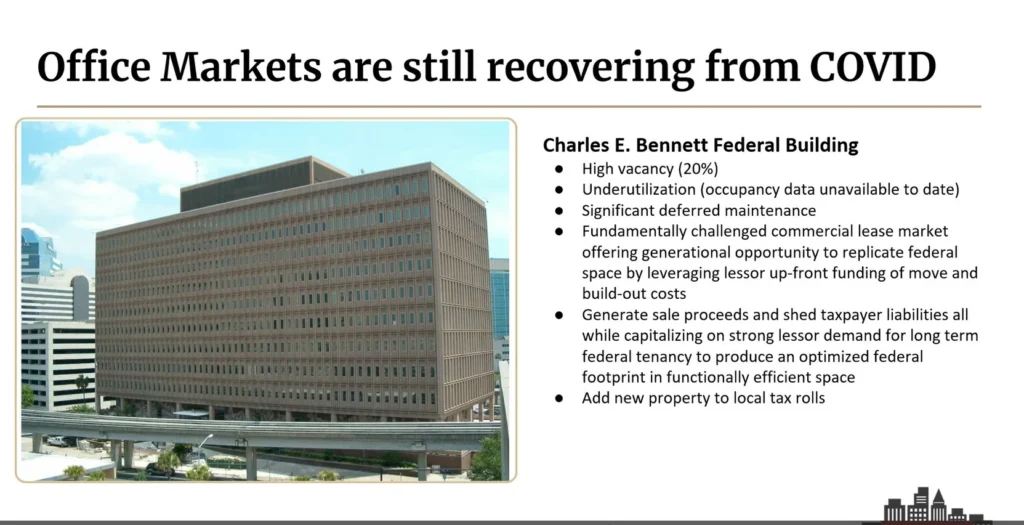
Rahall said the commercial office market in Jacksonville has not recovered from the downturn during the COVID-19 pandemic, with vacancies in excess of 25%. This building carries a high vacancy rate and over $20 million of deferred maintenance liabilities, but it is viable for private sale, he said.
The property is over 3 acres, sits blocks from the waterfront and offers prime accessibility to Interstate 95 and Interstate 10, Rahall said.
Board officials estimate that selling the Bennett building would save $73 million for taxpayers over 30 years.
Eliminating federal buildings
The Public Buildings Reform Board is an independent agency established in 2016. Its recommendations to reduce the federal real property portfolio are passed on to Congress and U.S. officials.
Along with saving taxpayers the cost of maintaining older buildings, selling them would return underused properties to the local tax base for redevelopment. That avoids taxpayers paying a premium for “aging, underused or vacant” federal office space, Acting Chairman Talmage Hocker said.
The board worked with a commercial real estate firm to analyze the 10 current Southeast federal properties being considered for disposition. Board members also met with local officials, commercial real estate executives, historic preservation organizations and other stakeholders in Charleston, Columbia, Savannah, and Jacksonville in September 2025.
The nine other federal buildings considered for sale are:
- West Palm Beach’s Paul G. Rogers Federal Building, U.S. courthouse and AUTEC Federal Building
- Charleston’s U.S. Custom House
- Columbia’s Strom Thurmond Federal Building, Strom Thurmond Courthouse and Matthew J. Perry Jr. Parking Deck
- Savannah’s U.S. Custom House and Juliette Gordon Low Federal Building “B”
The board opened up the hearing to comments from anyone regarding all 10 facilities, but no one from Jacksonville spoke.
“We are not at a point of making a formal recommendation,” board Chairman Paul Walden said during the meeting. “We have these public hearings per law to solicit input from the public on what properties we are considering for recommendation.”
The board had already recommended 12 federal properties for disposal in 2020. Ten have been sold to date for a total of $193 million.
The board recommended 15 federal properties in 2021 for disposition at $275 million.
The board is is analyzing more than 50 federal properties nationwide for the current review.
For more information about the Public Buildings Reform Board, go to https://www.pbrb.gov.