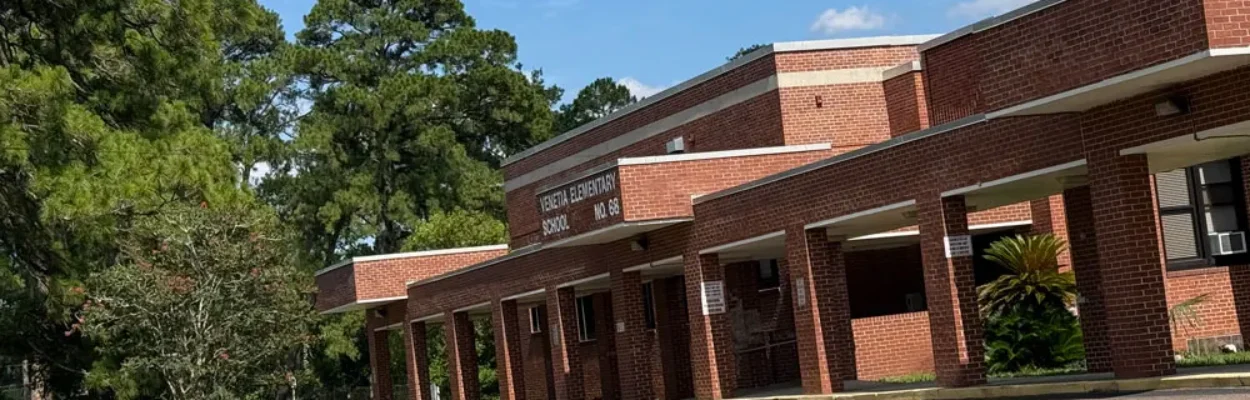
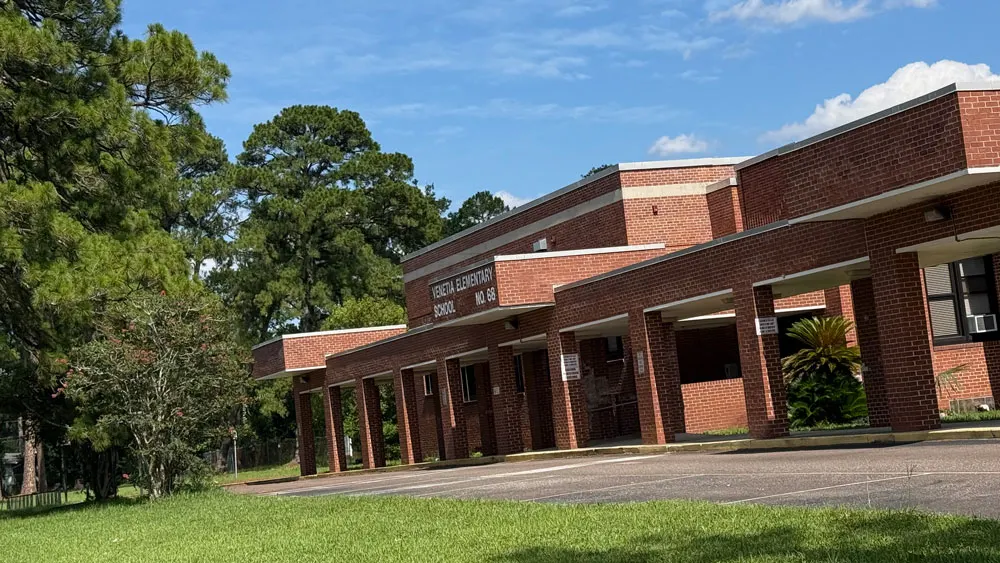
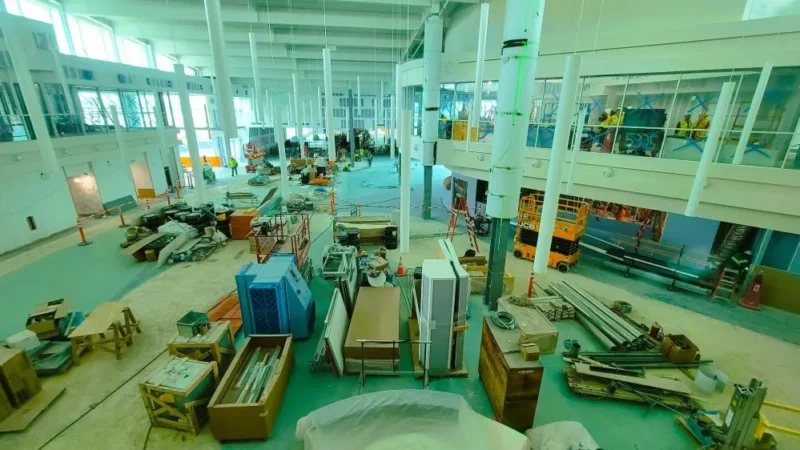
Venetia Elementary, seen here on June 24, 2026, is set to be torn down and replaced with a larger building on the same site. | Megan Mallicoat, Jacksonville Today
Published on September 27, 2026 at 8:03 pm
Free local news and info, in your inbox at 6 a.m. M-F. Sign up for the Jacksonville Today newsletter.
Faced with mounting criticism over what some parents see as excluding them from school-closure decisions and favoring schools in heavily resourced neighborhoods, Duval Schools will host a community meeting Tuesday on the Westside.
The meeting, which will provide an update on plans for a significantly expanded Venetia Elementary School in Ortega, comes after the School Board this month voted to pause its plans for that school’s rebuild — and to change the process it uses to close schools in general.
Jacksonville Today thanks our sponsors. Become one.
Transparency in school closures — what’s changing
In response to parents’ criticism, the board unanimously formalized the school-closure process to require the final steps be a formal recommendation from district officials and a yea-or-nay vote from the School Board. That’s after this summer parents criticized the district for attempting to declare Ortega Elementary a surplus property, laying the groundwork for selling it, without first putting the school forward for a closure vote.
At the time, parents said the move was rushed and didn’t follow the district’s own policies.
Meanwhile, students at nearby Venetia Elementary have been moved this year into the building once used for Hyde Grove Early Learning Center — which was quietly consolidated into Hyde Park Elementary a year ago. The district told Venetia parents the temporary displacement would last until a rebuilt Venetia is expected to open in August 2028.


Jacksonville Today thanks our sponsors. Become one.
Community members have often criticized the board’s closure decisions in recent years. They question why so many of the closed schools have been in areas of the city with higher poverty, and why it seems only schools with vocal advocates get their closure decisions revisited. Some say the process lacks transparency.
“I take it as a challenge from our very active community members, who I respect a great deal, to make sure that we are being true to our policy and fair across the board,” District 7 rep Melody Bolduc said at the September board meeting. “I appreciate those community members that came out — I’m grateful that you did, because we do need to hear your voices, and we need to hear all the voices.”
One of the hallmarks of the district’s previous school-closure procedure was a defined planning process, called ACE, that created a committee of specific school stakeholders who discussed proposed closures and made recommendations to the board.
Under the new policy, the district will still solicit community input but will not seat a formal voting committee. And the new rules require the district to publish the “facts and criteria being used,” including financial considerations, capacity projections, and details about traffic and transportation impacts.
They also explicitly require the board vote on individual school closures rather than lumping them together with boundary changes.
‘Voluntary desegregation’
The revised school-closures-and-consolidation policy also removes nearly all mentions of the word “diversity” — which the district says brings it in compliance with current laws. Instead, officials say the policy’s new language shifts the focus to “access” and “equity.”
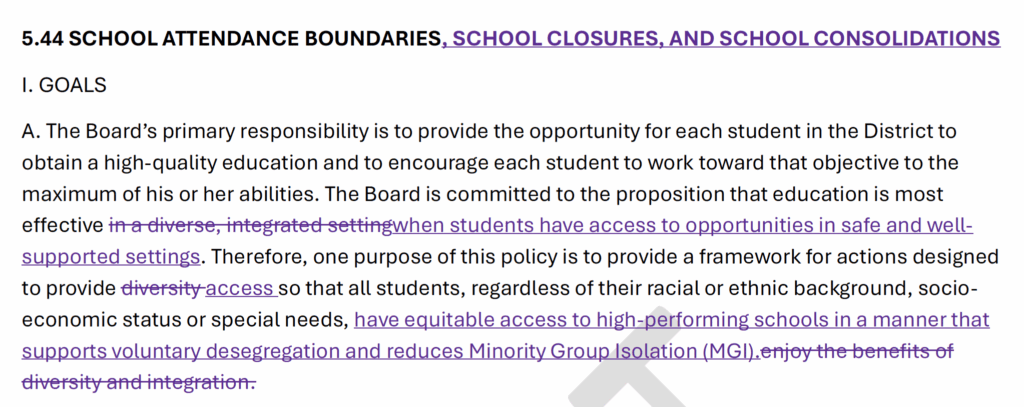
In removing references to diversity, the policy removed provisions ensuring Duval County’s school zones were drawn to maximize diversity within each school’s enrollment. Instead, the policy says all students should have “equitable access to high-performing schools in a manner that supports voluntary desegregation and reduces Minority Group Isolation.”
Tiffany Clark is a Duval Schools parent and member of the founding cohort of Parents Who Lead, a program supported by the Jacksonville Public Education Fund, Kids Hope Alliance and Duval Schools that trains parents in advocacy, communication and leadership.
Clark, who herself attended Hyde Grove Elementary, says her mother was among the Black students who were spit-on and pushed as they were bused-in to integrate the school following court-ordered desegregation in the early 1970s. (The district was declared officially desegregated by the federal government 45 years after Brown v. Board of Education, in 1999.)
In many cases, the small, neighborhood schools that district officials now say need to be closed can trace their origins back to the era when Duval built schools specifically for Black children. Today, many of them are poorly performing academically, are underenrolled, and have large maintenance backlogs.
“I have a very different kind of thinking about magnet schools and integration,” Clark says. “Just seeing the impact we’re seeing, it didn’t do what we thought…We’ve come a long way, but it just did not accomplish in so many areas what we wanted to do in terms of education.”
Clark has been substitute teaching in exceptional student education classes across the district lately in order to “get a better understanding of what we’re dealing with…and how much these teachers and [paraprofessionals] are struggling.”
The most obvious difference she sees between schools is in the resources given to new schools — compared to the great need present in older schools on the brink of closure.
“Again, it’s just who has access to what,” Clark says.
It’s a theme she remembers in the conversations surrounding a round of school closures a couple of years ago that included an organized effort by parents against closing Atlantic Beach Elementary.
“I saw how that community…how they showed up for themselves — and they have every right to do that — they showed up for themselves,” Clark says. “But in the midst of all of that was so much conversation about ‘I, me, us, we, they.’ And I’m just like, we are so divided. Even when it comes to what we want for students, and who we want to have access to our communities and our schools.”
At this month’s board meeting, while some parents were pleased to see the district respond favorably to their concerns about Venetia and Ortega, at least temporarily, others called out the school board for not listening to the similar concerns from other parents about their neighborhood schools.
“It is true that we are a tale of two cities in Jacksonville, and once again, we have proven that tonight,” Clark told the board at the meeting.
She and other critics say it seems that schools with a lower percentage of minority students and vocal supporters are often spared. For example, John Stockton Elementary’s students have been spared (so far) from a move to Venetia — a mile away on the other side of Roosevelt Boulevard — but Susie Tolbert’s students were moved to S.P. Livingston — a mile away on the other side of Kings Road.
Clark tells Jacksonville Today she worries the conversation about consolidating schools into a new Venetia Elementary could “potentially become very contentious” with “a community that is very privileged that is speaking on behalf of a group of children, and they’re saying what they don’t want — they don’t want to see this new school in their neighborhood.”
Reconsidering rebuilding Venetia?
Before the board voted to press pause this month, Superintendent Chris Bernier had asked them to approve $2 million to begin design work on a 1,200-seat prototype for elementary schools that would have started with Venetia Elementary.
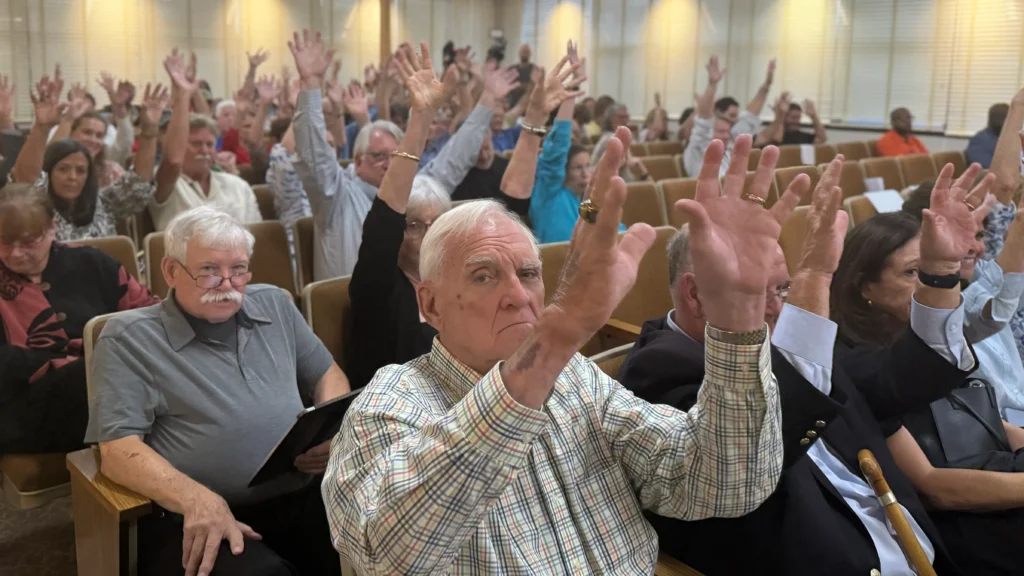
Dozens of Westside residents came out to speak against the plans for Venetia’s rebuild, which would consolidate the school with Ortega Elementary. Venetia currently has about 350 students, Ortega less than 300. The district has not said which other schools, if any, might also merge into the new Venetia to bring it closer to its planned capacity.
Some parents fear John Stockton Elementary — a 500-student school within walking distance of Venetia — would be the obvious choice. (Jacksonville Today asked Duval Schools COO Jim Culbert in June if Stockton would consolidate with Venetia. His answer: “I have no comment.”)
The commenters asked the district to consider the negative impact that such a large school would have on families and the surrounding neighborhood.
“A neighborhood school gives families something that a large regional campus cannot: community,” resident Laura Garcia said. “Kids can walk or bike. Parents can easily participate. Teachers and families know one another.”
The board rejected proceeding with construction planning on a vote of 1-to-6. Only District 1 rep Tony Ricardo voted in favor.
Venetia Elementary is in Reggie Blount’s district. He said he’s received a record number of emails from the school’s stakeholders.
“What I hear from the community is size, community and traffic,” Blount said. “Basically, it’s too big, too much traffic, and it’s going to disrupt the community on a basic level.”
Board Vice Chair April Carney said “this perception that we’re blindsiding community members gives [her] pause.”
“The families of John Stockton are terrified that you are going to close their school,” Carney said. “I look at this and this is a perfect opportunity for our new policy to go in place.”
Duval Schools will host a community meeting at Hyde Grove Elementary, 2056 Lane Ave. S., on Tuesday, Sept. 29, at 5 p.m.