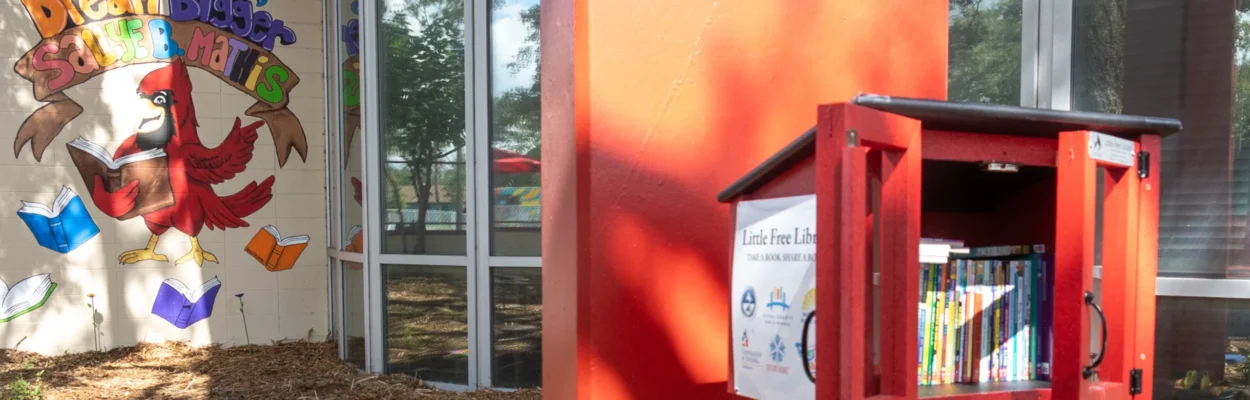
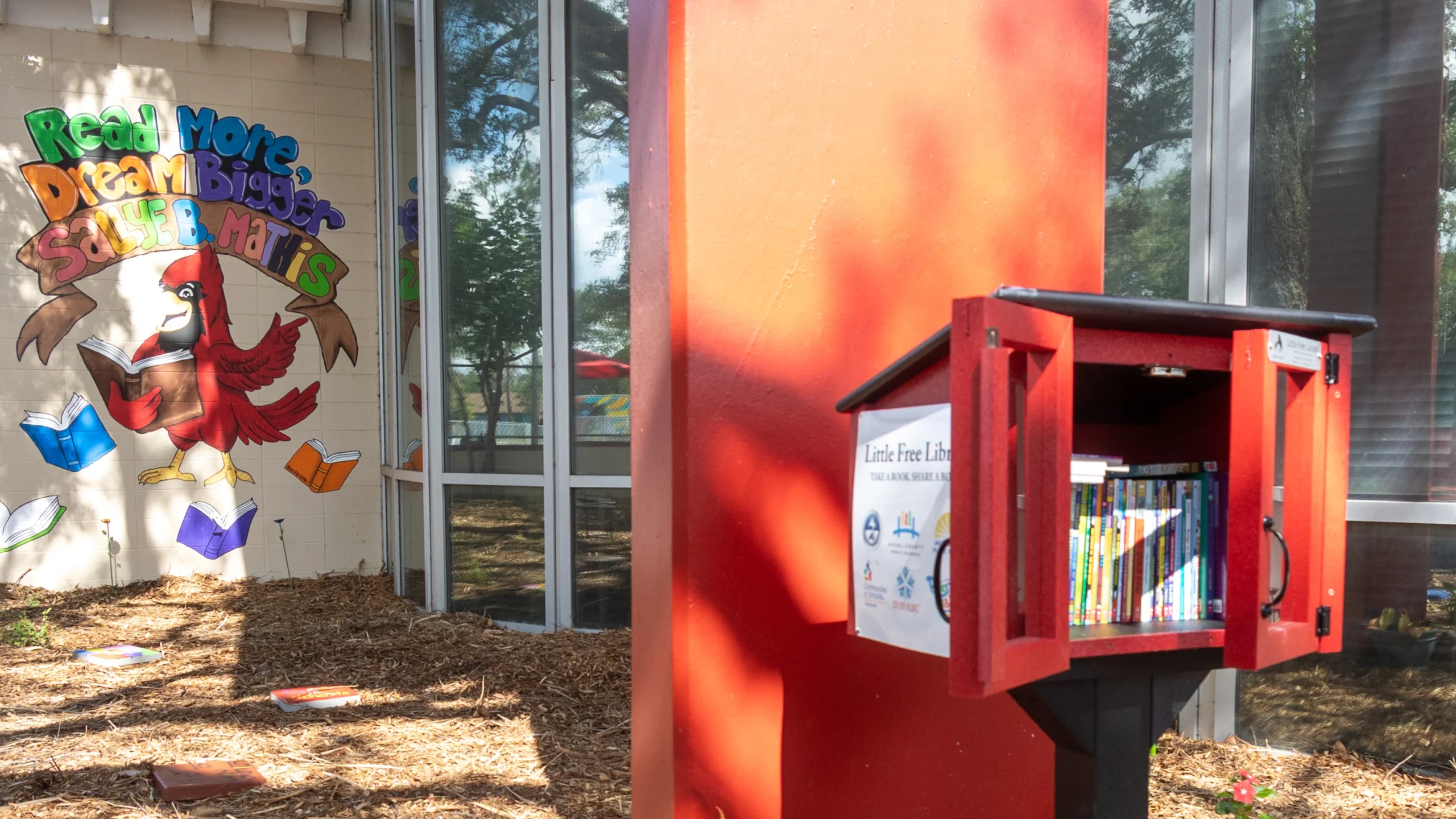
A partnership between Communities in Schools Jacksonville, Kids Hope Alliance and the city of Jacksonville led to a Little Free Library at Sallye B. Mathis Elementary School in Northwest Jacksonville on Wednesday, July 8, 2026. The effort provided nearly three dozen picture books and chapter books for students. | Will Brown, Jacksonville Today
Published on August 10, 2026 at 11:42 am
Free local news and info, in your inbox at 6 a.m. M-F. Sign up for the Jacksonville Today newsletter.
Duval Schools opened its academic year on Monday.
The A-rated district has historically lagged behind Florida’s other large urban districts in literacy proficiency.
In the 2025-26 academic year, 51% of Duval County third grade students were literacy-proficient. The Florida Department of Education considers a student literacy-proficient if they score at least a Level 3 on the five-tiered test.
Jacksonville Today thanks our sponsors. Become one.
Duval County Superintendent Christopher Bernier touted the consecutive A grades, during a July 28 new conference. He noted there is more work ahead.
“Academic improvement is not created in a district office,” Bernier said. “It happens in classrooms, hallways, tutoring sessions, extracurricular activities, before- and after-school programs, and the daily interactions between our educators and students.”
Duval County Public Schools is the sixth-largest district in Florida. The others, in descending order, are Miami-Dade, Broward, Hillsborough, Orange and Palm Beach counties.
Jacksonville Today thanks our sponsors. Become one.
In the 2026, the literacy gap between Duval and Miami-Dade was 13%. Five years ago, more Jacksonville students were literacy-proficient than Miami-Dade students.
Here is how Duval Schools compares to Florida’s largest school districts.
Earlier this year, the Jacksonville Public Education Fund concluded that poverty and chronic absenteeism were two of the biggest reasons for Duval’s literacy woes.
However, four of the five school districts in Florida that are larger than DCPS have a higher percentage of students in poverty.
What Duval Schools has is concentrated poverty.
In the 2025-26 academic year, there were 39 elementary schools in Duval County where fewer than 40% of students met the Florida Department of Education’s standard for literacy proficiency.
Every one of those schools had a poverty rate higher than the Duval County percentage of 43.2% of students. At 34 of the schools with low literacy rates, more than 80% of the student population come from economically disadvantaged households.
A student is considered economically disadvantaged if they are eligible for free and reduced price meals under the National School Lunch Program. According to the U.S. Department of Agriculture, students are eligible for free lunch if their household earns less than 130% of the federal poverty designation. Students are eligible for reduced lunch if their household earns less than 180% of the federal poverty designation. In a household of four people, those figures are $50,284 and $71,588 respectively.
Heart, hustle, high expectations
Communities in Schools Jacksonville, alongside the Kids Hope Alliance and the city of Jacksonville, opened a Little Free Library next to Sallye B. Mathis Elementary School in Northwest Jacksonville.
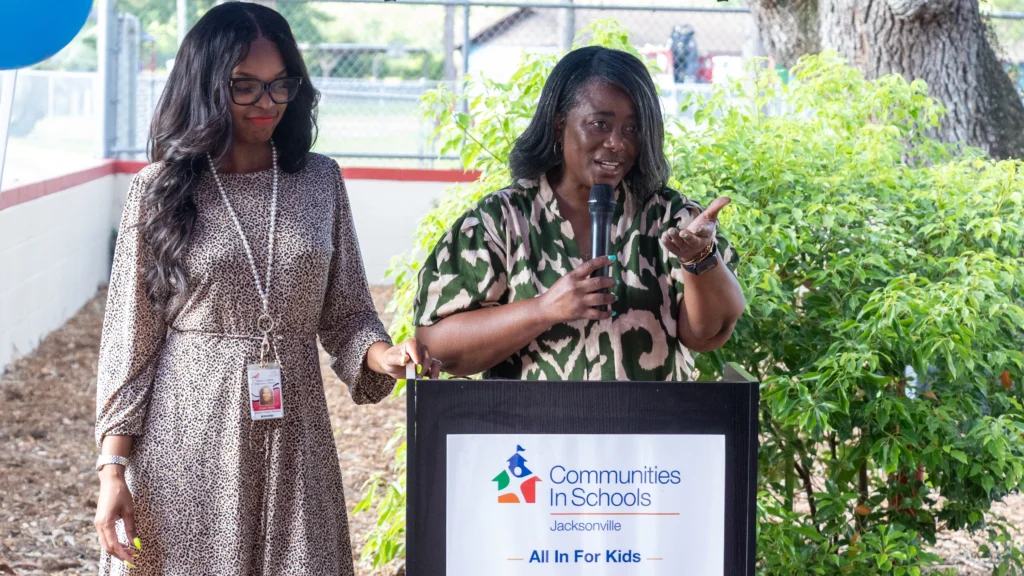
Communities in Schools Jacksonville has literacy programs at 11 Jacksonville elementary schools — all of which have high poverty within their student populations. Its leaders say there are plans to install three more libraries at schools it serves this academic year.
Sallye B. Mathis Principal Latarsha Jones says literacy has been at the forefront of the district’s focus — whether it’s professional development for educators to the books available for students. Jones says student data is part of a holistic story about literacy; student growth is another.
Jones started her third year as principal Aug. 10. She has led the school in Northwest Jacksonville with heart, hustle and high expectations.
“For us, it’s really about using the data to inform our instruction, inform our professional development, talk about the resources that we have, how we welcome our community partners in — because there’s always a lens of literacy through our community partnerships,” Jones says. “Data serves its purpose, but then it’s what you do with it. And, that’s where we get the work done with literacy.”