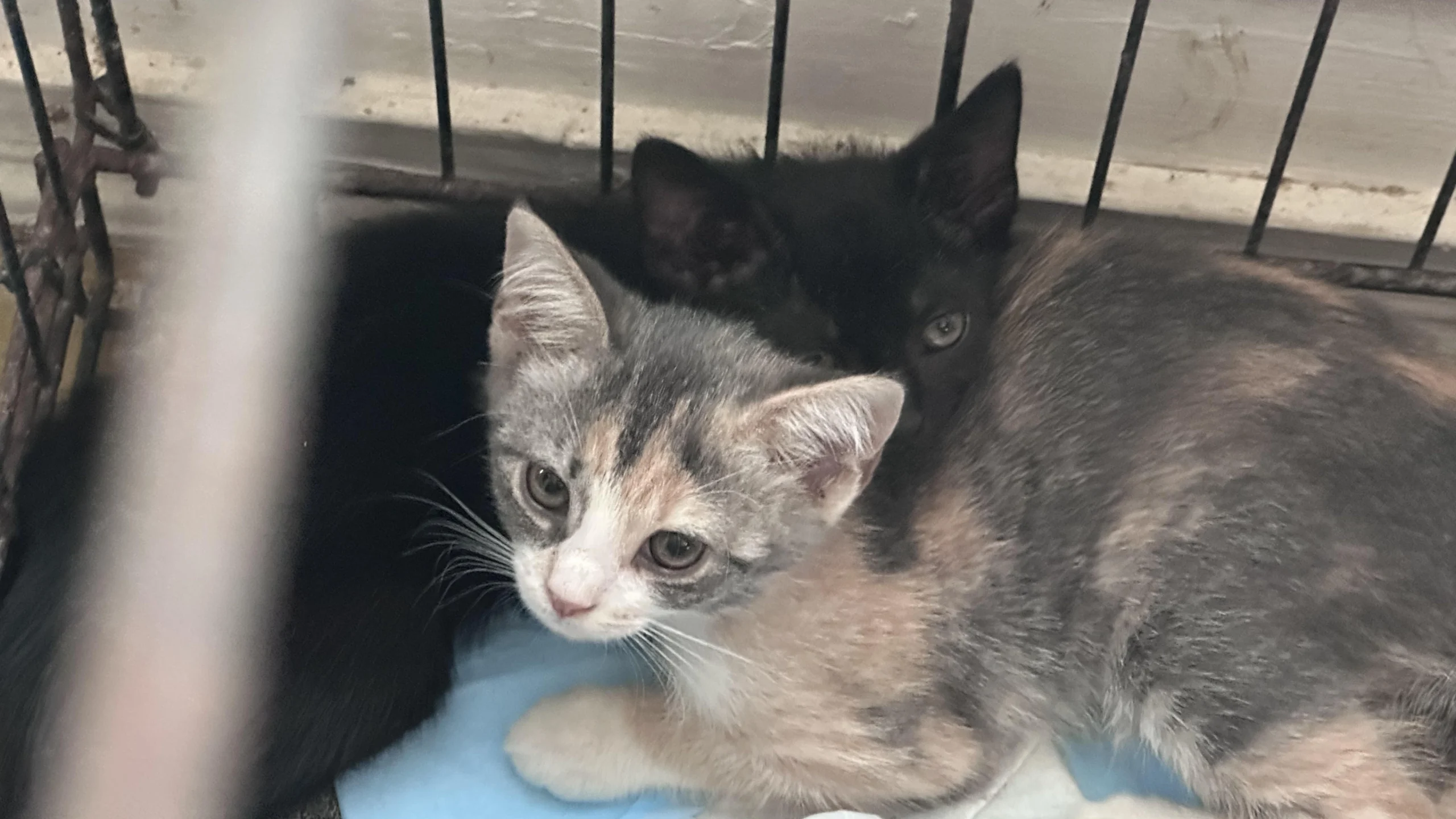
Cats like these kittens are trapped outside St. Augustine and taken to clinics in Jacksonville and Clay County. St. Johns County has no program to spay, neuter and vaccinate cats and return them to the ourdoors. | Photo courtesy Adrienne Arnone
Published on April 1, 2026 at 12:41 pm
Free local news and info, in your inbox at 6 a.m. M-F. Sign up for the Jacksonville Today newsletter.
Every week for the past year, Elaine Healy has visited the Petco store in south St. Augustine.
Actually, she visits behind the Petco store.
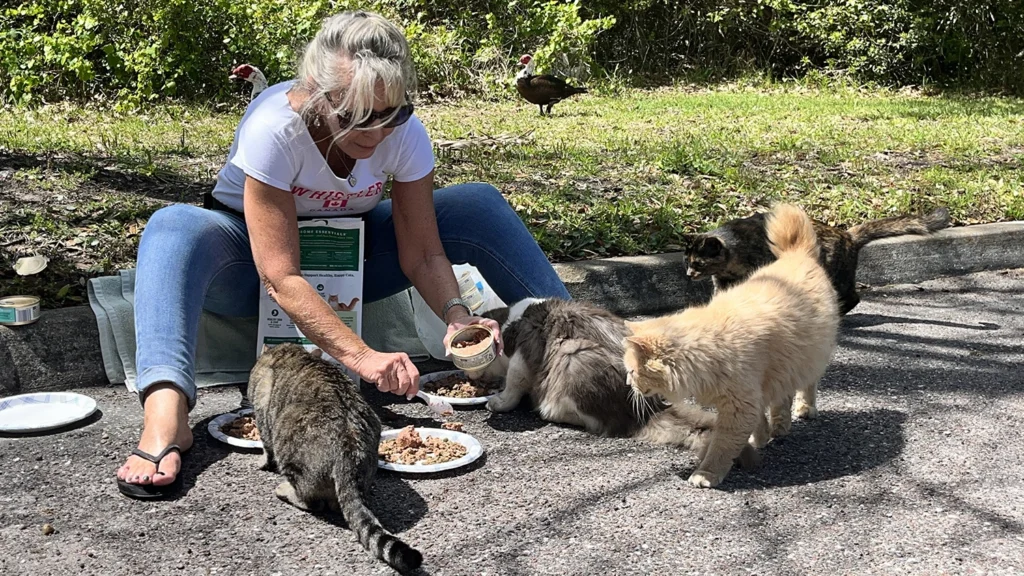
Healy, along with a group of other cat lovers, feed and keep an eye on a colony of cats that live behind the Cobblestone Village plaza off State Road 312. There are colonies of cats like this one all around the county, but about 13 cats frequent this particular plaza, along with a few others that live nearby.
Jacksonville Today thanks our sponsors. Become one.
“This is so rewarding,” Healy says. “It’s like I found my purpose in retirement.”
Many of the cats Healy and the others look after are friendly, and, after hard work on the volunteers’ part, many are sterilized and vaccinated. They call them community cats — outdoor cats that aren’t breeding, are vaccinated against diseases like rabies and are keeping to themselves.
But in St. Johns County, efforts to vaccinate and sterilize ownerless cats are performed entirely by volunteers.


Jacksonville Today thanks our sponsors. Become one.
Nearby counties like Duval and Clay fund trap, neuter/spay, vaccinate and return programs — known as TNVR. Activists want to see a change in how St. Johns County treats these cats.
Cats – a nuisance?
In St. Johns, Animal Control’s approach focuses on curbing “nuisance” animals.
Per the county’s code of ordinances, animals with a history of chasing people, chasing vehicles or simply running “at large,” meaning off a leash and off its owner’s property, are considered a nuisance.
Animal Services Director Paul Studivant says it comes down to an issue of property rights.
If Studivant’s office receives a call about an animal on someone’s property, whether it is a dog or cat, animal control sends someone to investigate. Studivant says his office doesn’t go out of its way to round up feral cats. But he still believes cats should be treated like any other potential nuisance animal.
“If you say one species gets a pass … that’s really not fair to the homeowners,” Studivant says. “Nor is it fair to the native species, the wildlife, killed by feral cats.”
Activists like Kim Whitaker want to see that approach changed.
Along with ending euthanasia at the shelter, Whitaker wants to see the county acknowledge that friendly, sterilized community cats are not the same as feral, untreated cats.
He wants to see St. Johns County take an approach like Brevard County.
Brevard carves out an exception to its broader rules for stray and feral animals by noting that community cats “may be cared for by one or more residents of an immediate area” and “shall be distinguished from other cats by being sterilized and ear tipped.”
But Whitaker acknowledges that an approach like that must come with a plan to depress the population of cats living on the streets.
“You can’t do no-kill without TNVR,” Whitaker says. “They work together.”
Creating positive outcomes for cats?
For many people involved in caring for stray and feral cats in St. Johns County, there’s one local woman on their phone’s speed dial.
When Adrienne Arnone gets a phone call about a stray without the signature clipped ear of a cat who has received veterinary services, the first thing she says is to not feed the cats, but to wait until she can arrive.
“I’ll be there with a trap and really stinky wet food,” she says. “If wet food doesn’t work, the magic potion is KFC with the skin on.”
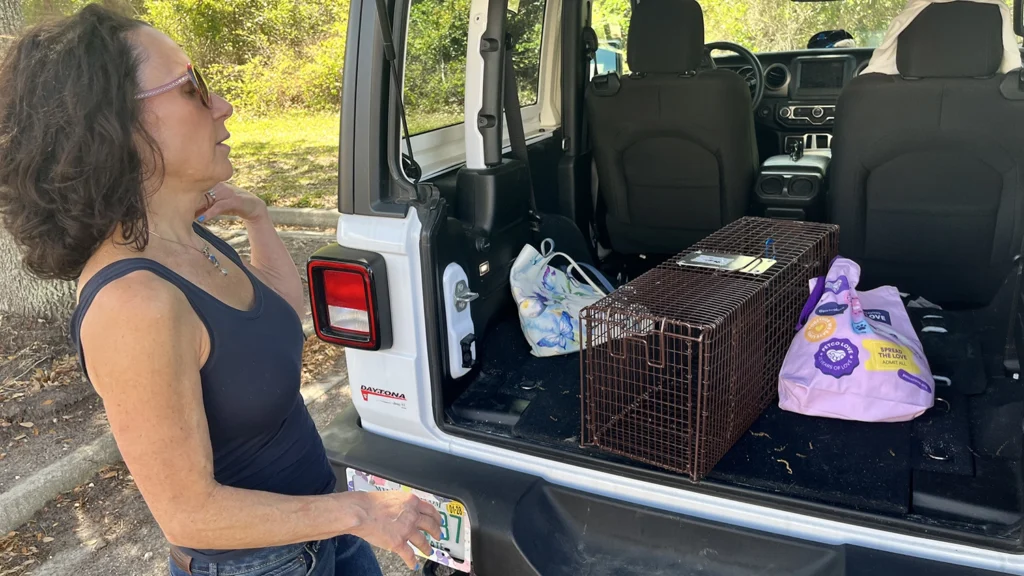
After trapping the cat, the next step is to transport it somewhere it can be sterilized and vaccinated against diseases like rabies.
But St. Johns County’s trap, neuter/spay, vaccinate and return services are few and far between. The St. Augustine Humane Society offers low-cost services, but only a few days per week.
Arnone often finds herself driving to Jacksonville or Clay County for services supported by residents’ tax dollars.
“There is no government support for TNR in St. Johns County,” Arnone says. “Duval is amazing. We have to pay for it, but it’s very reasonable.”
She argues that sterilizing cat populations helps to reduce the number of kittens born over time, which would ultimately lead to less stressed animal shelters.
During 2025, Arnone says, she and her group of volunteers trapped, fixed and vaccinated 550 cats that were released back to where they were living. With more robust local services, she believes that number could be much higher.
Support for TNVR
Courtney Sumner has worked for Clay County’s animal shelter for around a decade, and she says she was thrilled when the county decided to launch a TNVR program of its own in 2019.
In 2024, she says, the county performed more than 1,000 sterilization surgeries on cats, and since it launched, Sumner says, the shelter has seen a steady — if slight — decrease in the number of kittens coming in.
That’s a big deal, she says, because caring for kittens takes up a lot of staff time.
“TNVR is like population management, and it’s important because over time this stabilizes and reduces the population of our feral cats,” Sumner says. “It’s a lifesaving program. We’re really excited we can offer this to the citizens of Clay County.”
But that notion is not universally agreed upon.
University of Florida professor Mark Hostetler wrote in 2020 that data on TNVR programs has yet to conclusively show that populations decline over time. He argues that TNVR programs don’t solve the root problem feral cats face — living on the street.
“For me as a cat lover,” Hostetler tells Jacksonville Today, “I hate to have euthanasia. In terms of how humane it is for the cat, it’s much more humane.”
St. Johns County Animal Services Director Paul Studivant is skeptical, too.
Studivant has worked in the area for 30 years, and he says he has yet to see evidence that TNVR programs reduce population sizes in the long term.
“If this program works — trapping, neutering, releasing — that population’s going to shrink to eventually be nothing,” Studivant says. “How is this working? It doesn’t. It’s just a machine that generates income for another. That’s the way I look at that.”
A more humane society
When Adrienne Arnone and her clowder of volunteers come across stray cats, their dream is to get them off of the streets entirely. Arnone has 10 cats at home, and after Elaine Healy started feeding cats at the St. Augustine colony she looks out for, she ended up taking one home — a cat she named Sunnie.
But not all of the cats are adoptable, Arnone says — whether it’s because of their health or their behavior. Those cats, whether they are dangerous or sick, are the cats euthanized at the animal shelter if they’re taken in by animal control.
Arnone is not optimistic change will come anytime soon in St. Johns County. A change in policy would have to come from the Board of County Commissioners, and commissioners took no action when more than 10 residents came to a meeting to ask for changes.
None of the county commissioners budged or suggested bringing it up at a future meeting.
Arnone still remains hopeful the county will eventually change its tune on the notion that all cats living on the streets are just a “nuisance.” But she and her fellow volunteers don’t intend to stop their work anytime soon.