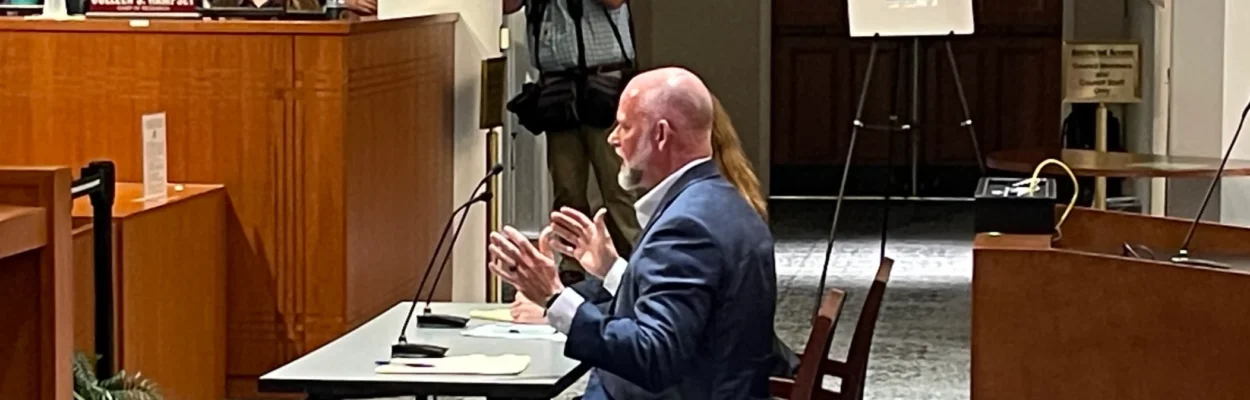
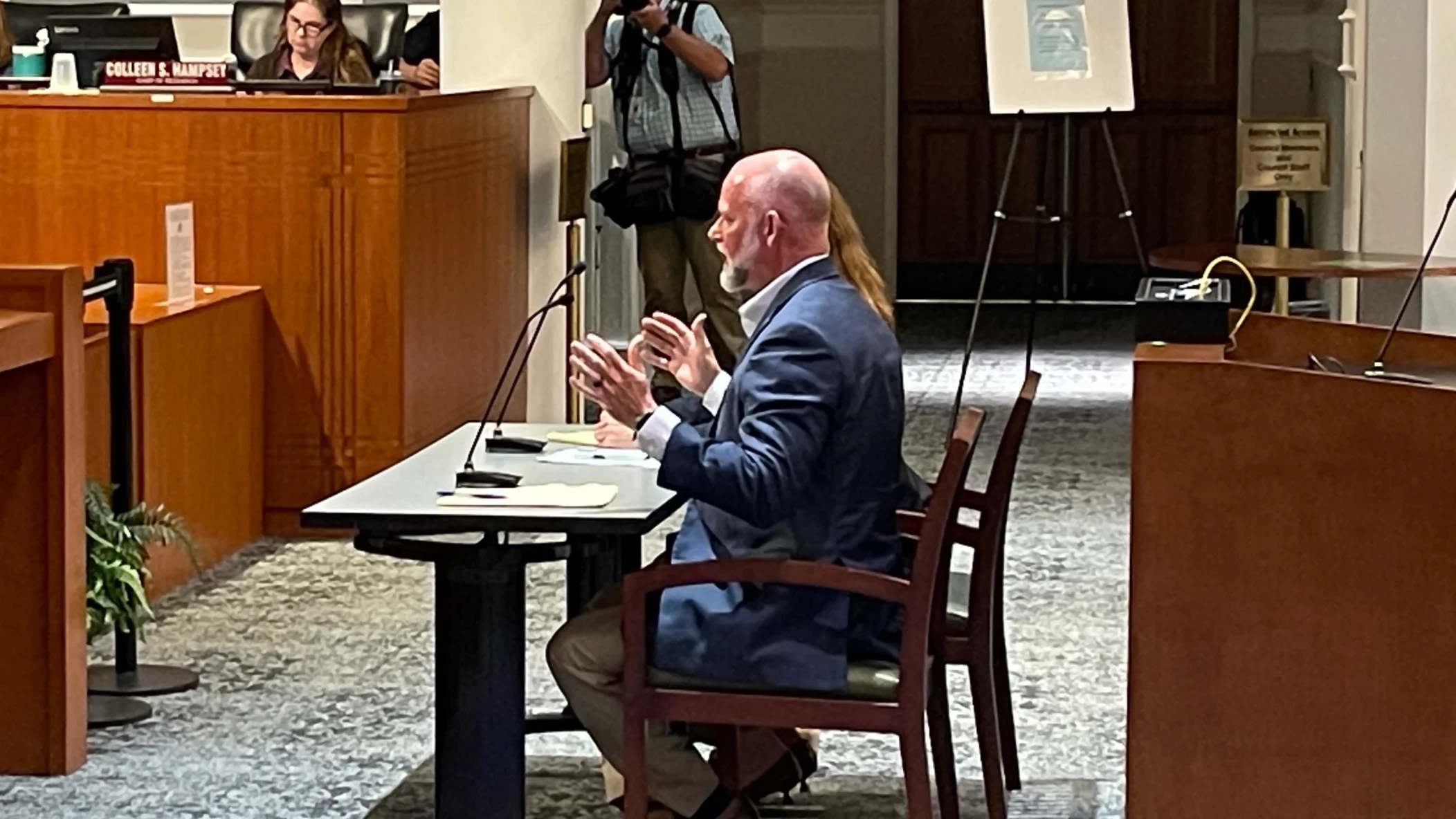
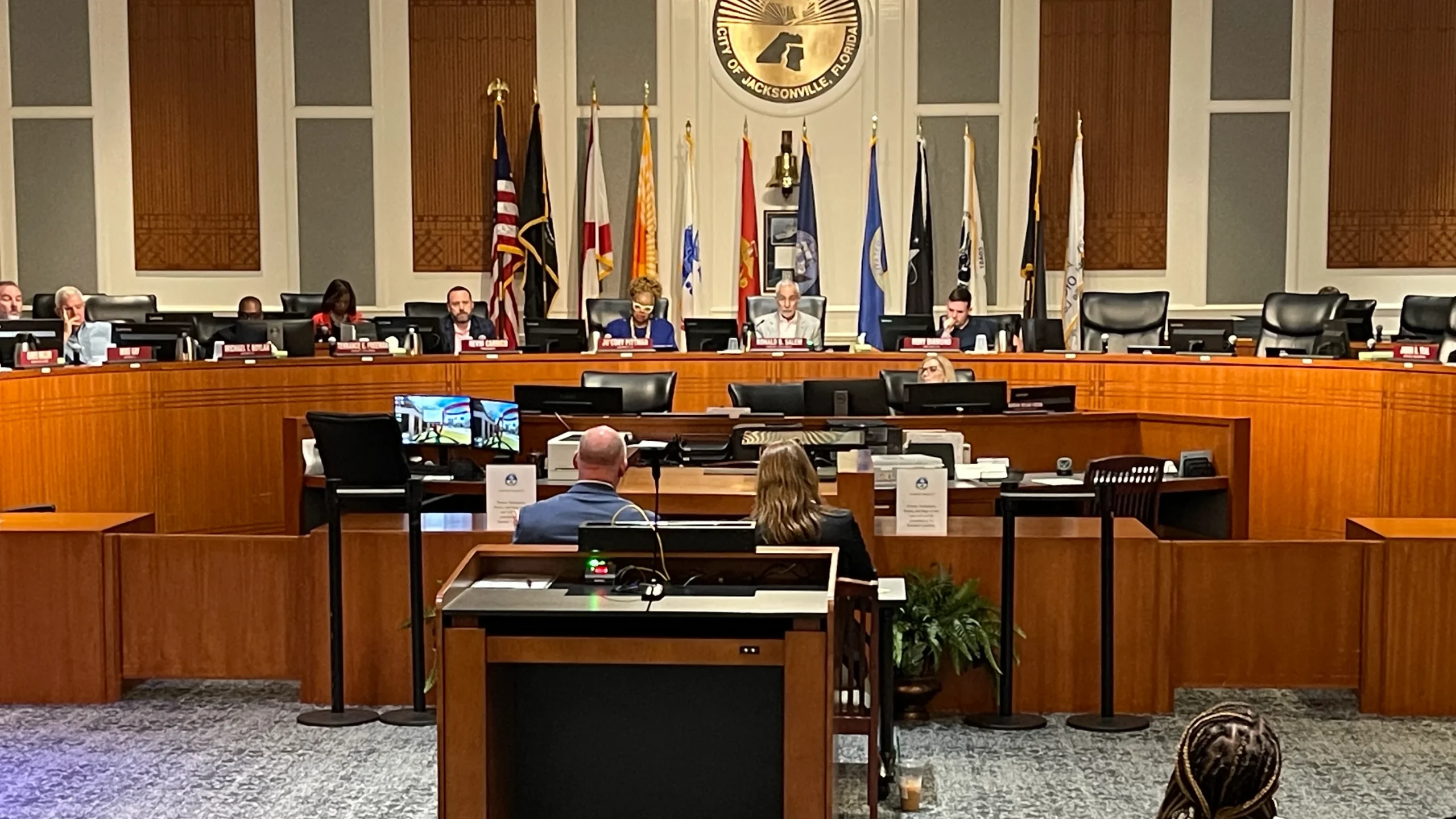
Former JEA Chief of Staff Kurt Wilson testifies in front of the Jacksonville City Council's Special Investigatory Committee on JEA on March 23, 2026. | Mike Mendenhall, Jacksonville Today
Published on March 23, 2026 at 10:02 pm
Free local news and info, in your inbox at 6 a.m. M-F. Sign up for the Jacksonville Today newsletter.
JEA’s former chief of staff says the public utility’s management has been trying for years to resolve its lax policy that’s caused the under collection of what are called capacity fees from several commercial water customers for decades.
Kurt Wilson, whose position was eliminated in February by JEA CEO Vickie Cavey, testified under oath Monday during a hearing in front of the Jacksonville City Council’s Special Investigatory Committee on JEA.
Jacksonville Today thanks our sponsors. Become one.
In addition to Wilson’s testimony on the fees, the committee’s questions also zeroed in on Wilson’s dismissal from JEA, his allegation that Cavey created a toxic work environment for some on her senior leadership team, and Wilson’s involvement in ending a lobbying contract with Ballard Partners, which employs former Mayor Lenny Curry.
The scope of the newly created committee — chaired by Ron Salem, with council members Rory Diamond and Ju’Coby Pittman — has been criticized by others on the council and by Mayor Donna Deegan’s administration as overreach.
According to Wilson, JEA’s senior staff became aware of the lax capacity fee policy in 2022, during the tenure of former CEO Jay Stowe.


Jacksonville Today thanks our sponsors. Become one.
He said a customer’s development project triggered an audit, which found multiple companies within JEA’s service area were building and expanding but not reporting it to JEA and therefore not paying additional capacity fees.
By 2025, the problem was raised to the level of the CEO and other senior management, Wilson said.
One example referenced in the investigation is Mayo Clinic’s water usage.
A December 2024 memo from JEA’s then-chief legal counsel Regina Ross to Mayo Clinic’s attorneys says the hospital could owe $18.9 million in water and wastewater capacity fees. That was based on how much more water Mayo has consumed due to its growth since 1995.
In a contentious meeting last week, city General Counsel Michael Fackler said Ross — who’s now an attorney for the city — would not be made available to auditors due to her attorney-client privilege with JEA.
Mayo Clinic claims it’s exempt from paying for the additional water and wastewater usage based on an agreement with the city dating back to 1986.
Wilson said one issue is when a growing or expanding company applies for a permit with JEA’s electric business, there is no coordination with the water and wastewater services to verify if the company needs to report additional capacity.
“There’s no flag in there. Ask key account people, they don’t know. If you’re not driving past these businesses on a daily (basis) and your mind’s not thinking, ‘This place has really grown in the last 20 years. I wonder if they’ve ever paid’ — I’m not putting this on people (or a) person; the system’s broken on JEA’s side,” Wilson told the committee.
He said instead of filing a lawsuit or going to mediation, which he and Cavey agreed would have been “bad optics” because the oversight was JEA’s error, Cavey came to an agreement with Mayo: JEA would waive the previously unpaid fees and Mayo would pay the full amount moving forward. According to Wilson, there was some question as to whether the CEO had the authority to waive the fees unilaterally or if that needed board approval.
It never came to the board.
“Forty percent of our customers right now struggle to pay our bills. So whatever the business is — there’s plenty of them out there — but the reality is, if they’re not paying the capacity somebody else is,” Wilson said.
Wilson highlight the pushback JEA received from developers in 2021 when its board approved a 149% increase on the one-time water and sewer fees for new housing and commercial development — the first increase in more than 15 years.
JEA is required to collect capacity fees under Florida law, and it says the fees repay bonds it uses to borrow money to build water plants and infrastructure.
Wilson said he didn’t see any evidence JEA was trying to cover up the uncollected capacity fees.
“I do think (the fees are) the 800-pound gorilla that makes me the most nervous,” council member Diamond said. “And hopefully it’s just something that they can get worked out and JEA goes along in a good way.”
Who owes capacity fees?
There are still questions about how many and which organizations could have unpaid and unreported water capacity increases.
Wilson told the committee he heard it’s anywhere between 12 and 20 companies. Salem previously said there could be more than $100 million in unpaid water capacity fees.
During the investigatory committee’s first meeting last week, Diamond named Florida State College at Jacksonville and the Jacksonville Zoo and Botanical Gardens as examples of organizations that could be on the list.
Salem said Monday that it would be unfair to single out Mayo Clinic.
“We need to resolve this once and for all, and fairly to all parties involved,” Salem said.
A spreadsheet provided to the City Council Auditor by JEA and obtained by Jacksonville Today lists more than 40 organizations and their water/wastewater capacity increase. But the document is marked “Not accurate – Do not rely on.”
City Council Auditor Kim Taylor told the committee her office will be trying to independently confirm JEA’s capacity data through its own research.
She told Jacksonville Today in an email Monday that she doesn’t think the utility has an updated list.
“Part of the problem is knowing the initial starting benchmark for capacity, and that requires pulling very old records,” Taylor said.
Taylor stressed the capacity fee investigation will be time intensive, as the auditor, city attorney and JEA work to locate records dating back to the 1980s and ’90s, when the city controlled Duval County’s water service.
Oversight or overreach?
Not all council members are on board with getting involved in JEA’s internal personnel issues or investigating its handling of capacity fees.
Council members Matt Carlucci, Jimmy Peluso and Michael Boylan — who led the effort to reform the JEA charter after the failed sale attempt — are calling out what they see as the committee’s slant.
City Chief Administrative Officer Mike Weinstein, who’s worked under Republicans and Democratic mayoral administrations, says the council’s move to influence JEA’s leadership makes him nervous.
“It’s not that JEA shouldn’t have oversight, but the oversight shouldn’t be people who are here for a few years trying to get a next position in politics. It should be done by professional organizations that are in the business, not people who don’t know anything about electricity and water,” Weinstein told Jacksonville Today.
Council President Kevin Carrico, who formed the special committee to aid the city Office of Inspector General’s investigation into the fees and look into the allegations against Cavey, is asserting his authority to be a voting member.
Carrico is himself the subject of a State Attorney’s Office subpoena, which appears to be looking into his attempt to appoint his boss, Boys & Girls Club Boys & Girls Club CEO Paul Martinez, to the JEA board.
Weinstein previously served as chief financial officer in the John Delany and Curry administrations. He said he watched the attempt to sell JEA during Curry’s tenure, and said a “legitimate” problems inside JEA should be looked at by professionals, “not politicians.”
“I’m just nervous that again, here we are years later with local politicians exerting a tremendous amount of influence and power trying to take over management decisions of a very large business,” he said.