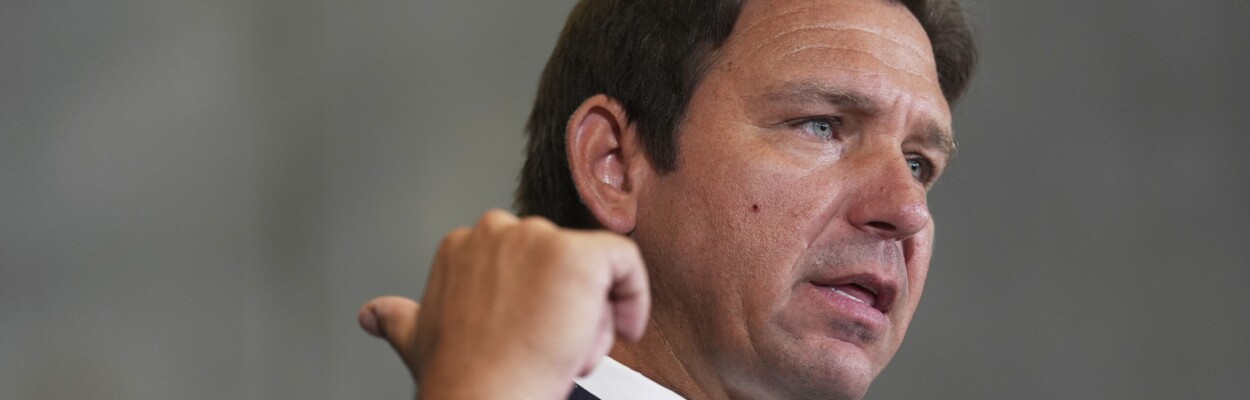
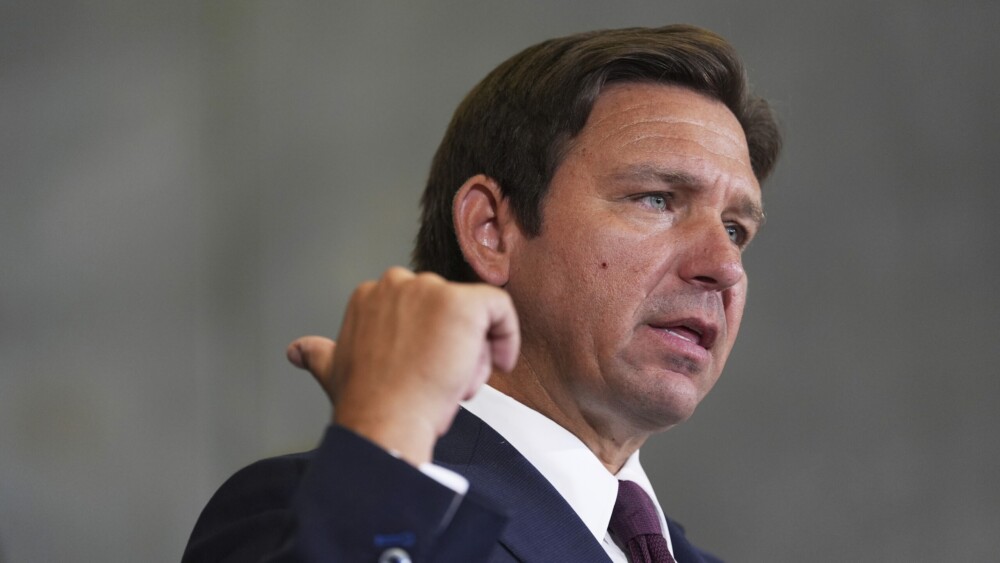
Gov. Ron DeSantis speaks on May 1, 2025, in Miramar. | Rebecca Blackwell, AP file
Published on March 14, 2026 at 6:00 pm
Jacksonville Today seeks to include a diverse set of perspectives that add context or unique insight to the news of the day. Regular opinion columnists are independent contractors who are not involved in news decisions. Want to submit your own column on a matter of public interest? Email pitches to jessica@jaxtoday.org.
Do self-styled fiscal conservatives want to liberate long-suffering homeowners from the yoke of unjust taxation?
Or are they willing to find ways to extract more money from the suckers amid a flat-lining economy, a floundering greenback and a jacked-up job market where no one’s getting raises except the JEA CEO?
Jacksonville Today thanks our sponsors. Become one.
Why not both?
In the latest indication that Florida’s political culture is best interpreted through the lens of The Diagnostic and Statistical Manual of Mental Disorders, 5th Edition, policy makers want to convince voters that it’s day and night at the same time.
Consider two items in the news for evidence that it might take a seance with Sigmund Freud to actually figure out what it is Republicans want to do with your tax money.
Exhibit A: the ongoing promises from the governor’s office to push through the Legislature language that would allow Florida residents to vote to get rid of property taxes on homesteads, a neat piece of class division currently polling below the requisite 60% on the ballot needed to make this happen, especially since many voters do not own a home and may never be able to, so what’s their incentive not to soak the suckers?

Jacksonville Today thanks our sponsors. Become one.
You’ll note the regular session, which ended Friday after 60 days of little but posturing and farewell speeches, didn’t encompass this revolutionary plan.
In St. Augustine last month, DeSantis said it was by design.
“I would not anticipate this happening in the regular session. That was never our plan on this. And there’s reasons for that. But it’s going to get done. And you guys are going to be able to go to the polls and be able to vote something that’s really, really meaningful,” DeSantis claimed.
The House passed a product that would exempt homesteads from all ad valorem taxes, with the exception of school district obligations. But the Senate didn’t take that up, apparently because of some undefined semantic deficiency.
“You can’t just have a bureaucrat write that, that there’s an art to it, that you have to know how that language is going to do,” DeSantis added.
DeSantis’ idea of the “art” of the whole thing may be debatable.
But what’s less arguable, at least according to Jacksonville City Council auditors, is that eliminating property taxes would gut the budget, shaving roughly $375 million off the top, a functional 20% haircut that would drive as much austerity as the city has experienced since the aftermath of the Global Financial Crisis – to be clear, we’re talking about the last one from almost 20 years ago, not the one that’s coming in a few months.
Roads, sidewalks, indigent health care – these are the things you’d say goodbye to, as if Hans Tanzler pulled a Weekend at Bernie’s and got a fourth term. And never mind the heartburn this would give bond and credit rating agencies that no one is mentioning yet, meaning future borrowing would just get more expensive, thus canceling out the nominal gains.
While Tallahassee theoretically wants to put money in homeowners’ pockets, the Duval County School Board more than theoretically wants to take it back.
Ironically, given the governor who is so concerned about homestead taxes did everything he could to elevate conservative politicians to the board in recent years, it’s that same group that is ready and raring to extend a 1 mill tax that was a priority of those very same liberals who merited repudiation in 2022.
The vote wasn’t close: 6 to 1.
They want your money, and they want it amid a push to close schools and replace them with charters … meaning that we’re seeing yet another example of socialized costs, privatized profits.
The only backstop that exists is the Jacksonville City Council, which wasn’t thrilled with their last power grab, the attempt to create a parallel general counsel that got watered down eventually into more of a “here’s your dedicated lawyer but he still answers to Michael Fackler” scenario.
As befits this board, the debate radiated with false choices. The sole no vote, Charlotte Joyce, said that “the arts and athletics are a luxury.”
The others, meanwhile, wanted to keep the vacuum in homeowners’ pocketbooks, because they might talk the talk of fiscal conservatism but they don’t walk the walk.
Here’s the reality if this one gets through: Anyone on the City Council who votes for this thing leaves themselves wide open to the “they raised your taxes” mail pieces the next time they run for office. And as we’ve seen, many of those who serve legislatively don’t envision themselves going away of their own volition.
Does the city council have the mettle to shut the school board down?
As we get closer to the local elections of 2026 and 2027, this question looms large, especially for homeowners who don’t run charter companies or have kids in local schools and therefore don’t benefit from the scheme.