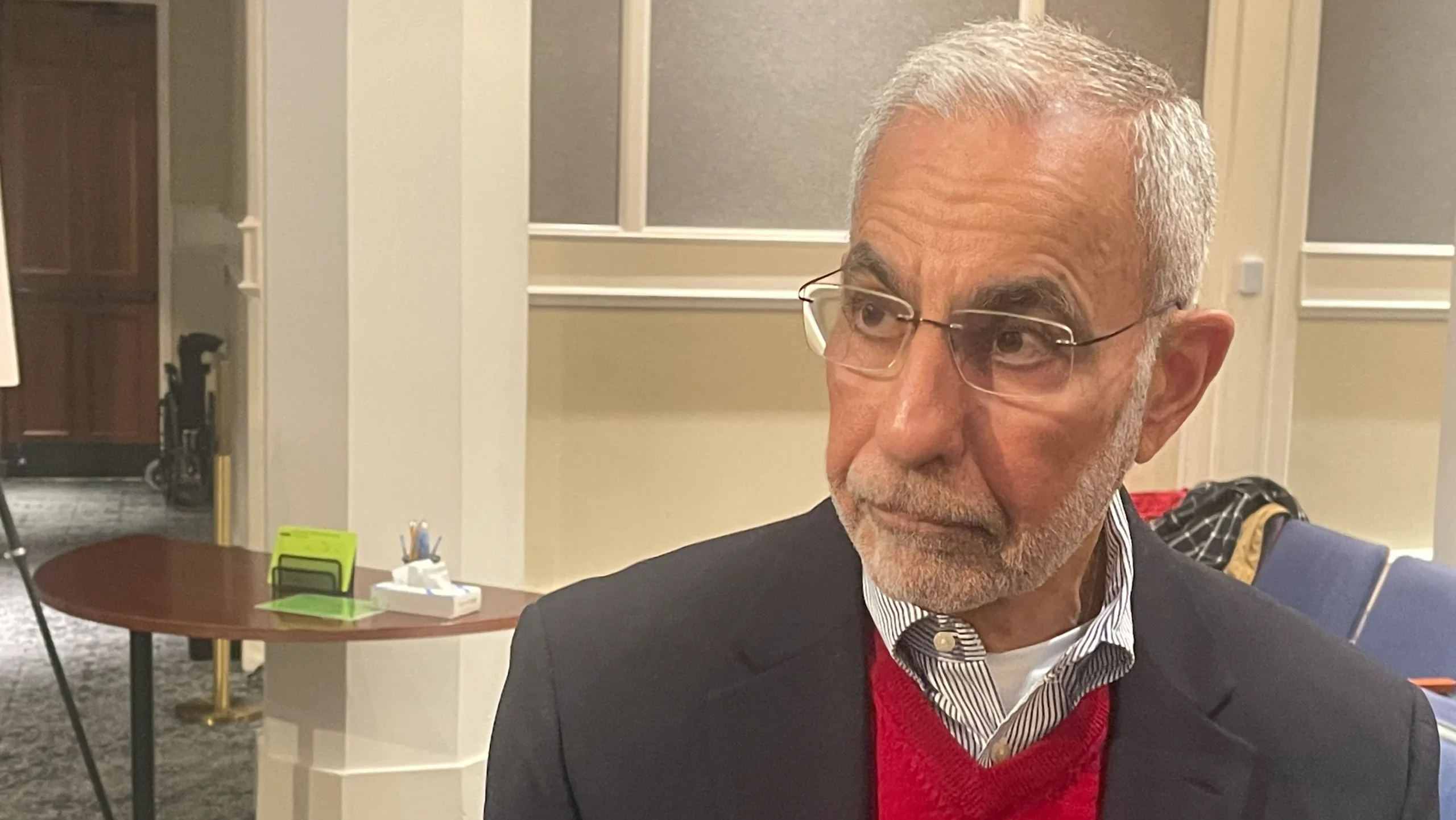
City Council member Ron Salem speaks to news reporters after a meeting Feb. 3, 2026. | Mike Mendenhall, Jacksonville Today
Published on February 3, 2026 at 6:34 pm
Free local news and info, in your inbox at 6 a.m. M-F. Sign up for the Jacksonville Today newsletter.
After a review of the Florida DOGE report on local government spending, the Jacksonville City Council auditor says she could not conclusively identify the $199 million that the state entity claims the city spent wastefully.
Council Auditor Kim Taylor went through her analysis of the state DOGE report during a meeting of the City Council’s city-level Duval DOGE committee on Tuesday.
Jacksonville Today thanks our sponsors. Become one.
Three of the committee members said the analysis appears to identify about $90 million cited by the state as waste. But Taylor said without more context, the Council Auditor’s Office was unable to verify all the numbers by Florida DOGE.
The state DOGE report outlined what it called wasteful spending in 13 local Florida governments. Local auditors found several spots where the state DOGE report lacked enough context for them to verify the data.
On personnel, Florida DOGE said Jacksonville increased its spending by $228 million, or 29.7%, from fiscal year 2020-21 to 2024-25.
Jacksonville Today thanks our sponsors. Become one.
The council auditor found spending did increase during that time, but nonpublic safety personnel spending increased by only 22%. The Jacksonville Sheriff’s Office and Jacksonville Fire and Rescue’s personnel spending was what drove the growth at 44%.
The auditor’s report says when looking at the citywide salary costs compared to citywide benefits, they were able to get “reasonably close” to the amounts stated by Florida DOGE. But salary and wages expenses were a lot less when looking at the portions of the budget funded by property taxes.
DOGE Committee Chair Ron Salem told news reporters after the meeting that, despite the lower numbers found by the council auditor, he still thinks the Florida DOGE report released last week points to possible waste by the city.
“There was still a 20% increase on nonpublic safety spending over the four- or five-year period even when you account for growth and inflation,” Salem said. “There’s still excessive spending in there, for sure.”
Salem said part of the discrepancy in that top-line number could have come from inclusion of a request to JEA by the city to develop a 15-year plan to convert the city’s gas-powered non-emergency fleet vehicles to electric.
The auditor’s report says JEA and the mayor’s office estimate the conversion would cost $105 million, but that plan has not been approved and no money has been spent.
Blaise Ingoglia, the state’s chief financial officer and Florida DOGE lead, was the first to claim Jacksonville had overspent by $199 million during a news conference in September.
Gov. Ron DeSantis created the state-level DOGE in February 2025. It takes its cues from the controversial Department of Government Efficiency effort commissioned by President Donald Trump and run at one time by billionaire Tesla and SpaceX CEO Elon Musk.
Three of the five members of the DOGE committee attended Tuesday’s meeting — Salem and members Chris Miller and Raul Arias. Council members Rory Diamond — who’s been a vocal proponent of the state DOGE effort – and Mike Gay had excused absences, according to Salem. All council members on the Duval DOGE committee are Republican.
“So I would like to see an overall list of everything that went into that $199 million estimate of waste for Jacksonville. Because right now what I’m seeing on this report only highlights something around $94 (or) $95 million,” Miller said.
While Miller praised the state’s work, he said City Council needs to make sure they are “comparing apples to apples” and not “apples to oranges” before taking any action on the state DOGE recommendations to reduce spending.
In an interview after the meeting, Salem said he planned to share the council auditor’s analysis with state DOGE officials to get clarity on the areas the city office could not verify.
“I’m going to send the (auditor’s) report to them and have them respond to us and make sure that we’re looking at the right things or if they have further information on some of the areas where we didn’t have a conclusion to it,” Salem said.
Pressure on public service grants
The report’s three-page section devoted to Jacksonville’s budget is critical of $1.9 million in cultural service grants awarded by the Cultural Council of Greater Jacksonville in fiscal year 2024-25 that the state claims went to fund DEI programs.
City Council created the Cultural Council to manage the city’s Art in Public Places program. Its board includes six mayoral appointees confirmed by City Council and nine other members elected by the board. The board awards cultural service grants on behalf of the city.
Salem suggested Tuesday that city lawmakers should add restrictions to that process based on the DOGE report.
In 2024-25, city council appropriated $7 million for the cultural council board to use for grants.
The state DOGE report singles out:
- $480,000 to the Cathedral Arts Project’s Justice-Involved Youth program
- $57,000 to Hope at Hand, for a therapeutic art and poetry program
- $538,000 to the Jacksonville Symphony, which used to mention its support for DEI on its website
The council auditor also could not identify a fourth grant that DOGE characterized as a cultural service grant — $27,000 for the Jacksonville Area Sexual Minority Youth Network (JASMYN).
The city did award JASMYN a $90,339 public service grant in fiscal year 2024-25, according to the auditor’s report.
The council auditor found that in that year, the Cultural Council awarded about $6 million to programs consistent with the city code governing the cultural service grants, known as CSG.
After the report was released last week, two grant recipients — the Jacksonville Symphony and Cathedral Arts Project — sent letters to the City Council committee. Both organizations said they did not use CSG dollars for DEI-related programs while defending the initiatives criticized by the state DOGE.
“The DOGE report highlighted that the Cathedral Arts Project program received $480,356 in CSG dollars. No CSG dollars were used to fund the ‘Justice Involved Youth’ program,” the Cathedral Arts Project wrote. “The ‘Justice Involved Youth’ program cost is $11,100 annually, and The Moran Family Foundation currently funds this program in its entirety and has since the pandemic.”
The Symphony’s letter says all CSG dollars were used to fund musicians’ salaries.
Salem said he was contacted directly by the Symphony and Cathedral Arts and provided documentation of how they spend the city dollars and was satisfied.
Salem said the committee could use the state DOGE report in the future to push for more oversight in how the organizations funded by the Cultural Council’s $7 million city appropriation spend their money.
“We need to have some dialogue with (the Cultural Council), but clearly there’s some items that are getting funded that I think many members of the council would not be comfortable with,” Salem said.
“My thought is maybe some legislation that restricts the way they fund certain items might be the way to do it. But I want to have some dialogue with them to see if that works for them. I think to have all their grants come back to us for further scrutiny I think will slow down the process considerably.”
How much waste?
The state’s audit said it found $500,000 in “excessive” overtime by city workers in its review including Parks and Recreation, traffic engineers and parking staff.
The City Council DOGE members expressed concern about the overtime, but the council auditor said it could not assess how the state determined the $500,000.
Mayor Donna Deegan’s administration told the council auditor that overtime in 2024-25 for the parks department was due to weekend park and riverwalk maintenance, revenue generating community center, stage, and bleacher rental operations, supervisory oversight and emergency responses, including safety, plumbing and electrical call-outs.
For the Downtown Investment Authority, the extra hours came most from the parking office staffing parking garages for special events after business hours and on weekends. In public works, there were six vacancies that pushed some overtime hours, according to the administration.
There were also two projects in the city’s Capital Improvement Plan for infrastructure where state DOGE officials could have misinterpreted how the budgets were reported.
State DOGE claimed the city spent $54 million more on bike lanes and sidewalks than it provided for fire and rescue services. The council auditor said it would need more background to confirm the information, but she said it’s possible they were looking at multiple years of sidewalk and bike lane funding.
“It is possible the Florida DOGE team may have looked at the “Total Costs” of projects in the CIP countywide recurring projects such as “Sidewalk – Curb Construction and Repair” or “ADA Compliance – Curb Ramps Sidewalks,” which include large amounts of previous funding because we use one project and they show up in the CIP every year compared to when we finish completion or upgrades of a fire station that fall off when fully funded,” the council auditor’s report says.
There was similar confusion in Florida DOGE’s comparison in the report of a $7.5 million 1-mile sidewalk project’s cost to the Florida Department of Transportation’s estimate that a 5-foot sidewalk on both sides of a road typically costs about $900,000.
The council auditor said the report could be referring to a planned Art Museum Drive Sidewalks project planned over the next two years that includes bridge construction and modifications to the slope walls under the Emerson Street overpass.
Salem said it’s unclear.
“It was listed as a $7.5 million sidewalk. As the auditor got into it, they realized there was a bridge involved and some other things involved,” Salem said after the meeting. “Clearly, the description needs to be better, so they’re not looking at a $7.5 million sidewalk, if that’s the one. We’re still not convinced that’s the project.”
State DOGE completed its two-day, on-site audit of Jacksonville City Hall on Aug. 8, more than five months before the report was released.
When asked if the state team could have done more to close those contextual gaps, Salem defended the state DOGE team.
“I think they were just here for a couple of days. There’s only so much you can do in a couple of days and gather information. I think it’s up to us from that report to give more scrutiny,” he said. “I think they visited 10 cities. I think you’d have to ask that question. But I think they were pretty busy. This is a template to take future action on. That’s how I view it.”
Regarding the JEA study, Arias pushed back at the suggestion that converting nonemergency would be wasteful spending, He said he wants to see more information from the study on how much the program could save the city in fuel costs.
‘Holo-Donna’ removed
The state DOGE report added to the scrutiny by Jacksonville Republicans on spending on the Proto-Box — which came to be known as the “Holo-Donna” — that featured a virtual Mayor Deegan providing local information to travelers at Jacksonville International Airport.
Salem revealed during the meeting that the vendor that supplied the technology to the city has removed the device.
State DOGE overestimated the total cost of the Proto-Box to the city in its report by $8,698, according to the council auditor’s assessment. The auditor was able to confirm $66,302 in payments for the device, while the state DOGE claimed it was $75,000.
Salem speculated in his post-meeting interview that the removal was due to the report. But two spokespersons for the mayor told Jacksonville Today on Tuesday that the city’s six-month contract with the Jacksonville Aviation Authority to pilot the technology expired Feb. 1 and it was removed as scheduled.
“The proto box has been returned to the city while we explore additional public education projects for the Public Works Department,” Phil Perry, the city’s chief communications officer, said in an email.
The mayor’s director of strategic initiatives and press liaison, Melissa Ross, added: “It is city-owned and now back on city property. We will use it in the future, possibly at the Main Library and/or other locations. Additionally, it was unfair for the airport to be subjected to constant hyperpartisan attacks.”