
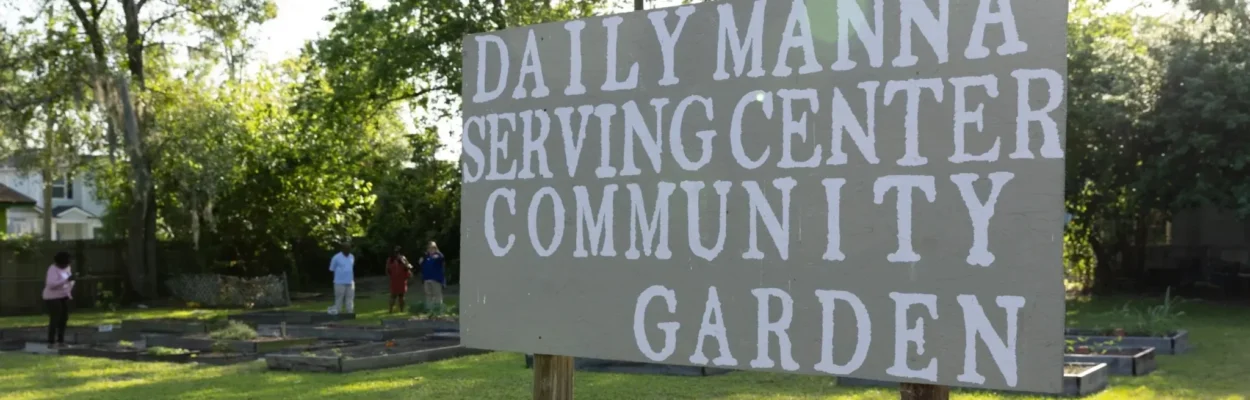
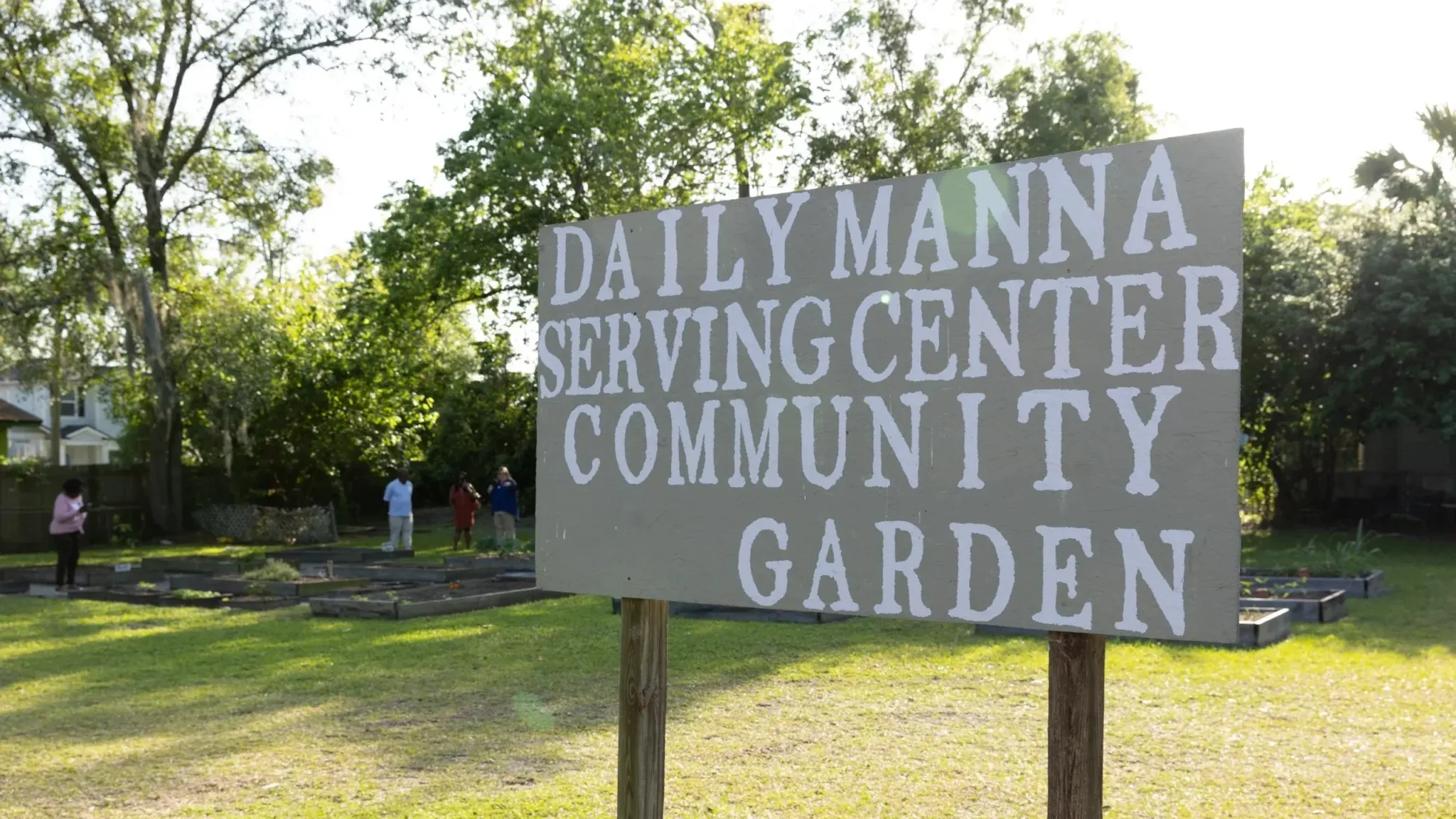
The Daily Manna Community Garden at 426 Smith St. in Jacksonville. | Will Brown, Jacksonville Today
Published on January 22, 2026 at 3:44 pm
Free local news and info, in your inbox at 6 a.m. M-F. Sign up for the Jacksonville Today newsletter.
At Eartha’s Farm and Market, the nonprofit’s director grows herbs, greens, tomatoes, cucumbers, 240 blueberry bushes, fruit trees, grape vine and more on 2½ acres on Jacksonville’s Northside.
“Anything you can grow in Florida, we grow,” director Sarah Salvatore told Jacksonville Today.
Jacksonville Today thanks our sponsors. Become one.
The Clara White Mission initiative hosts programs and provides resources for other local growers and urban farmers, as well as people affected by food insecurity. Its weekly Saturday farmers market accepts SNAP and WIC food benefits.
But Salvatore says Eartha’s could be doing more. Another 8 acres goes unworked due to limited resources and employee capacity.
“I can only fund so many farmers — only have so much time in a day to grow food. So I have a ton of acres that I can grow food on if we had the coordination,” she said.



Jacksonville Today thanks our sponsors. Become one.
“We do have really cool partners like Blue Zones (Project Jacksonville) who provided a walk-in cooler through technical support which is going to increase our ability to aggregate other local goods and also distribute more food. But I need funding to be able to develop that agricultural land — when it comes to irrigations and tillage and crop maintenance. It’s a lot of upfront cost that will then pay off down the lane.”
Salvatore was one of the several dozen growers, experts and community members who attended the public launch Tuesday of the city’s State of Food effort to analyze Jacksonville’s food system.
According to city officials, the multimonth study aims to understand how and where Jacksonville’s goods are produced, distributed, accessed and consumed and how Jacksonville can reduce and recover its food waste to be used as a resource by local agriculture.
The project, led by the city’s Office of Resilience, has partnered with the University of Florida Institute of Food and Agricultural Sciences Extension and the Jacksonville-Duval Agricultural Counci. It’s looking for others to contribute.
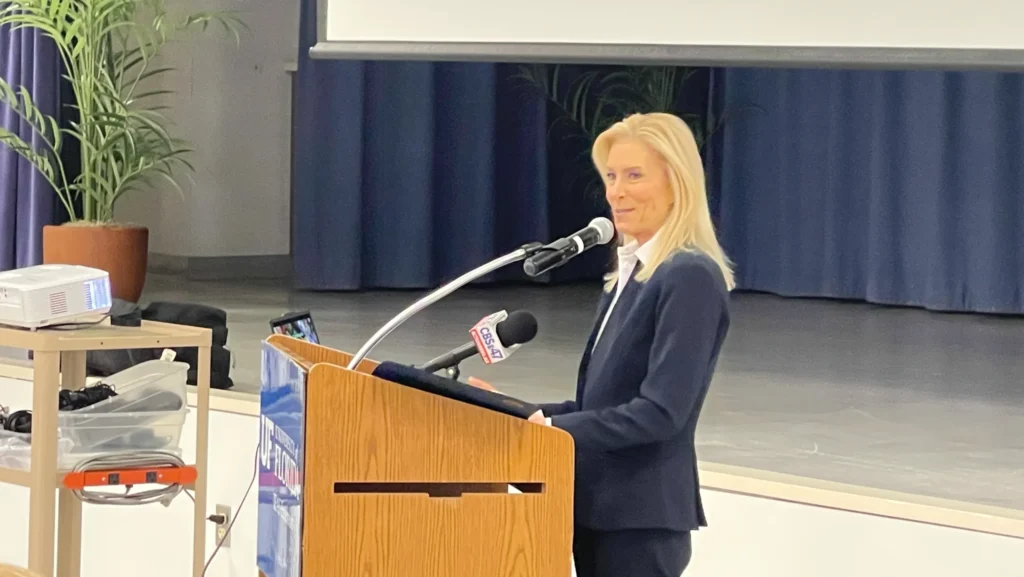
During the launch event at the UF/IFAS Extension Office on the city’s Northwest side, Mayor Donna Deegan called food system planning “a core part of city planning.”
Deegan says it will allow the administration to propose policies to help relieve food insecurity locally and lift barriers for urban farming.
“Food connects us, it changes our health, our economy, it changes our neighborhoods, and our resilience as a city,” Deegan said. “And as Jacksonville continues to grow the way we move, the way we access and the way we recover food really does matter more than ever.
“This process will also examine how existing policies and practices are supporting or possibly limiting those efforts so we can identify opportunities of improvement and make some informed recommendations,” she said.
State of Food trend
With the launch, Jacksonville joins other major U.S. cities that have integrated food system analysis into their broader city planning.
Anne Coglianese, chief resilience officer, told Jacksonville Today that city staff is modeling their work after the Health and Equitable Food System adopted by the Austin, Texas, City Council and the Travis County Commissioners Court in October 2024.
Coglinese said that although Jacksonville’s food system is stable, there are gaps in access, distribution and where it can be grown. She said the city needs to have a better understanding of distributions to protect the food system.
“From a resilience perspective, this is where we know they’re could be breakdowns, and I think COVID-19 was a real wakeup call for a lot of people on just how much decisions and events that are happening outside our community can have that local impact on what you expect to see when you go to the store or where you source your food,” she said.
About 20,000 acres in Jacksonville is active agricultural production land and, according to UF/IFAS Extension Agent Stephen Jennewein, more than 79% of the farms in Duval County are less than 50 acres, which classifies them as small farms with USDA.
At the meeting Tuesday, he said understanding how to further diversify food production could be an opportunity for the area’s small urban farmers
“We’re expecting more and more production from less acreage. And I think urban agriculture has a real chance to shine on that, capable of producing a lot of food in a small amount of area,” Jennewein said during the presentation. (Click here to download the presentation.)
Gaps, growth and development
City officials say one in seven people in Jacksonville is food insecure. But the report aims to see what else is limiting growth.
Two possible outcomes from the report could be a proposed citywide composting program that could more easily distribute food waste as a fertilizer and nutrient source for local producers.
Colglianese said the report could result in proposed zoning code changes to make it easier for urban farms to work more of their land or economic incentives to open grocery stores.
“Because we do have so many people moving to Jacksonville, so much development happening here, there is a need to think about how are we innovating, how are we growing and how are we building out our food system to be ready to meet the moment in the future in addition to where we have gaps and opportunity today.” Conglianese said.
She told Jacksonville Today that, in addition to smaller growers and retailers, officials will work with larger grocery store chains and food distributors to understand how food moves through the city.
“We’re planning to engage everyone big and small. You can’t talk about food without having those national retailers in the mix. It’s where so many people are getting their food.
According to Colgianese, about 171,500 Duval County residents work in food distribution and 300,000 metric tons of food is imported through JAXPORT annually. Food that’s exported helps the city’s gross domestic product, but any locally produced food that stays only strengthens the local food system, she said.
“I’m a small grower, so my food is staying very tight in my local community,” Salvatore said. “I know other beef/dairy farmers that are exporting all their products out of Jacksonville. There is absolutely no beef staying here that’s being grown here. That’s a problem. But all of the food that I grow at Ertha’s stays all within the Jacksonville community. There are no exports on that. That’s my goal.”
The city will be announcing more community meetings and surveys to get the public engaged in the food plan. Officials hope it could be completed by this summer. City officials are asking the public to provide feedback and to ask questions at foodplan@coj.net.