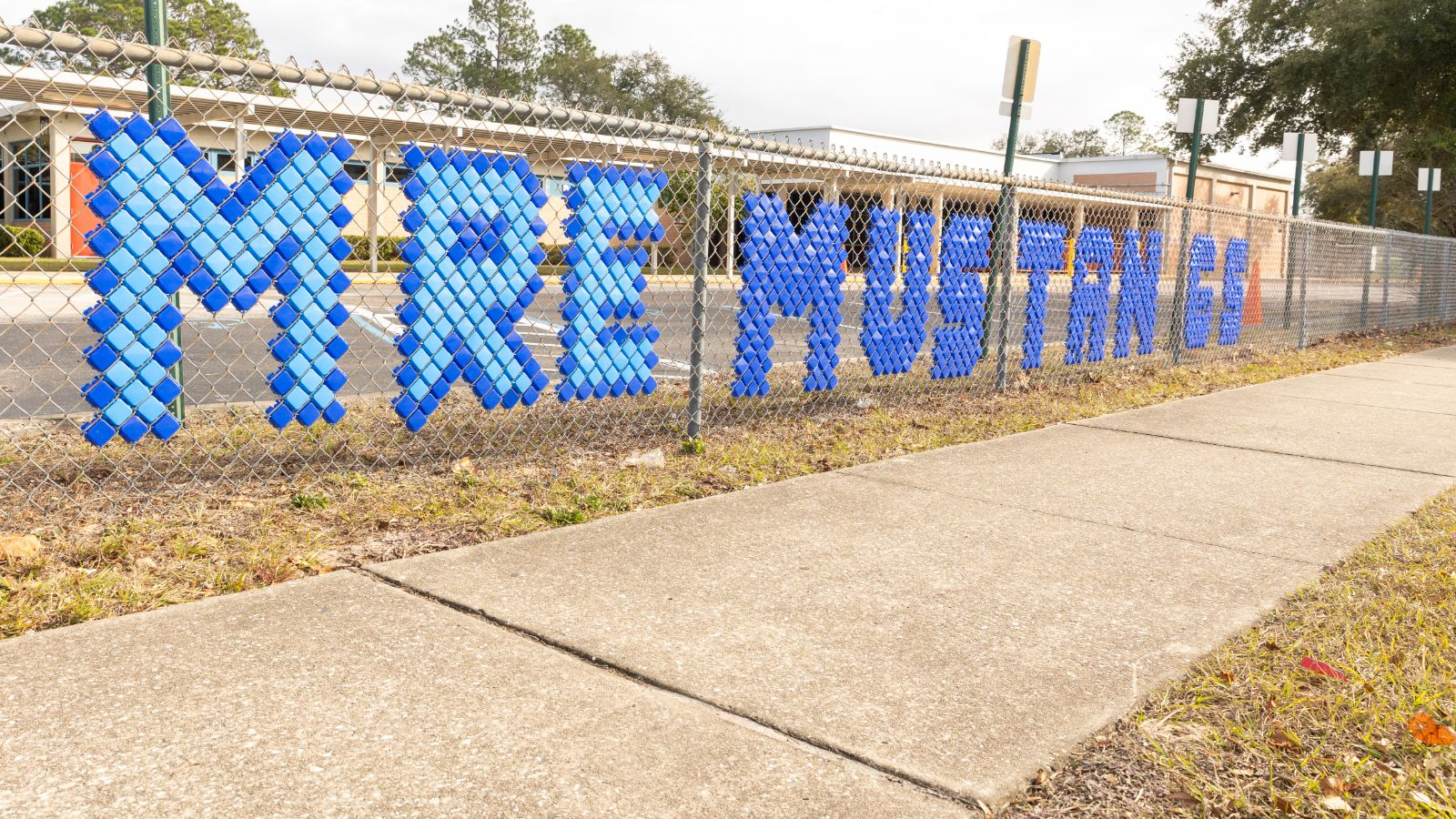
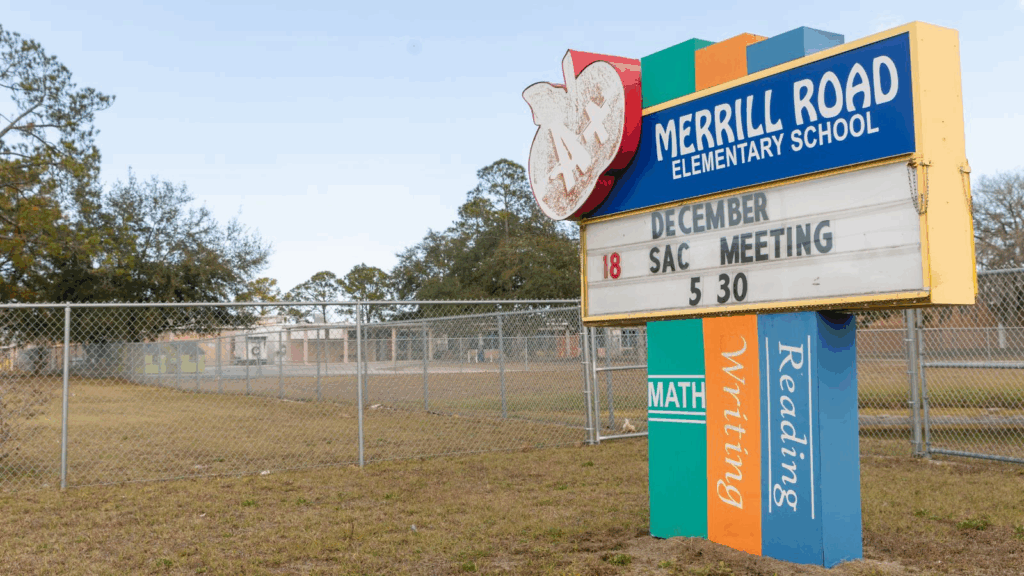
Merrill Road Elementary is one of two schools that remain on Mater Academy's list for Schools of Hope. | Will Brown, Jacksonville Today
Published on December 23, 2025 at 4:50 pm
Free local news and info, in your inbox at 6 a.m. M-F. Sign up for the Jacksonville Today newsletter.
Only Merrill Road Elementary and Fort Caroline School of the Arts are “under active review” as potential locations for Schools of Hope charter schools, after charter operator Mater Academy withdrew all but two of its requests to open in Duval Schools buildings.
On Dec. 12, the district received notices from Miami-based Mater Academy withdrawing 23 of its 25 letters of intent to open Schools of Hope, district spokesperson Laureen Ricks confirmed this week.
Jacksonville Today thanks our sponsors. Become one.
The withdrawal came “through sustained engagement and advocacy by both the School Board and the District,” Ricks wrote in an email to Jacksonville Today.
Ricks says Duval Schools is now evaluating the remaining two notices “in full compliance with (Florida) Senate Bill 2510 and applicable state guidelines.”
Florida law and state Department of Education regulations require certain “Schools of Hope” charter operators to be able to move into some district buildings, rent free, including “co-locating” at existing schools. The law’s stated aim is to give parents another choice in areas where neighborhood schools are underperforming.

Jacksonville Today thanks our sponsors. Become one.
“The District and School Board will continue to advocate on behalf of our students, families, and schools,” Ricks wrote. “Transparent communication remains a priority, and updates will be shared as the process moves forward.”
A spokesperson for Mater Academy’s for-profit parent company, Academica, did not respond to a request for comment by this story’s publication. Mater Academy President Roberto Blanch also did not respond.
Remaining schools targeted
Monique Tookes, whose children attended or attend Fort Caroline, was part of the process that converted the middle school to an arts magnet a decade ago, and her husband is current chair of its School Advisory Committee. She says the school is an “amazing space.”
“It’s really on the cusp of urban art,” Tookes tells Jacksonville Today. “When I look at the vision of the leadership at Fort Caroline — daring to just do something a little different, and bringing some different things in — there’s a lot of things on the horizon for Fort Caroline, and they’re already getting great recognition with the great work they’re already doing.”
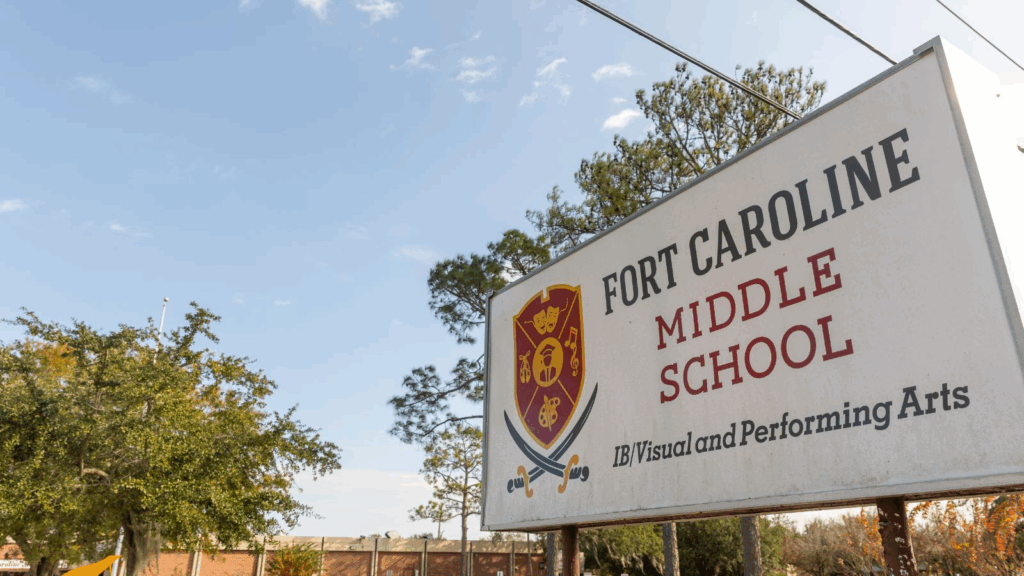
Fort Caroline has earned a “C” under the state’s academic grading system for several years running. Over the last three years, though, Fort Caroline’s test scores have rapidly risen. Florida tracks the academic progress that the lowest-performing students make during each school year. Last year, 55% of Fort Caroline’s lowest performers progressed in language arts, and 54% progressed in math — on par with or slightly higher than average testing gains statewide.
Fort Caroline’s enrollment stands at about half its capacity, district records show.
A little more than half, 54% of Fort Caroline Middle students, are economically disadvantaged. And 82% aren’t white.
Merrill Road Elementary, which serves students in kindergarten through second grade, is scheduled to consolidate with Don Brewer Elementary and receive its students at the beginning of next school year. Combined, the two schools have an enrollment of about 600, and Merrill Road’s building holds about 850. State testing begins in earnest with third graders, so Merrill Road wasn’t assigned a school grade.
About 42% of Merrill Road’s students are economically disadvantaged, and 81% aren’t white.
Both schools are in the Arlington area and represented by District 1 School Board member Tony Ricardo. He didn’t respond to a request for comment before this story’s publication.
FISHing for space
The Florida Legislature created the Schools of Hope program about 10 years ago. Until this year, a handful of state-designated “hope operators” had to build, buy or lease space to open their privately operated, tuition-free charter schools.
This year, the Legislature expanded the program to allow Schools of Hope to use school district facilities — while the district pays the bill. The law was also expanded to broaden the definition of a “persistently low-performing” school and to allow Schools of Hope to open within a five-mile radius of them. It also allows Schools of Hope in geographic areas the federal government designates “opportunity zones” — even if the schools in those areas are high-performing.
School districts have little recourse. When a hope operator sends notice of their intent to open a school, the district must respond within 20 days. They can propose an alternate facility, but the hope operator isn’t required to accept it.
Duval first received notices from Mater Academy in October — before the program officially opened. Many other districts around the state also received stacks of notices. Two other companies also sent notices to Duval, but they were not valid because they were not Hope Operators, the district says.
The Florida Inventory of School Houses — something staffers call “the FISH report” — is Florida’s mechanism for tracking available space in and the condition and age of districts’ public schools. (Duval is tied with Putnam County for the third-oldest facilities: an average of 48 years.)
The FISH report can be a sore spot for districts because it’s based on a formula that Duval Superintendent Christopher Bernier says “has not been addressed for a long period of time.”
He said it can be difficult for the FISH report to show how space is really used in schools. Pre-kindergarten programs, for example, don’t count, and neither do certain other programs outside traditional classrooms.
The FISH report is used to determine how much space a district has to give to Schools of Hope, though, so districts around the state are scrambling to make sure they account for as much space as they can.
In a recent board workshop, Bernier said the state FISH office would tour Duval schools in January to “make some decisions.”
“It’s something that really has to be looked at because our classrooms aren’t used the way they were 15, 20 years ago,” Bernier said.
Voicing opposition?
A state senator, Darryl Rouson, D-St. Petersburg, has filed a bill that would reverse certain provisions of the Schools of Hope expansion — which the Republican-dominated Florida Legislature added in the final hours of their last session.
Rouson’s proposal aligns with the position of the Florida School Boards Association, which recently updated its legislative platform to oppose the Schools of Hope “co-location” requirement. Duval’s board is set to vote Jan. 6 on a similar resolution. So far, district officials have chosen to “privately” broach the subject with state lawmakers.
District 3 representative Cindy Pearson, who’s behind the local resolution, calls Schools of Hope a “huge area of concern” and says the resolution would give the district’s Tallahassee lobbyists a clear mandate.
“What I don’t want to see happen is this board do nothing,” Pearson said. “I don’t want us to kick it down the road, kick it down the road, kick it down the road — and do nothing.”
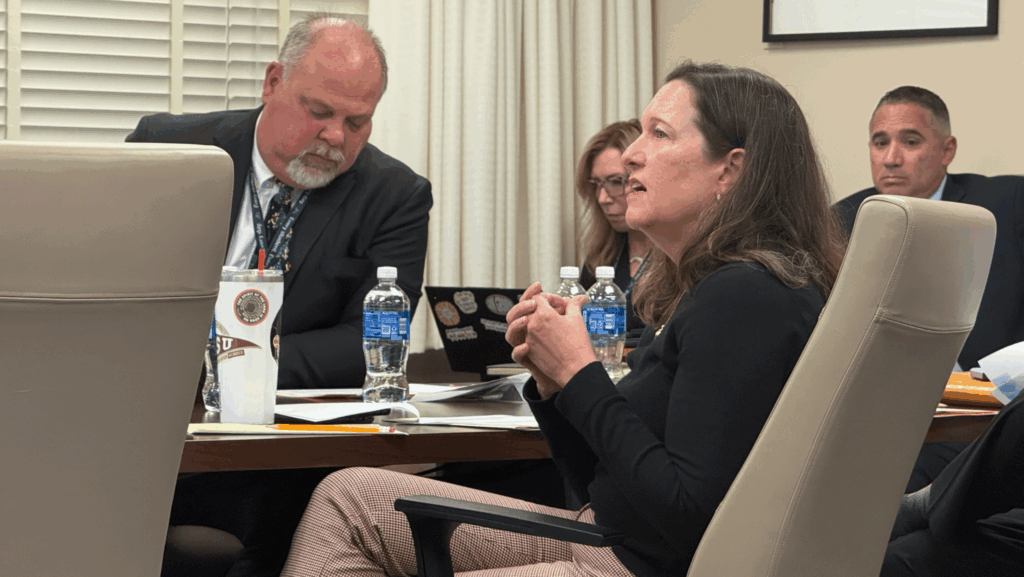
School Board Vice Chair April Carney seemed to oppose the resolution this month.
“I know [Board Chair Charlotte Joyce] has said at this table that she’s been having conversations. I’ve been having conversations. I think all of us have been having very robust conversations with our legislators, as well as the Department of Ed, on this particular topic,” Vice Chair April Carney said. “I feel like we’re making a lot of headway in those conversations, and it would be my preference to wait and see what is filed because I think that those things are forthcoming.”
Schools of Hope a DeSantis priority
And despite the pushback from some on the local level, Gov. Ron DeSantis’ proposed budget triples the allocations for the Schools of Hope program — going from $6 million currently to a proposed $20 million.
At a press conference announcing the budget this month, state Education Commissioner Anastasios Kamoutsas called it “critical funding” that would allow “proven high-performing charter school operators to establish, open and operate within the neighborhoods of Florida’s chronically struggling public schools.”
DeSantis pushed back on the idea that Schools of Hope pull resources from Florida’s public schools.
“They are going to the toughest areas that we have, where a lot of people have given up on some of these students, and they are going in there and they are going to create an environment where these kids can learn,” DeSantis said.
“’I’m hearing…some of these more affluent areas complaining,” DeSantis said in Orlando . “You ain’t gonna have Schools of Hope there. It isn’t going to affect you.”
He said one charter operator that submitted “60 or 100” applications — presumably Mater Academy, though the governor didn’t specify — and that had triggered alarm that Schools of Hope would “come in and take some of the school that that my Sally or my Johnny goes to.”
“No, that’s not what’s going to happen,” DeSantis said, asserting that the charters would be built in “some hard areas in Miami, probably Fort Lauderdale, Broward County, probably Orlando, maybe Tampa, maybe Jacksonville.”
“Schools of Hope, I think, is going to make a big impact,” DeSantis said. “I think geographically it’s going to be very limited. I don’t think most Floridians are even going to know that there’s a School of Hope. Because quite frankly, probably where they’re setting up, a lot of Floridians aren’t spending a lot of time in some of these areas.”