
Judge R. Hudson Olliff | The Tributary
Published on December 23, 2025 at 12:09 pm
Free local news and info, in your inbox at 6 a.m. M-F. Sign up for the Jacksonville Today newsletter.
This story is part of “Cold-Blooded,” a series of stories by The Tributary’s senior investigative reporter, Nichole Manna, that unravels the 1993 prosecution of Kenneth Hartley, who is on death row. To read the whole series go to jaxtrib.org/cold-blooded
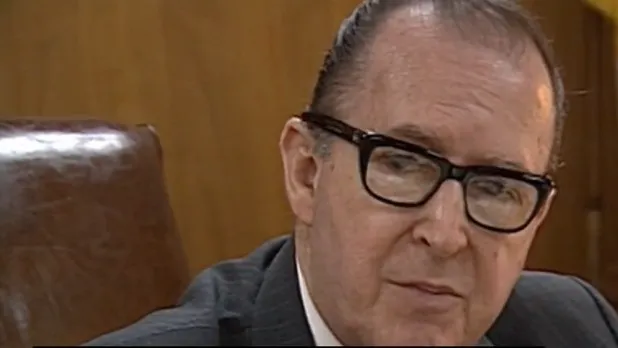
William “Bill” White had just called his client to the witness stand to testify. It was the assistant public defender’s first jury trial before Jacksonville Circuit Judge R. Hudson Olliff, and he began his questioning by addressing the defendant, a Black man in his 20s, as “Mr. Ponder.”
Jacksonville Today thanks our sponsors. Become one.
Judge Olliff cut him off and summoned White to the bench.
Olliff admonished him, in a hushed tone, that courtesy titles like “Mister” were reserved for white people in his courtroom: “We don’t call Blacks and children by their last name. You should call him by his first name.”
That scene, relayed by White in sworn testimony taken years later, was from the 1970s, when the wounds from Jacksonville’s Jim Crow era were fresh and city leaders were still struggling to desegregate the schools.


Jacksonville Today thanks our sponsors. Become one.
Over the next two decades, Olliff became one of Jacksonville’s most high-profile jurists, known for his harsh approach to crime and the defense bar. He sent at least 12 men to death row in his nearly quarter-century on the bench, during which Jacksonville’s Black population swelled.
Those who found themselves in his chambers, a judge’s private sanctum, say he would sometimes say things about Black people that raised questions about whether such defendants would find equal justice in his courtroom.
A decade after Olliff’s death, at least one of his death row cases remains very much alive. An evidentiary hearing is expected to take place before Circuit Judge London Kite in Hartley v. Florida, the appeal from Kenneth Hartley, who was convicted and condemned to death in 1993 for the kidnapping and killing of a teenage drug dealer.
Except for Olliff, the attorneys and a jailhouse informant, virtually everyone connected is, or was, Black, including the defendants, the eyewitnesses and the victim, Gino Mayhew.
The planned evidentiary hearing comes on the heels of a series of articles by The Tributary that examined the investigation and prosecution of Hartley, finding that, in the absence of any physical evidence tying him to the murder, prosecutors pinned their case on the word of a man who had a proven track record of lying under oath, which the jury was never told.
Those stories focused on the actions of the police and the prosecutor and revealed that a slew of jailhouse informants may have concocted their testimony with help from the state.
This is the story of the judge who oversaw the factually wobbly case and who made a habit of doling out death sentences even when it meant overriding juries that recommended mercy.
An open secret
Ten years after Olliff’s death, an examination by The Tributary of his legacy — built on interviews with attorneys who practiced in his courtroom and others who knew him, and reviews of reams of court records, including little-noticed sworn statements about Olliff’s closed-door behavior — shows that Olliff’s retrograde views on race were an open secret in the legal community but less understood by the broader public.
Those outside the legal profession were instead regaled with tales about his colorful quips, his packing a firearm under his robes and his lock-them-up-and-throw-away-the-key mentality, which could elongate the appellate process.
To this day, Olliff’s cases continue to ricochet around the court system.
It is difficult, from a review of the full transcript of State v. Hartley, to draw a straight line between anything Olliff did — or any attitudes on race he might have had — and the outcome of the case, other than imposition of the death penalty, which was the judge’s calling card. In Hartley’s case, that was in keeping with the jury’s 9-3 recommendation.
He did deal the defense a setback when he refused a request by defense attorney Robert Willis to introduce testimony about an alternate suspect who purportedly had confessed to acquaintances — an issue that has since come up on appeal.
But his alleged comments about race were well known among local attorneys and have since become a matter of court record, laid out in writing by the defense in one prior death penalty appeal in a chapter headlined “Judge Olliff and the Etiquette of Jim Crow.”
“It was problematic to be a Black person in [Olliff’s] courtroom,” said Frank Tassone, a ’70s prosecutor who later, in private practice, represented condemned inmates in their appeals, including one of Hartley’s codefendants, Ronnie Ferrell. “I think anyone in those days who handled cases would say the same thing.”
For the 250-plus people on Florida’s death row — many dating back to a time when Olliff’s views were less of an outlier among southern judges — capital appeals like Hartley’s have taken on added urgency. Florida Gov. Ron DeSantis has been signing death warrants on decades-old cases at an unprecedented pace. On Dec. 18, Florida racked up its 19th execution this year, far exceeding the state’s previous record.
That list of the executed includes Michael Bell, who was sentenced by Olliff in 1995 and was put to death in July. Bell’s appeal echoed some of the same concerns about prosecutorial misconduct — centered on the same prosecutor and Jacksonville Sheriff’s Office detective — that Hartley’s attorneys and The Tributary have raised.
Three of Olliff’s death sentences have been remanded to life, including the one he imposed on Ferrell, Hartley’s codefendant. A third co-defendant, Sylvester Johnson, is also serving a life sentence.
Along with Hartley, two other men whom Olliff put on death row remain there.
‘Not a wimp’
Olliff earned a title as Jacksonville’s hanging judge because of his prolific track record of sending men — Black and white — to Death Row.
He was known in courthouse circles for favoring the state, sometimes offering up tips to prosecutors on how to shore up their cases. After Hartley’s conviction, Olliff dashed off a glowing letter to the elected state attorney praising prosecutor George Bateh’s “unparalleled accomplishment” in getting a guilty verdict. As Hartley had not yet been sentenced, the case was still on Olliff’s docket when he sent the letter.
If Olliff liked prosecutors, the affection was mutual. On the occasion of his death in 2015, then-State Attorney Angela Corey described him as “larger than life.”
“I absolutely adored Hudson Olliff,” she said. “He was one of the finest judges we ever had.”
Ralph Greene, a longtime prosecutor, told The Tributary, “I never felt he was sentencing a Black man or woman any differently, and I handled many trials in his courtroom.”
In 1994, an 18-year-old American named Michael Fay was sentenced in Singapore to six lashes with a cane — a vicious form of flesh-ripping punishment outlawed in most countries — for vandalizing a car. It stirred furious debate in the United States, with many Americans calling the punishment barbaric. WJXT, putting together a local story on the global controversy, knew which Jacksonville judge might offer a contrary view.
Oliff said rather than complain or plead for mercy, the teen ought to shut up except to say: “I’ll take the caning and be a man about it.”
His punishment was reduced to four lashes.
If Olliff won praise from defense attorneys, it was often the grudging kind — sometimes because they said he forced them to become better by making their jobs more difficult.
“I am not popular with defense attorneys, and I know that,” Olliff once told the Florida Times-Union. “Because I’m not a wimp.”
Product of war
Olliff’s experiences as a boy growing up during the Great Depression molded him, according to his son R. Hudson Olliff III, who works in real estate in Alabama and who says his father, although a disciplinarian, “treated everyone fairly.”
Also clearly shaping the judge’s outlook were his experiences in the bloody European Theater of World War II, where he served with valor, earning a Bronze Star. His obituary says he dropped out of Andrew Jackson High to enlist.
His warrior ethos shone through in Florida v. Ernest Dobbert Jr., a grim case in which a man killed his son and daughter and tortured two of his other children. Grisly facts or no, the jury, by a 10-2 vote, recommended he receive life in prison instead of death.
Olliff had the final say. As he would do several times in his career, he disregarded the jury’s vote and imposed a death sentence.
He wrote: “My experience with the sordid, tragic, and violent side of life has not been confined to the Courtroom. During World War II, I was a United States Army Paratrooper and served overseas in ground combat. I have had friends blown to bits and have seen death and suffering in every conceivable form.”
“I am not easily shocked or (a)ffected by tragedy or cruelty, but this murder of a helpless, defenseless and innocent person is the most cruel, atrocious and heinous crime I have eve[r] personally known of — and it is deserving of no sentence but death.”
In State v. Carnes, another capital case, he rolled out the same preamble, with a couple of tweaks, capped off by another death sentence.
In State v. Lewis, Olliff’s sentencing statement followed a similar path: a cut-and-paste of the paratrooper paragraph, followed by “… but this was an especially heinous, atrocious and cruel crime — and deserving of no sentence but death.”
As the death sentences piled up, winding their way through upper-level courts, appellate judges began to take note, with U.S. Supreme Court Associate Justice Thurgood Marshall, the court’s first Black member and a staunch death penalty opponent, critically noting the “boilerplate” language in Olliff’s judicial pronouncements
It was in the eventually successful appeal of Jacob John Dougan’s death sentence, for the murder of a random white hitchhiker in a quest to unleash a race war, that Bill White — as part of a pleading submitted under oath to the court — described his own racially tinged interactions with the sentencing judge.
In addition to the don’t-call-him-Mr.-Ponder admonition, White said he once walked out of the judge’s chambers aghast as an attorney began to share a crude joke — a racist story about a mythical, slow-witted Black man. Everyone was chuckling, he said, including the judge.
“As a child, and being up in Georgia where my relatives were, I had heard those. I recognized it right away for what it was, and I got up and left,” White said.
“[Later], when he came into the courtroom, the judge asked me why I had left chambers. And I told him it was because of the joke. And he said: ‘Well, there were no Black attorneys in the room, so it shouldn’t have been a problem.’”
To White, the absence of a Black attorney was not the point.
Under questioning, White, who has since retired, related how Olliff once summoned him into chambers to object after White, by then a top assistant to the elected public defender, assigned Ed Dawkins, a Black lawyer, to his courtroom. Although the judge wasn’t explicit about the reason for his objection, White said it was clear to him that the issue was Dawkins’ race.
Dawkins, a pioneering Black graduate of the University of Florida’s law school, said White’s story, as passed along by a Tributary journalist, was news to him. However, he wasn’t particularly shocked to hear it.
“He was a different kind of judge,” said Dawkins, who is winding down his law career decades later. “Everybody told me he was an A-hole. He was one of those guys. [But], you meet him outside [the courtroom], and he was perfectly nice.”
Tassone, the prosecutor-turned-defense attorney, said Olliff was “a bright guy” who “in my opinion did not act appropriately, especially with Black individuals.”
In the killing aimed at igniting a race war, Dougan had a codefendant, Elwood Barclay, who received a death sentence from Olliff despite the jury’s voting 7-5 to spare his life.
In support of his decision to override, the judge listed several statutory aggravating factors, which is a legally required step to support a sentence of death. And then he tacked on one more that’s not prescribed in any statute: preaching hatred of white people.
That left some U.S. Supreme Court justices puzzled over why the sentence had not been overturned by the Florida Supreme Court.
But, just like the Florida justices, they let the sentence stand, although dissenting Associate Supreme Court Justice Harry Blackmun declared: ”The errors and missteps [of the Florida courts] — intentional or otherwise — come close to making a mockery of the Florida [death penalty] statute.”
Olliff’s handling of Barclay’s death sentence — which would later be reduced to life amid a fresh wave of appeals — is described in a 1983 New York Times Magazine article headlined “Death Row on Trial.”
Although some of Olliff’s death sentences, including Dobbert’s, have been carried out, several have been reduced to life behind bars. Besides Dougan’s and Barclay’s, they include Michael Shellito and Robert Fieldmore Lewis.
In more than one case, appellate lawyers pointed out that Olliff, improbably, found zero mitigating circumstances to stack up against multiple aggravating ones.
But Olliff was resolute, even when rebuffed by higher courts. He sentenced Dougan to death on three separate occasions for the same crime, in 1975, 1979 and 1987.
That would not be the end of Dougan’s odyssey through the legal system. In 2016, 40 years after Olliff first sentenced him to die, the Florida Supreme Court ruled that Dougan was entitled to yet another trial.
Nine years later, Dougan, 78, is listed as an occupant of the Duval County jail, still awaiting his latest retrial. He has outlived Olliff by a decade.
‘Injudicious under the circumstances’
Olliff and the state’s highest court had a history. In 1976, Olliff was pressured by the state’s chief justice to issue a written apology after Olliff conducted a courthouse news conference in his judicial robes to rail against his reassignment from criminal to civil court, which he blamed on Chief Circuit Judge Major Harding.
Olliff said the transfer was a punitive action taken because Harding didn’t agree with his “hard-on-crime” stance. He threatened to sue. Other judges were startled by what they considered an egregious breach of decorum by Olliff, according to a news story at the time.
The apology — whose contents were largely dictated by then-Florida Chief Justice Ben Overton, according to a note between the two men — was dutifully sent by the judge to local newspapers and TV stations.
“The statements I made on Wednesday, November 17th, no matter how sincere or well-intended, were injudicious under the circumstances,” he wrote.
“I will perform my judicial assignment to the best of my ability and will assist any new felony judges in any way requested.”
The reassignment to civil was not permanent, and Olliff would shift back into criminal court, where he grew to relish the spotlight afforded by high-profile trials.
Lawyers said Olliff was known for scheduling them in a manner to maximize news coverage. According to White, who would eventually become Jacksonville’s elected public defender, Olliff even allowed a local news reporter to type up stories about the doings in his courtroom from his chambers.
All the while, the judge would dish out the harshest justice possible while making statements that gave lawyers practicing in his courtroom pause.
“He was a good trial judge, but if you lost, you could expect ‘the policy limits’’’ — the maximum sentence, said Robert Link, a longtime Jacksonville attorney.
If it was a crime involving a Black defendant and a Black victim, especially one that was not a capital case, it might get less attention, lawyers said. Link remembers Olliff, in chambers, dismissing lesser such crimes as “Ashley Street social encounters,” referring to a predominantly Black part of Jacksonville.
Alan Chipperfield, a former public defender, remembers another term Olliff used for those crimes. “He used the abbreviation NHI, which meant No Humans Involved. … That is a comment that would have been made in chambers.”
Death of a teenager
But there were also crimes involving Black defendants and victims that garnered the most severe punishment when they landed in Olliff’s courtroom. The killing of Gino Mayhew, on the night of April 22, 1991, was one of those.
The case against Hartley — and the other two men arrested and tried separately — largely hung on the testimony of Sidney Jones, a drug dealer who doubled as a longtime paid undercover informant for Jacksonville detectives.
Jones told the jury he watched as Hartley, 24, and codefendant Ferrell, 27, abducted Gino Mayhew, 17, at gunpoint as Mayhew sold drugs outside an apartment complex in northwest Jacksonville. Jones said the two men forced Mayhew into the victim’s Chevy Blazer, which then sped away, with Mayhew behind the wheel, trailed by a purple truck driven by the third subject, 23-year-old Sylvester Johnson.
Mayhew was found the next day, slumped over in the front seat of the abandoned Blazer. He’d been shot in the head.
What jurors were not told was that Jones, who had been helping Mayhew by steering customers his way amid a buzzing bazaar of competing drug peddlers, had recently been “blackballed” — dismissed as unreliable by Jacksonville detectives. And, even more significantly, jurors weren’t informed that he had been convicted of perjury and sentenced to prison for his testimony in a previous murder case.
In that earlier legal saga, he gave elaborate testimony to personally witnessing certain events when, in fact, he could not have witnessed them because he had been in jail at the time. His story quickly unraveled.
The prior perjury conviction was overturned on appeal because the judge had opted not to give Jones a chance to return to the witness stand and correct what he had previously stated falsely under oath. Nonetheless, there was no doubt that Jones had demonstrated a willingness to lie on a witness stand.
In pretrial pleadings in the Hartley case, defense attorney Willis asked Bateh, the prosecutor, if there were any state witnesses who had committed perjury in the past. Under a legal requirement called the Brady Rule, the prosecution is obliged to share information of that nature — exculpatory evidence that could be beneficial to the defense.
Bateh answered that he was aware of no such thing but that Willis could consult the state’s records.
If Olliff took note of the lack of disclosure, the record gives no indication.
Another key witness against Hartley, Juan Brown, had his own credibility problems.
A window tinter with a long arrest record, Brown testified that he and two others were heading north in a Burgundy Catalina on Moncrief Road around 11:30 p.m. when he spotted his friend Mayhew’s Blazer heading toward him in the dark. He said he was able to make out Ferrell, another acquaintance of his, sitting in the front passenger seat, with an additional man — his face unrecognizable but a light-skinned Black man like Hartley — crouched in the back.
The Blazer would have been heading in the direction of Sherwood Forest Elementary School, where Mayhew and his vehicle were found the next morning.
A crime reconstruction expert hired by the defense, using similar vehicles, found that it was impossible to replicate what Brown said he saw. Under the conditions described — darkened streets, vehicles approaching each other from opposite directions at approximately the speed limit — there would have been no way to discern the facial characteristics of someone in the passenger seat of the oncoming Blazer, the expert found.
The two others purportedly riding with Brown, who might have vouched for his story, in theory, were not identified or deposed.
In Hartley’s trial, three men who were in jail at the same time said that Hartley had confessed to them that he had committed the murder. They testified for the prosecution.
Legal teams working on his appeal have since submitted a sheaf of sworn affidavits from other jail detainees who said the witnesses admitted making up their stories about Hartley confessing, coordinated their efforts with each other, and tried to solicit other cellmates to back them up. Their reward was to be a drastic reduction in whatever sentence they might receive when their own cases were adjudicated, which indeed occurred.
Those signing the affidavits said a Jacksonville Sheriff’s Office detective brought coffee and donuts to the jail to encourage the witnesses’ participation and also fed them information from police files to help them make the “confessions” align with the evidence. The detective cited in the records refused to discuss the allegation with The Tributary.
Based largely on the above facts — and despite his fingerprints not matching those found in the Blazer — Hartley was convicted. It was the second go-around for Hartley, who had previously been incarcerated for manslaughter in the fatal shooting of his teenage girlfriend in an incident he claimed was an accident.
Unlike several other cases overseen by Olliff, the Hartley jury recommended the defendant be sentenced to death for Mayhew’s murder. Olliff obliged.
A trial, but in miniature
An evidentiary hearing like the one planned for Hartley’s case is sometimes described as a mini-trial. But there is a crucial difference: There is no right to a jury. The judge decides.
The scope of the hearing will be determined by Judge Kite, who could, in the end, throw out the conviction and order a new trial, rule that the conviction was proper but void the death sentence, or let things stand as is.
In preparation, Hartley’s attorneys have been requesting that documents used to build the case against Hartley be placed in the state’s Capital Postconviction Records Repository, a system set up to streamline the appeals process in capital cases. The wheels have been grinding slowly, with the appellate lawyers requesting decades-old documents and the state trying to comply.
The hearing also could delve into the testimony of the jailhouse informants who pointed the finger at Hartley.
All three, men with criminal records facing new felony charges, swore in front of Olliff and the jury that prosecutors had promised they would be sent away to prison for several years — but for less than the legal maximum — provided they testified truthfully.
In fact, none spent a day in prison for those crimes, including one who ultimately received his sentence from Olliff.
If what is presented at the hearing undermines the case against Hartley, the ripples could affect his two codefendants. Other than a different set of jailhouse informants, the cases against Ferrell and Johnson largely mirrored Hartley’s, with each of them tried before Olliff.
At any future trial, a defense attorney could destroy key witness Sidney Jones’ credibility simply by citing his earlier documented lies under oath.
Hartley’s appellate attorneys would not speak to The Tributary; nor would Jones.
No evidentiary hearing date has been set.
This story is published through a partnership between Jacksonville Today and The Tributary.