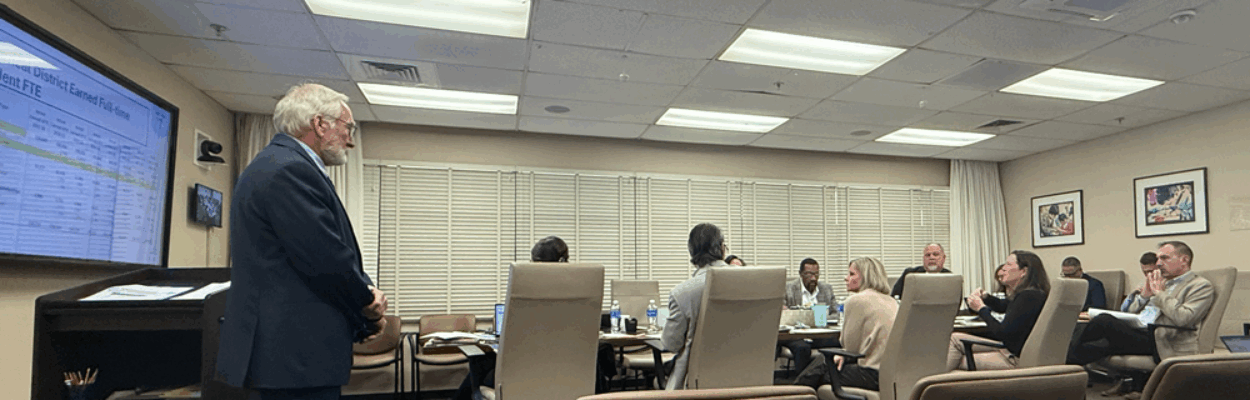
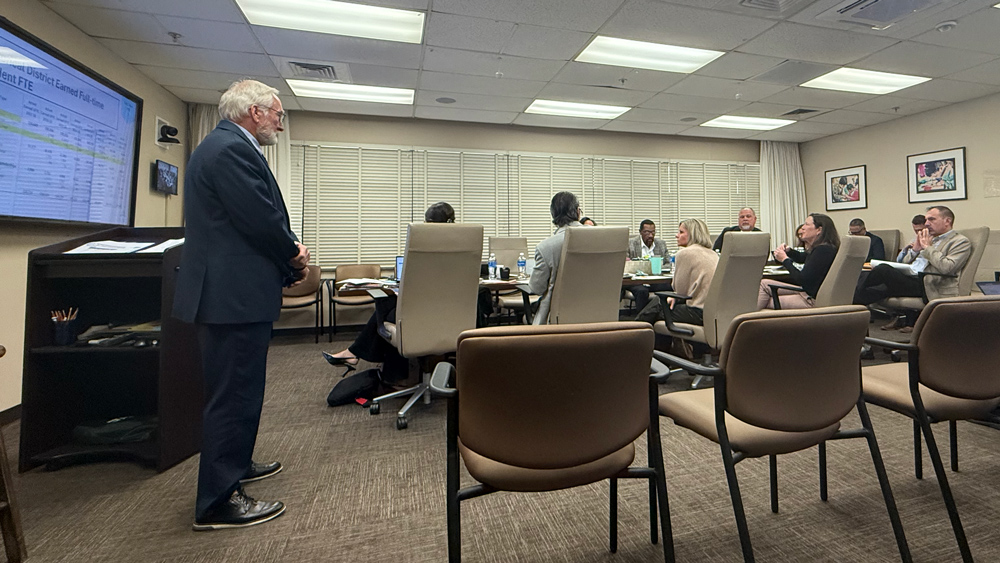
Duval Schools CFO Ron Fagan, left, gives a presentation to school board members about the district's finances on Dec. 8, 2025. | Megan Mallicoat, Jacksonville Today
Published on December 10, 2025 at 9:07 pm
Free local news and info, in your inbox at 6 a.m. M-F. Sign up for the Jacksonville Today newsletter.
Duval Schools’ financial position is “strong,” according to its CFO, and what Superintendent Christopher Bernier characterized as “$100 million debt” was, in reality, a “projection of a potential” reduction in the district’s reserves that never came to pass.
The district’s finances have come under scrutiny after Bernier repeatedly invoked the “$100 million debt” while encouraging the School Board to close schools over the past year.
Jacksonville Today thanks our sponsors. Become one.
State Rep. Kimberly Daniels, D-Jacksonville, this week wrote to district officials, demanding proof of the budgetary crisis that, she said, was used to justify closing schools.
“That number shaped public opinion and became the primary justification for school closures and program reductions,” she wrote. “However, the district’s own financial documents reflect reserve levels and fund balances that do not align with the picture of a crisis requiring drastic cuts.”
Daniels wrote that the district’s “actions created confusion, and some community members now question whether a budget crisis ever existed.”



Jacksonville Today thanks our sponsors. Become one.
She requested a list of documents and written responses to a series of specific questions about Duval Schools’ finances and the decision process behind the recent school closures.
“This inquiry gives the district a clear opportunity to address those concerns directly, explain its decisions, and provide the documentation needed for public understanding,” Daniels wrote. “Once I review the district’s formal response, I will determine whether any further action is appropriate.”
In a board workshop this week, CFO Ron Fagan said the district “got lucky” during the last fiscal year, and with the last of some one-time COVID-era federal funding, was able to “right-side the ship.”
In an interview with Jacksonville Today afterward, Fagan took responsibility for the $100 million number.
“At that point in time, that was the impression I gave the superintendent,” Fagan said. “So you can put in your notes that Ron Fagan advised the superintendent that ‘the sky is falling, you’re heading for a trainwreck, based upon what I’m seeing, we’re gonna be in some serious trouble.’”
In a written statement, district spokesperson Arwen FitzGerald called the oft-repeated $100 million figure “a legitimate projection of a potential shortfall.”
How much money does a closed school save?
Since Bernier took over in July 2024, the school board has voted to close eight elementary schools, with several more in queue for consideration.
Last year, a consultant created a list of about 30 schools it suggested closing. The communities of several of the schools were vocally opposed to the closures. They made signs and T-shirts, protested at board meetings and asked the district to keep their schools open. Ultimately, many of them successfully advocated against closing.
Six schools weren’t so lucky; a year ago, the board voted to close three schools at the end of last school year and three more at the end of the current school year. Last week, a new board voted to close two more.
Since 2020, Duval Schools has shuttered a total of 13 schools — creating a total multi-year savings of about $22 million. However, district data presented to the board last month show some of the savings is negated when, on average, 15% of the students of closed schools leave Duval Schools entirely. Funding is determined according to enrollment, so the exodus reduced the actual savings to nearly $8 million.
Despite Bernier’s warnings that closures are necessary to avoid the loss of jobs and other deep spending cuts, the district recently cut nearly 500 positions — though the district says many of those were vacancies, and the majority of employees who lost roles were reassigned elsewhere. The exact number of staff cuts was not provided by this story’s publication.
At the same time, the district this year spent $15 million to decrease elementary class sizes and gave employees a 2.9% raise, according to Bernier during the board workshop.
A primary metric the state Education Department uses to monitor the financial health of its school districts is to watch the bottom line figure for their reserve accounts. State statute requires a balance equal to at least 3% of a district’s overall budget. District data show Duval ended its last school year with a balance of 13%, which a spokesperson says was reduced to 5% when money earmarked for building construction, extended day programs and required reserves was removed.
“Thanks to proactive steps, the district has avoided an immediate crisis,” FitzGerald wrote. “As we look ahead, we’re working closely with families and community partners to explore sustainable options for a system with nearly 30,000 unfilled seats, including, but not limited to, school consolidations. Throughout this process, our priority is serving all Jacksonville families with safe, accessible, and well-resourced schools.”