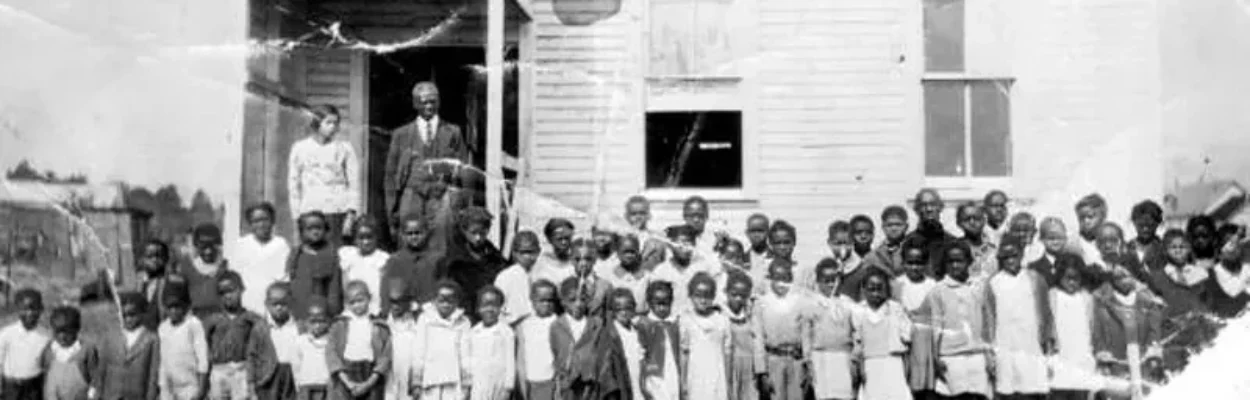
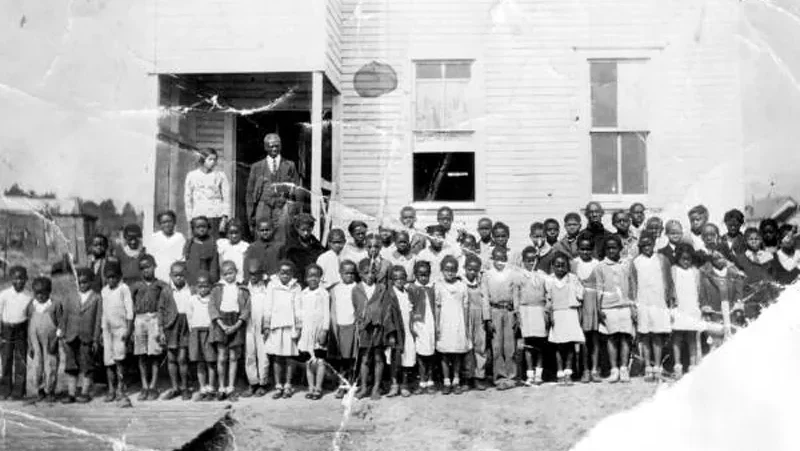
North Riverside's West Lewisville Elementary School was replaced by Forest Park Elementary in 1954.
Published on December 3, 2025 at 11:23 am
Free local news and info, in your inbox at 6 a.m. M-F. Sign up for the Jacksonville Today newsletter.
Surrounded by McCoys Creek and Interstates 10 and 95, North Riverside is a collection of several small subdivision plats developed in the early 20th century during the aftermath of the Great Fire of 1901. Here’s a photographic journey into the history of various sites in a neighborhood significantly affected by heavy industry and expressway construction.
Our Lady of the Angels Catholic Church

Our Lady of the Angels Catholic Church was the second Roman Catholic parish established in Jacksonville. Founded in 1915, it was created to serve the city’s expanding population in the years following the Great Fire of 1901. After decades of declining membership, the church at 2701 Edison Ave. closed in 2002. Since 2014, the historic building has been managed by the Clara White Mission and repurposed as an event venue, giving the former parish a renewed role in the community.
Jacksonville Today thanks our sponsors. Become one.
Jones-Chambliss Meat Packers

The Jones-Chambliss Co. was incorporated in 1911 by Charles A. Jones and John O. Chambliss. That same year, Chambliss and several partners established the Jacksonville Cattle Co. at 406 Forest St., a slaughterhouse in the middle of an established African-American neighborhood. In 1916, a brick abattoir designed by Prairie School architect Ransom Buffalo was added, and by 1920 Chambliss had become president.
In 1921, Chambliss, Jones and Alfred H. Goedert formed Jones-Chambliss Meat Packers, operating the Forest Street facility and marketing “Better Brand Products.” The complex expanded through the 1930s, adding new buildings, cattle pens and a dog food plant. Conditions were difficult; former worker Marie Hendricks Brooks recalled long hours for as little as 20 cents per hour. Workers went on strike in 1949.
Under Goedert’s leadership, the company won military contracts, prompting major expansions, including Henry’s Hickory House in 1966. The 1970s brought decline as federal price controls disrupted the industry, leading to layoffs. The original slaughterhouse closed in 1980.
Jacksonville Today thanks our sponsors. Become one.
In 1988, the Goedert family sold the property to William “Billy” Morris. Bubba Foods later operated the site, producing millions of pounds of bacon annually until closing in 2010. In 2015, Peterbrooke Chocolatier converted the former Hickory House plant into its headquarters, beginning a new chapter for the historic industrial property.
Forest Park Elementary School

Forest Park Elementary opened in 1954 as a replacement for the smaller West Lewisville Elementary School. Located at the intersection of Forest and Goodwin Streets, the new school quickly became a central educational institution for the neighborhood, enrolling 744 students by 1955.
In 1971, Forest Park was among eight all-Black inner-city schools in Jacksonville ordered to close following U.S. District Judge Gerald Tjoflat’s ruling mandating extensive crosstown busing in Duval County. At the time, officials argued that these schools could not meet the required 70/30 white-Black teacher ratio, citing concerns, rooted in the racial biases of the era, that white teachers would be unwilling to work in predominantly African American neighborhoods.
The site entered a new chapter in 2020, when Jacksonville Classical Academy opened on the former Forest Park Elementary School campus.
Forest Park Community Center

The Forest Park Center was built by the National Youth Administration during the Great Depression. Established in 1936, the NYA was a federal agency championed by First Lady Eleanor Roosevelt under President Franklin D. Roosevelt’s Works Progress Administration. Its mission was to provide relief, training, and employment opportunities for young people and women during the Great Depression. The NYA’s programs for African Americans were led by Mary McLeod Bethune, a national adviser to President Roosevelt and a towering civil rights advocate often called “The First Lady of the Struggle” for her lifelong work to improve opportunities for Black Americans.
Constructed in 1940 by the youth administration, the Forest Park Center stands as a longstanding North Riverside community landmark and a tangible legacy of the collaboration between Eleanor Roosevelt and Bethune. Together, their efforts created a space dedicated to the advancement of African American youth, one that continues to hold meaning for the neighborhood today.
McCoys Creek

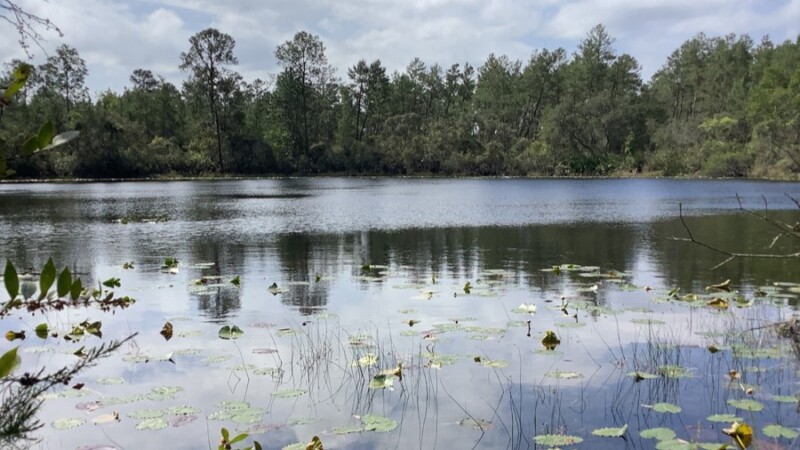
McCoys Creek forms the western and northern boundaries of North Riverside, shaping both the neighborhood’s geography and its history. Long prone to flooding, the creek became the focus of a major public works effort in the early 20th century. On September 11, 1930, the city of Jacksonville completed the $610,000 initiative that added a bulkhead along the creek, seven new bridges and a public park. The Atlantic Coast Line Railroad also invested in the effort, contributing $50,000 toward construction of a new concrete railroad bridge spanning the re-engineered channel and McCoys Creek Boulevard.
Today, McCoys Creek is once again at the center of significant investment. The city of Jacksonville, in partnership with Groundwork Jacksonville, is leading an ambitious restoration initiative designed to return the waterway to a more natural, ecologically healthy and resilient condition, reshaping it for the next century of neighborhood life.
Edison Avenue
Edison Avenue’s role as a major neighborhood commercial corridor can be traced to the early 20th century, when Jacksonville’s westside was rapidly transforming. The Great Fire of 1901 accelerated growth across the city, prompting reconstruction efforts and new residential development spreading outward from downtown. In 1903, Seaboard Airline Railroad established its maintenance shops along McDuff Avenue. This industrial investment spurred the emergence of the Lackawanna neighborhood by 1907. To link the growing neighborhood and its workforce with Downtown, a streetcar line was built along what was then known as Lackawanna Avenue, today’s Edison Avenue.
By 1909, the SAL shops and terminals employed roughly 1,000, anchoring the area as a major employment center. The streetcar line made Lackawanna (Edison) Avenue an attractive location for commercial activity, and businesses soon clustered along the corridor to serve both nearby residents and the railroad workforce.
By the 1930s, the avenue was home to a diverse mix of enterprises, including the Great A&P Tea Company grocery, Sam Crews Blacksmith, Louis Fleet’s shoe repair shop, George Sumner’s dry goods store, Lackawanna Hardware Company, and Michael Schneider’s grocery. Together, these establishments formed a bustling commercial strip central to daily life in the neighborhood.
However, Edison Avenue’s prominence as a neighborhood commercial thoroughfare began to wane with the construction and opening of Interstate 10 in the 1960s. As automobile-oriented development patterns reshaped Jacksonville and diverted traffic away from traditional streetcar corridors, the once-thriving Edison Avenue commercial district entered a period of decline.