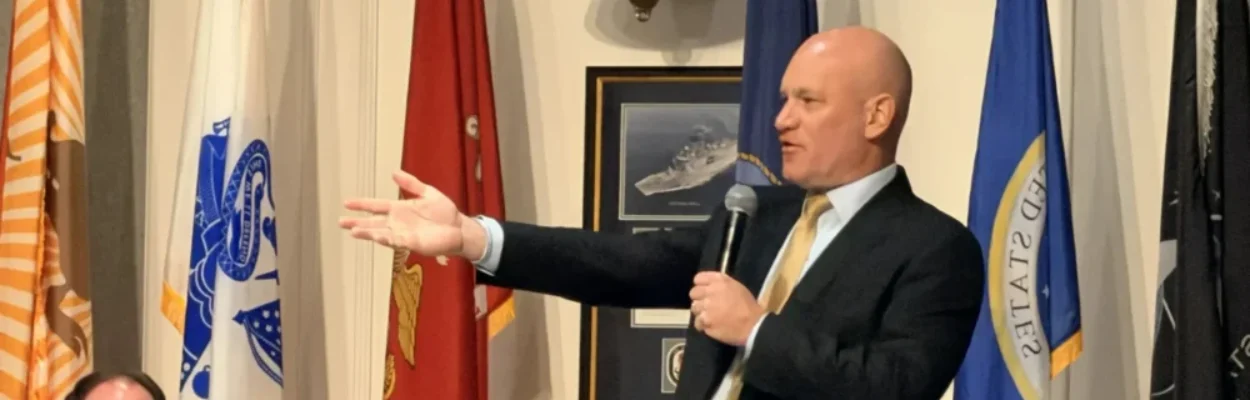
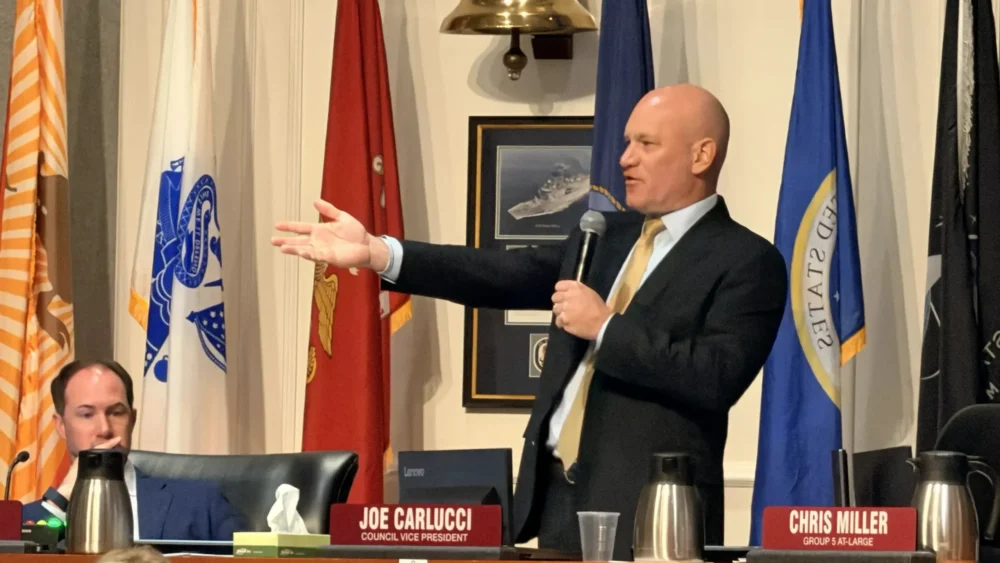
Council President Nick Howland talks on budget night, Sept. 22, 2026. | Mike Mendenhall, Jacksonville Today
Published on September 27, 2026 at 3:48 pm
Jacksonville Today seeks to include a diverse set of perspectives that add context or unique insight to the news of the day. Regular opinion columnists are independent contractors who are not involved in news decisions. Want to submit your own column on a matter of public interest? Email pitches to jessica@jaxtoday.org.
As compared to the shambolic budget vote last year, this year’s 18-1 ratification of Jacksonville’s $2 billion general fund budget was a model of efficiency.
The amendments were worked through quickly and with an eye toward compromise, as exemplified by former President Ron Salem’s work to ensure $4.9 million in affordable housing funding made it into the final document, as he carried a Matt Carlucci proposal to viability.
Jacksonville Today thanks our sponsors. Become one.
Raul Arias also scored a win with a floor amendment: to use $237,427 from the Public Safety Contingency to pay membership dues for Florida Association of Counties ($110,915), Florida League of Cities ($72,488), National Association of Counties ($19,878), and National League of Cities ($34,146).
And while the Cultural Council didn’t get its $2.45 million in grants moved above the line as Jimmy Peluso wanted, assuming Amendment 3 doesn’t prevail in November, they’ll end up getting the money anyway after the election.
Rahman Johnson’s curious proposal to spend $500,000 on remodeling council offices and apparently remediating mold along the way was withdrawn, which is just as well given it was a lightning rod for criticism almost as soon as the floor amendments were released over the weekend.
Jacksonville Today thanks our sponsors. Become one.
We didn’t get the drama over diversity, equity and inclusion language in the budget this time around, as we did in 2025. Council President Nick Howland did the necessary and unglamorous work of prioritizing practical concerns over symbolic battles.
It was the right play and a direct contrast to the bellicose bombast of his immediate predecessor.
As President Lincoln said at Gettysburg, the world will little note nor long remember the 2026-27 budget cycle. And as someone who has spent much of his adult life covering these processes, I can tell you that beats the alternative.
With that in mind, what does it mean for the next big event on the local docket: the 2027 municipal elections?
While we still expect Republican Rep. Wyman Duggan to get in the race for mayor, presenting a serious and well-capitalized challenge to Mayor Donna Deegan if and when he does, the lack of drama in the budget process removed a potential line of attack against the Democratic chief executive.
The knock on Deegan, pushed relentlessly by critics who might have expected to be in and around the mayor’s office had the 2023 election gone differently, is that she supposedly is a better communicator than administrator.
However, isn’t communication what the job calls for ultimately?
The mayor isn’t the one prowling around City Hall in the way Sam Mousa did way back when, making sure the departments are on point. That job is Mike Weinstein’s these days, and he has been in the game a long time. He’s done a good job of defusing potential issues this administration has faced. Barring some improbable big hurricane in a few weeks, there likely won’t be any catastrophes between now and the March “first election.”
And scandals ginned up by Republicans the last few years – such as the staffer who warned people about ICE stakeouts, the airport hologram, and the “gun registry” – have been in the back of the icebox for a long time, running the risk of tasting like freezer burn if rehashed next year.
The mood seems to have changed statewide and locally. Polling shows that even though Democrats haven’t been able to match GOP fundraising, they – David Jolly, Angie Nixon, and the rest – appear to be capitalizing on a Republican message that is complicated by national headwinds.
Democrats often do best in polls before voters start voting, such as in 2018 when surveys showed Andrew Gillum and Bill Nelson winning over Ron DeSantis and Rick Scott. But the effect this time around is that Tallahassee may be able to pour money into races, but they don’t really have a messenger who is motivated to wade into Jacksonville and make the case that Deegan must go.
While there are no sure things in politics, Deegan is well-positioned at this writing to get four more years.
Whether a second term would go as smoothly as the first is an open question; the last mayor to get a drama-free eight years may have been John Delaney, who also understood instinctively that the best politics is that of the golden mean. But what’s clear is that a budget cycle that could have been used to undermine the Mayor’s Office largely served to reinforce its authority.