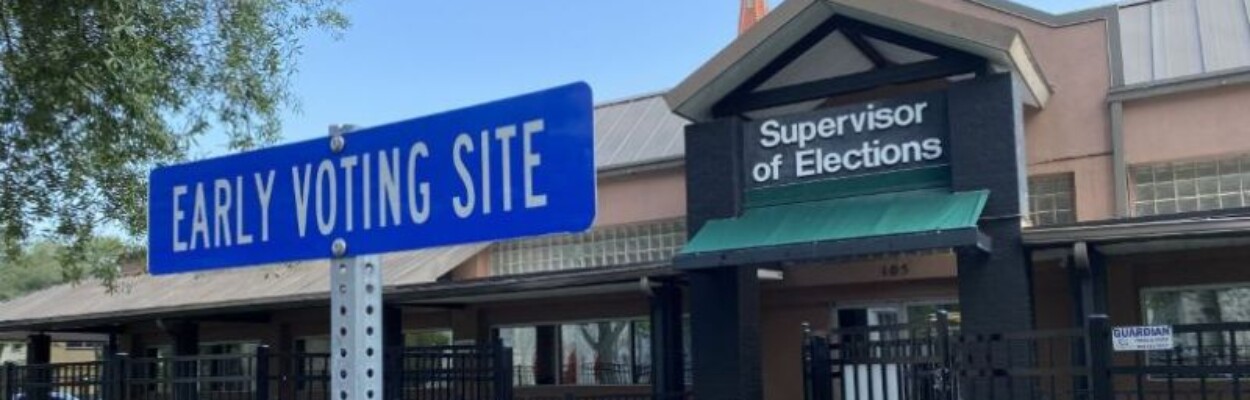
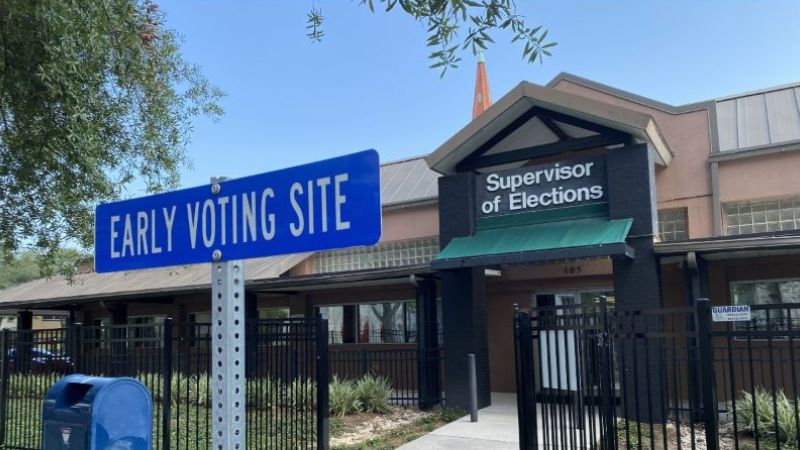
The Duval County Supervisor of Elections Office l Steven Ponson, Jacksonville Today
Published on July 5, 2026 at 3:00 pm
Jacksonville Today seeks to include a diverse set of perspectives that add context or unique insight to the news of the day. Regular opinion columnists are independent contractors who are not involved in news decisions. Want to submit your own column on a matter of public interest? Email pitches to jessica@jaxtoday.org.
The last tranche of legislative vetoes are in the books now, with Gov. Ron DeSantis having wrapped the material passed by the Legislature at last.
He took out local priorities ranging from money for Edward Waters to bulletproof vests for K9s, so as usual Northeast Florida gets fragged.
Jacksonville Today thanks our sponsors. Become one.
Out of the carnage, one particular veto jumps out at me as particularly ill-considered, especially if we believe that a key to representative government continuing to function is getting young people involved.
HB 461, which was sponsored by Jacksonville Republicans Rep. Kiyan Michael and Sen. Clay Yarborough, would have let high school students aged 16 and over volunteer at polls, in exchange for community service credit applicable to Bright Futures scholarships.
If it had become law, students could have been a part of the process as soon as next month’s primaries.


Jacksonville Today thanks our sponsors. Become one.
It was hard to imagine any opposition to the legislation. It cleared every stop with unanimous support in both the Senate and House and was supported by the League of Women Voters and the Southern Poverty Law Center.
At one committee stop, Yarborough said the bill would “be one of the greatest firsthand civics lessons” in both universal suffrage and how elections are conducted.
Duval County Supervisor of Elections Jerry Holland made his way to Tallahassee to argue for the legislation on numerous occasions.
For him, the legislation was personal. He wanted his grandson to be able to see how it works and for young people to perhaps be inspired to become election workers by volunteering first.
In the end, it was all wasted effort.
DeSantis, a former high school history teacher himself, worried that high school students would rig elections and said his rejection was because one left-of-center group liked it.
“While the House and Senate sponsors had a noble intent in filing the bill, the application of the bill may result in an avenue for polls to be staffed with volunteers that may not be subject to Florida’s prohibition on single-party registered poll workers for general elections. Given the bill received support in committee by representatives of the Southern Poverty Law Center, this may indeed be the consequence of the legislation,” he said in his veto letter.
There’s a certain irony in a governor who has spent the last few years bragging to audiences around the country about how he left the Florida Democratic Party for dead due to his aggressive use of executive power fretting about undue partisanship.
That spectacle should not distract from the very salient reasons that Florida should find ways to encourage as many young people to be part of the process as possible.
Especially given that DeSantis himself hails Florida elections as a gold standard. If that is true, why not widen the pool of incentivized volunteers?
The leading reason to infuse the process with new blood boils down to demographics.
Poll workers and elections workers, by and large, are older. More than half nationally are over 60 years old, and that tracks with what I’ve seen when at various early voting locations and in my home precinct.
They are competent. But they are not invulnerable to the ravages of time either.
If there is a mechanism to teach young people that a job like that is worth doing and how to do it well, then it’s something we should avail ourselves of.
Beyond Father Time being undefeated, there’s also the question of teaching young people civic responsibility.
Every election cycle, we hear the familiar complaints about young people not caring enough to participate.
This can lead to some interesting imbalances, particularly in local elections, where the median voter is closer to retirement age than to college graduation. As a group, the body politic isn’t thinking about the future and how to build so much as how to protect the status quo in the short term.
Politics sometimes is a functional equivalent of the old “We’re spending our children’s inheritance” license plate. And those children often nope out rather than say yes to civic engagement.
Young people who do get politically active often veer to the extremes, supporting candidates and causes that have no path to victory, often engineered by people or organizations looking to monetize angst or anger.
Working elections may help to balance the scales and teach younger people that the process isn’t their enemy, but is a way to work toward meaningful change and progress.
A new governor will be in place next year. And there is no reason this bill shouldn’t be run again.
It is aspirational policy that benefits the youth, the administration of elections and democracy itself. And if the parade of horribles that concerned DeSantis comes to pass, a future legislature can repeal it.