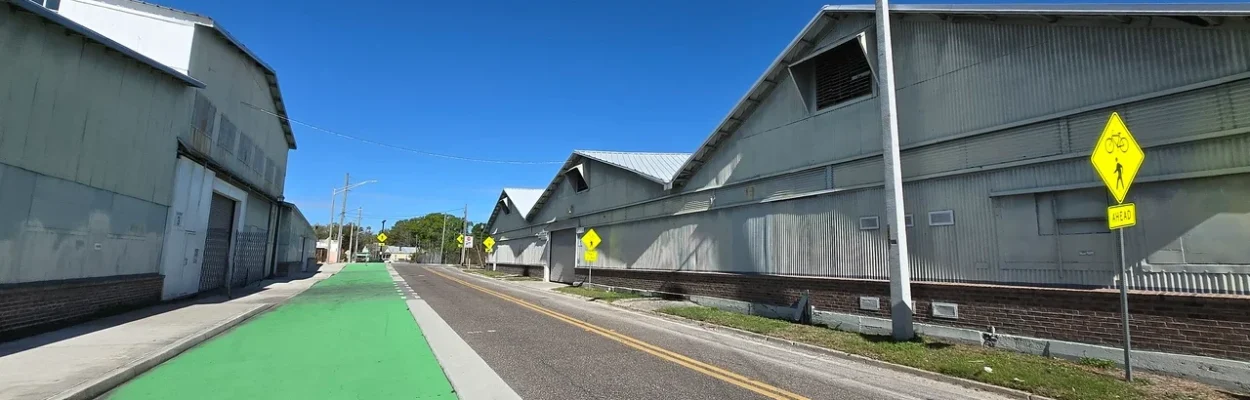
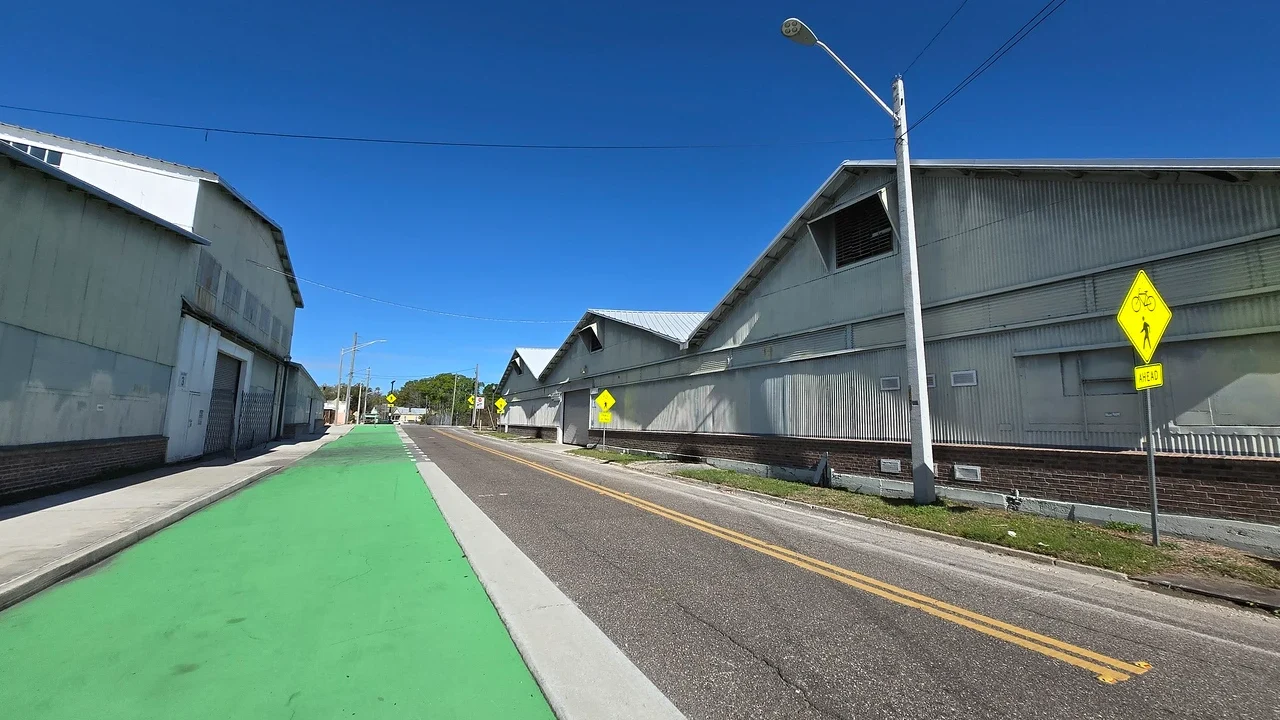
Now situated at the intersection of the Emerald Trail’s LaVilla Link and the S-Line Urban Greenway, the historic Moore Dry Kiln buildings have been repurposed for a variety of industrial and commercial uses.
Published on April 29, 2026 at 12:01 pm
Free local news and info, in your inbox at 6 a.m. M-F. Sign up for the Jacksonville Today newsletter.
For over 100 years, the Moore Dry Kiln industrial complex near Downtown Jacksonville adapted, expanded and survived through changing economic eras.
Founded in 1897 by Georgia native Lafayette Moore, the Moore Company began as a traveling operation designing and constructing lumber-drying kilns for sawmills across the South. Though rarely recognized outside industry circles, dry kilns were essential to the growth of the American lumber, furniture and construction sectors. These large, heat-regulated structures transformed freshly cut timber into usable building material, making modern wood production possible.
Jacksonville Today thanks our sponsors. Become one.

From rail clerk to industrial partner
In 1905, Moore partnered with Charles Judson Williams, Jr., a former Seaboard Air Line Railroad clerk known as “Hickory.” Born in rural North Carolina, Williams brought business acumen and ambition to the venture. Within a few years, the pair formally incorporated the L. Moore Dry Kiln Co. in 1911, capitalized at $50,000.
That same year, they established a permanent manufacturing base in Jacksonville, purchasing land in Aubert’s Addition, a growing industrial subdivision in West LaVilla strategically located along Myrtle Avenue and adjacent to major rail lines. The site would become the nucleus of a sprawling manufacturing complex that expanded over the next century.
Building an industrial footprint

The company’s first major structure, completed around 1915, was a 25,000-square-foot wood-frame warehouse. Designed with metal cladding and gabled roofs for ventilation and light, it reflected early 20th century industrial construction practices when timber was still widely used as a structural material. Wood ceased to be a common structural material for industrial buildings by the mid 20th century due to increased costs, advances in building materials and technologies, and the significant fire risk posed by industrial uses.
Jacksonville Today thanks our sponsors. Become one.
By 1916, Williams had assumed full control of the company, buying out Moore and guiding the firm into a new era of growth. During Florida’s land boom of the 1920s, he diversified operations by launching the Moore Pipe & Sprinkler Co., the first sprinkler manufacturing plant in the state of Florida.
Located on West State Street, the new subsidiary quickly found success, supplying fire suppression systems to major industrial clients, including automotive, manufacturing and shipping companies operating as part of Jacksonville’s booming port economy. Early clients included the Chevrolet Motor Co., Firestone Tire & Rubber Co., Continental Can Co., Schelle-Sasse Manufacturing Co., John H. Swisher & Son and the Municipal Docks and Terminals.

The company’s most significant physical expansion came in the early 1940s. In 1941, Moore acquired the neighboring Florida Ice & Coal Co., a once-essential supplier of ice before refrigeration became widespread. Florida Ice & Coal was organized by Albert Dixon in 1911. Dixon was the former general manager of the Thomasville Ice and Coal Co. in Thomasville, Georgia, who came to Jacksonville in 1907.
Following its acquisition, the former brick ice plant was incorporated into a larger building that became Building 4 at 1011 Blanche St. The ice plant and surrounding blocks would eventually became the manufacturing operations of the Moore Dry Kiln Co.
The same year, a 48,692-square-foot warehouse was added at 942 Blanche St. It became known as Building 3 and was used by the L. Moore Pipe & Sprinkler Co. as a pipe storage warehouse. Unlike wood-frame Building 1, which was completed in 1915, the warehouses of the 1940s were erected with steel-frame systems, reflective of mid 20th century industrial design.
By 1943, the combined operations of Moore Dry Kiln and Moore Pipe & Sprinkler employed 125 workers. The post-war decades brought additional growth, with new warehouses and offices added throughout the 1950s.
Moore Dry Kiln: Labor, innovation, and change
Following the death of Charles J. Williams in 1956, the company underwent a series of structural changes, including the sale of its sprinkler division and western operations. Amid these shifts, Moore Dry Kiln remained a dominant force in its field.
By 1968, the company handled approximately 70% of the nation’s kiln-dried lumber industry. Its Jacksonville complex had grown to cover more than three-and-a-half city blocks, employing 250 workers locally and additional staff in Memphis.
A year later, the company was acquired by U.S. Natural Resources, Inc., becoming part of a larger forest products division. Renamed Irvington-Moore, the Jacksonville operation continued to expand, adding new facilities and diversifying its manufacturing capabilities.

The late 20th century brought both challenges and innovation. Additional expansion came in 1979 with the completion of a 20,160-square-foot warehouse at 1250 Union St. Today, this warehouse is known as Building 7. In addition, a 1979 labor strike highlighted tensions between management and members of the Boilermakers Union Local 433 over wages, while broader market shifts forced the company to adapt.
By the 1980s, Moore had expanded beyond kiln manufacturing into conveyor systems, stainless steel fabrication and bulk material handling equipment for industries ranging from food processing and tobacco to transporting coal and phosphate.
At its peak during this era, the company operated across eight city blocks with more than 200,000 square feet of manufacturing space. Many of its kilns, costing up to half a million dollars, were so large they had to be assembled on site by specialized crews.
A living century-old industrial landscape

Eventually rebranded as USNR, the company has remained a major industrial employer in the urban core for more than a century. In 2015, it relocated from its historic LaVilla complex to a new, state-of-the-art facility on Broadway Avenue, designed to support modern manufacturing, engineering and training operations.
While USNR has moved on, the former Moore Dry Kiln complex remains a vital part of Jacksonville’s historic urban fabric. Now situated at the intersection of the Emerald Trail’s LaVilla Link and the S-Line Urban Greenway, the historic buildings have been repurposed for a variety of industrial and commercial uses.
Today, the site hosts a mix of metal fabricators, construction firms and industrial suppliers, including Galvpro Quality Sales & Service, Ferrosource, LLC., Thybar Corporation, A.J. Wells Roofing & Construction and Elite Steel Manufacturers of Florida, continuing a legacy of production and innovation that stretches back more than a century.

Though often overlooked, the story of the Moore Dry Kiln Co. is deeply embedded in Jacksonville’s identity as a rail, port, and manufacturing hub. Its legacy is not just preserved in old buildings but in the continued economic life of the city’s historic industrial core.