
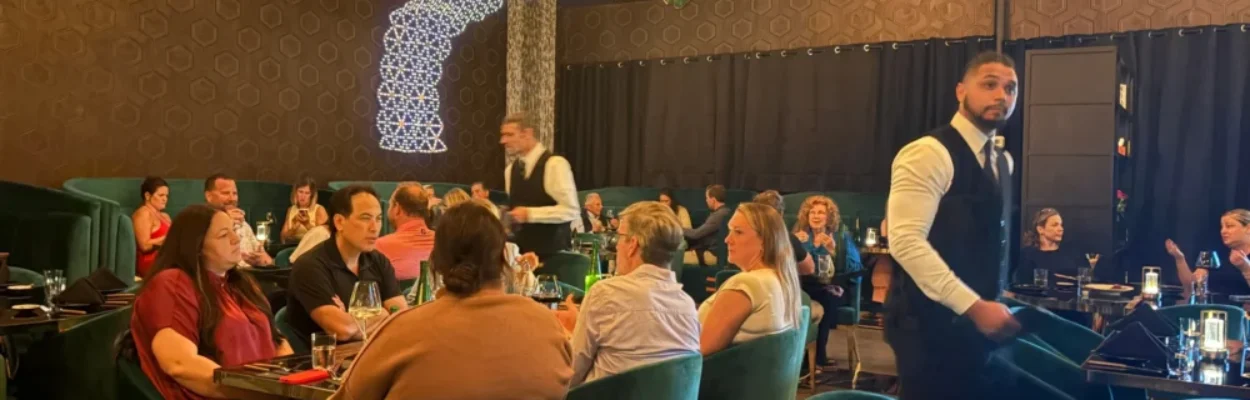
Black Pearl's website describes its cuisine as "From Italy & France, by way of Japan." | Hanna Raskin
Published on April 28, 2026 at 10:08 am
Jacksonville Today seeks to include a diverse set of perspectives that add context or unique insight to the news of the day. Regular opinion columnists are independent contractors who are not involved in news decisions. Want to submit your own column on a matter of public interest? Email pitches to jessica@jaxtoday.org.
As is immediately apparent from its dramatic black curtains, barrel-backed chairs upholstered in green velvet and parametric LED chandelier, Black Pearl in Ponte Vedra Beach is meant to feel very much of the moment. In other words, the three-month-old dining room shouldn’t make you think of JFK.
But on a recent visit, it wasn’t just the servers incongruously attired in starched white shirts and black bow ties that brought the long-ago president to mind. Rather, it was his famous gripe about Washington’s blend of “Southern efficiency and Northern charm” that recurred to me as I sized up Chef Abel Leonardo Chiok Diaz’s take on itameshi, the suddenly fashionable fusion of Italian and Japanese cookery.
Jacksonville Today thanks our sponsors. Become one.
An ongoing exploration of comfort food boundaries that dates to the 1950s, when Japanese chefs started tinkering with the spaghetti favored by occupying U.S. troops, itameshi emerged as a stateside restaurant genre roughly half a dozen years ago. Since then, it’s gained a secure foothold in Florida, with practitioners including Kinjo in Tampa, and OISE Ristorante in Fort Myers.
Typically, the hallmarks of itameshi are sophisticated cooking techniques, esteem for seasonality and an emphasis on umami-rich ingredients that the two cuisines share, such as garlic and mushrooms (and a few that they don’t, a list led by parmesan and miso.) Resulting dishes look more like local clams gently steamed in sake than pizza topped with teriyaki chicken.
Black Pearl, though, appears to take a different approach. I wasn’t aware of the restaurant’s itameshi inclinations before I ordered—the menu doesn’t mention it, and my server’s spiel extended to “Depends what you like,” when I asked for guidance—but it’s hard to square what it’s serving with the contemporary trend.


Jacksonville Today thanks our sponsors. Become one.
Instead, Black Pearl has borrowed a few less vaunted aspects of Italian and Japanese traditions to produce what in my case amounted to a disappointing meal.
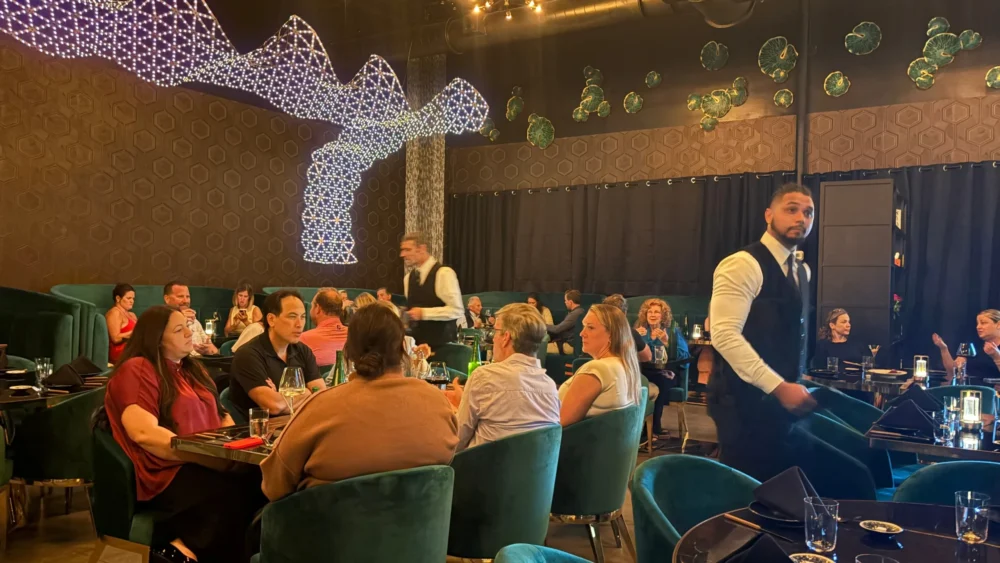
Namely, the restaurant has plenty of swagger, and cuteness to spare, but falls short on timeless elements of hospitality, delicious food and attentive service among them.
To be sure, should you have 100 bucks to drop on a two-course dinner—or, more aptly in light of the setting, a corporate credit card and lenient expense policy—the swanky surrounds at Black Pearl are appealing, as is the energy of a dining crowd eager to show its support for kitchen ambition. If friends proposed meeting there, and promised to pick up the check, I doubt I’d object too strenuously. But if they were chasing an itameshi induction, or after a memorable upscale experience, I’d at least suggest waiting for gas prices to drop.
In addition to its main dining room, Black Pearl operates an eight-seat omakase chef’s counter, which is presumably an entirely different experience. But if you eat with the relative plebes in the room that occupies 4200 square feet of Black Pearl’s strip mall storefront, the evening begins with a drink, boozy or otherwise. Rather than the dressed-up juices that many restaurants pass off as mocktails, Black Pearl pours non-alcoholic gin and non-alcoholic rum (and charges accordingly: at $17, teetotaling is a $1 savings.)
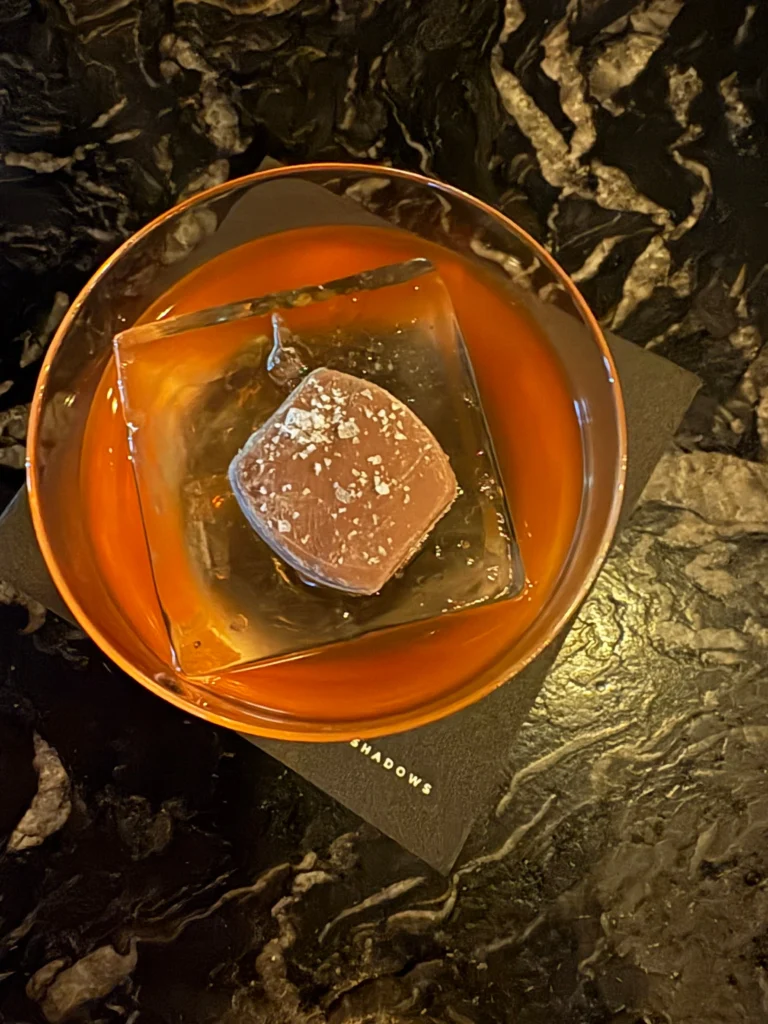
Otherwise, the cocktail menu might be the clearest expression of itameshi. A bee’s knees is ornamented with green tea liqueur; a blood-and-sand gets its citrus tang from orange-flavored sake. Still, what works in theory doesn’t always bear out in practice. My old fashioned, for instance, tasted more of its component Cognac than Japanese whiskey. Mostly, though, it was dominated by miso syrup, which made the drink remarkably viscous. That sensation might have been alleviated by melting ice, but the giant rock in my glass stayed stubbornly intact. While something smaller would have been more appropriate for the cocktail, the bar apparently needed a platform for the hotel turndown-type chocolate inexplicably perched atop the massive cube. Cute, I guess.
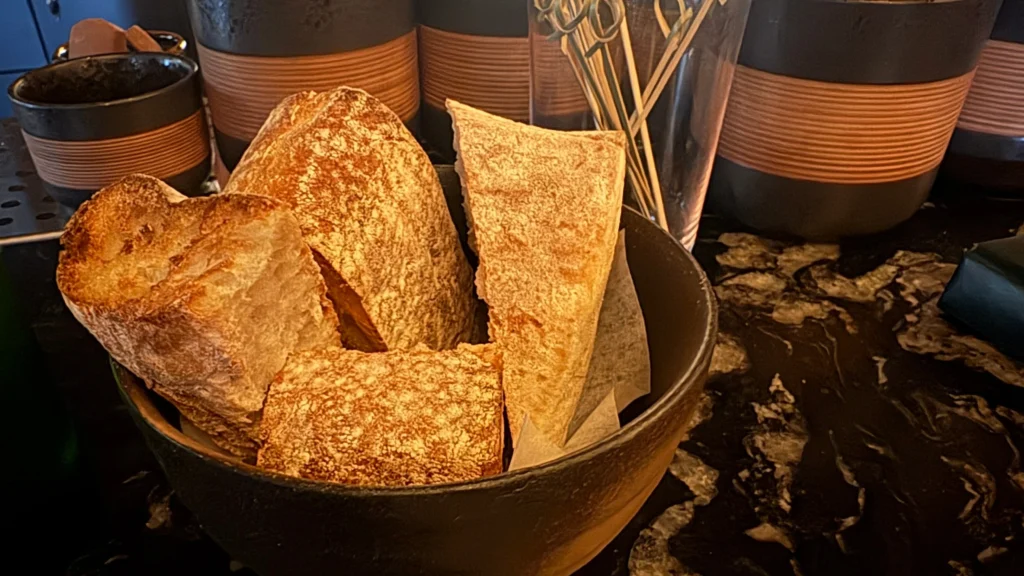
Black Pearl read the room correctly when it appended truffle butter to its $8 bread service. I’m not sure if that butter’s the lone culprit, but the chemical scent of truffle oil hovers over the dining space as though it was applied with an air freshener. As for the bread, it’s billed as “warmed,” which is accurate; the restaurant didn’t respond when I emailed to ask about its sourcing, but it tasted freshly defrosted.
Most of the appetizers are predictable, ranging from tuna carpaccio to chicken karaage, essentially chicken nuggets heaped with thinly grated parmesan.
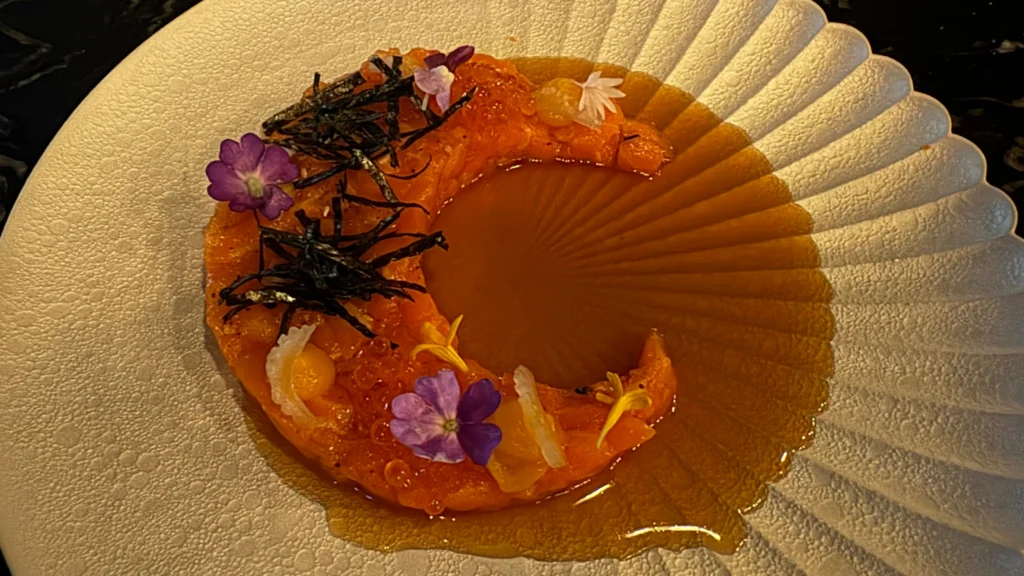
I’d been wowed by Diaz’s cooking at Taste Kitchen in Ann Arbor, Michigan, so was looking forward to king salmon tartare with sweet potato and trout roe, which sounded like a smart Carolinian riff on the French fixture. Visually, the tartare was stunning. A crescent of coral-hued fish garnished with dark filaments of seaweed and nickel-sized floral blossoms, it looked like a maritime celebration. But its taste was anything but lofty: The fluted plate was swamped with so much lime-infused shoyu sauce that the fish registered as nothing more than ponzu-saturated mush. As for the advertised sweet potato, it was shuffled out of the flavor deck entirely.
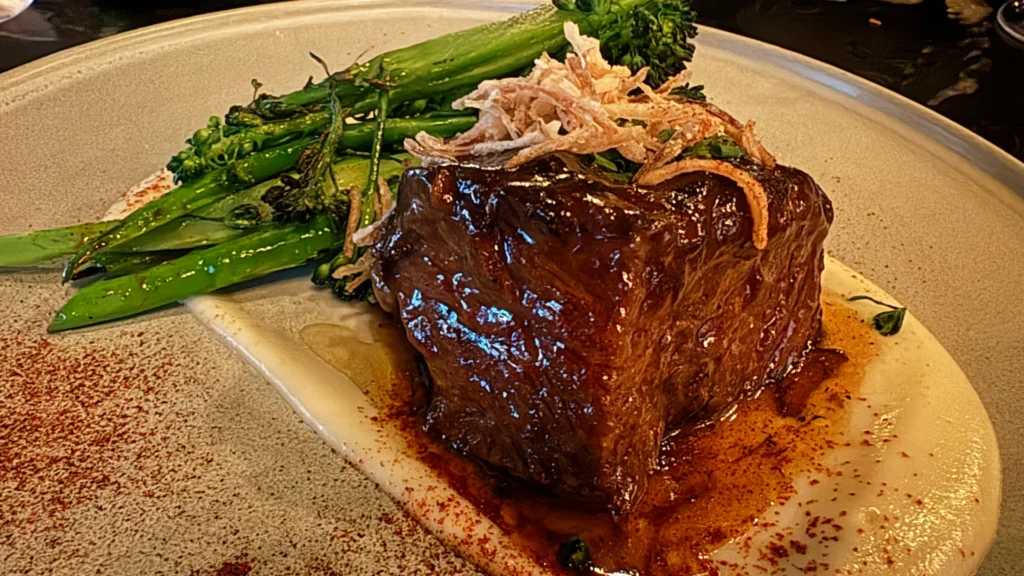
Unfortunately, I didn’t have much more luck with a hulking short rib that was sadly reminiscent of the entrée portions sous vided in huge quantities for conference galas.
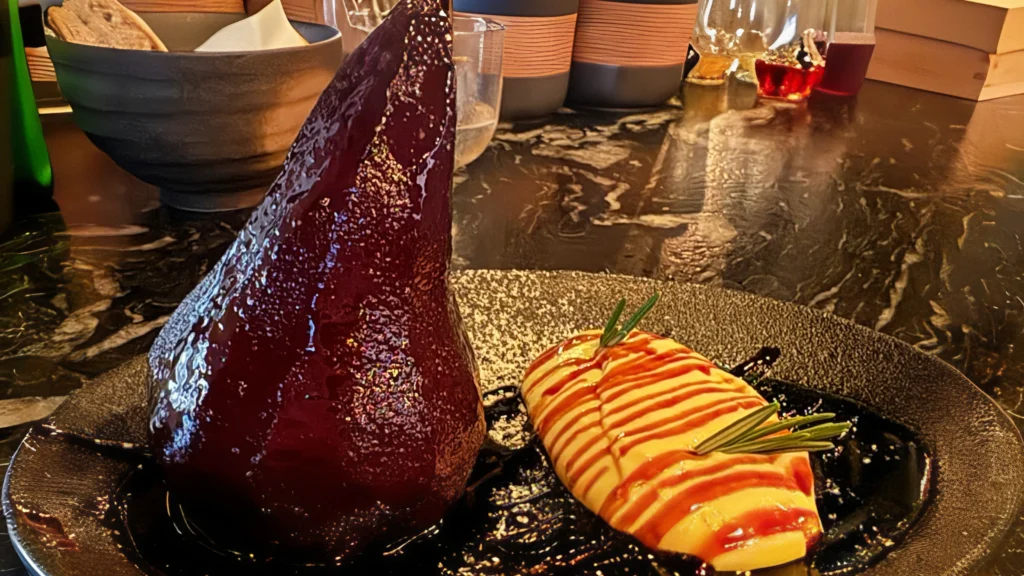
By contrast, a poached pear served for dessert was lovely: Wine-dyed a brooding maroon, the pear stood erect on its plate, evidently proud of its baking spices. To me, those flavors telegraph Yuletide—and confirm that Black Pearl is perhaps not as current as it might seem.
Black Pearl | 880 A1A N., 18B, Ponte Vedra Beach | Opens daily at 5 p.m. | Restaurant website