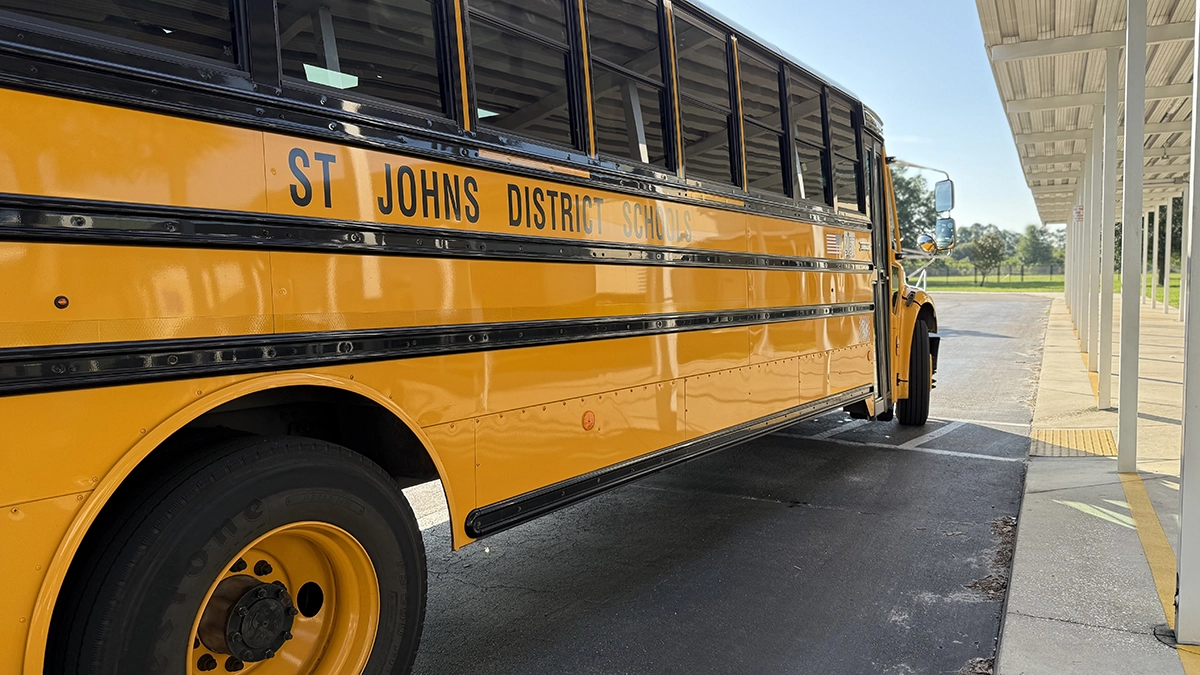
The St. Johns County School District is the highest-performing district in Florida. | Megan Mallicoat, Jacksonville Today
Published on April 24, 2026 at 2:26 pm
Free local news and info, in your inbox at 6 a.m. M-F. Sign up for the Jacksonville Today newsletter.
Florida’s education commissioner accused the head of the St. Johns County school district Friday of encouraging teachers to vote out lawmakers who support the state’s private school voucher program.
In a fiery letter posted to X, Anastasios Kamoutsas says his office received comments from St. Johns County teachers alleging that Superintendent Brennan Asplen encouraged them to complain to lawmakers that the state’s voucher program “takes the district’s money.”
Jacksonville Today thanks our sponsors. Become one.
Asplen has been a regular critic of the state’s voucher program, citing it as a key reason for the district’s current $8 million budget shortfall.
Gov. Ron DeSantis and the state Legislature expanded Florida’s school choice programs — often referred to as “vouchers” — in 2023 so that all students, regardless of income, can now receive subsidies to attend private schools or receive reimbursements for homeschool expenses.
But Kamoutsas says Asplen’s “divisive” rhetoric draws attention away from what he calls a leadership problem.

Jacksonville Today thanks our sponsors. Become one.
“It is wholly inappropriate for a superintendent to encourage or press their subordinates to vote for or not vote for a particular political candidate, especially on a school campus,” he wrote.
The education commissioner says that while none of the teachers who contacted his office would provide a signed statement, fearing retaliation, the state would pursue an investigation into Asplen’s conduct if that changed.
In a letter responding to Kamoutsas, Asplen denied any wrongdoing. The superintendent says he never encouraged anyone to vote one way or the other. Asplen says his goal is education.
“I believe it is incumbent upon public school leaders of our Great State to accurately and transparently inform taxpayers, parents, and community members of how funds are being spent in real time especially when there may be a negative impact on public schools,” Asplen writes. “As a high-performing district, the St. Johns County School District student population continues to grow and yet we are expecting a significant funding deficit for next school year. Why would this occur?”
Superintendent Brennan Asplen’s response letter to Education Commissioner Anastasios KamoutsasDownload
Making sense of school funding
Florida funds its schools mostly through the Florida Education Finance Program — a calculation that accounts for cost of living, tax base and other factors, and determines a per-student dollar amount to send to school districts. It pays for operational expenses like teacher salaries, textbooks, utilities and support staff.
Through the program, school districts receive from the state about $9,000 per student enrolled in their schools. If a parent opts to send their child to a private school or educate their student at home, they can apply to receive a similar amount to put toward private school tuition or approved homeschool expenses.
Supporters of the $4 billion program say it allows state education funding to “follow the child” to whatever kind of schooling their parent decides best suits them. Critics, though, note problems with the system the state uses to track students as they move between programs — and how much this rapid expansion of has cost taxpayers.
A state audit in November 2025 found “accountability challenges” with the program. The state funds school districts according to their enrollment at a few checkpoints throughout the school year. Last spring, the state was short $47 million when it came time to send districts their final payment of the year.
The audit found that unprecedented and unanticipated demand for the school choice programs had run the state’s accounts short.
Auditors suggested a better system for verifying student enrollment — to make funding more accurately follow where a child goes when they move in and out of school choice programs. And, they recommended lawmakers separate the school choice funding from traditional education allocations.
Though many districts lobbied for that change, a bill to do it didn’t get enough traction in the legislative session that just ended.
Superintendent speaks out
Speaking during a town hall event earlier this week, Superintendent Asplen said the district’s real problem is parents who never intended to put their children in public schools applying for the publicly funded voucher program. He says those parents are receiving money that, if it wasn’t going toward private school tuition or home schools where oversight is limited, could help fund public schools.
“The problem is the 39 private schools we have in our district,” Asplen said. “The parents are being told to get the vouchers, so we have 6,000 people we’ve never seen before, they’ve never been in our school district before, they’ve always been in private school, and now they’re getting the dollars.”
The district, Asplen said, also sees a number of students who were enrolled in a private or home school setting, but return to public school after the state’s funding is already distributed.
Still, Asplen believes St. Johns County is better off than many Florida school districts, including Duval County, which has closed 13 schools since 2020. Last school year, district officials at Duval Schools warned that they faced a $100 million budget shortfall, but more recent financial documents do not appear as alarming.
But between ballooning costs due to inflation and a desire to keep teacher salaries competitive with neighboring districts, St. Johns County Schools has seen its expenses rise as more students look elsewhere.
Earlier this school year, Asplen said, officials in Tallahassee informed St. Johns County’s school district that, due to the district growing at a smaller rate than anticipated when funds were distributed, it owed Tallahassee some $8 million. That number is estimated to be even higher next year.
He says the district intends to close the gap by increasing minimum class sizes, consolidating some academic programs and closing administrative offices.
A warning from Tallahassee?
In his letter posted to social media, Education Commissioner Kamoutsas says the district has received more money than it ever has. Kamoutsas says the St. Johns County school district received roughly 16% more in state dollars this school year than it did in the 2019-20 school year.
“If an increasing budget and increasing student enrollment do not allow you to make ends meet, perhaps the St. Johns County School Board can find a leader who does manage resources more effectively,” Kamoutsas wrote.
“Many superintendents across this state operate under greater fiscal challenges than the St. Johns County School District. Most navigate them with professionalism and accountability,” he said. “Florida’s families deserve leadership that is steady, focused on solutions and grounded in reality. They deserve someone who can manage complexity without assigning blame, communicate without creating chaos and lead without hiding behind excuses.”
In his response letter, Asplen stood by his leadership.
“There, if also being transparent, factual, and collaborative with our stakeholders to make appropriate decisions for our students is not leading appropriately, then I fully accept your vitriol,” he writes. “As you threatened in your letter, I encourage you to send my information to Professional Practices; I own my behavior and stand behind what I have communicated publicly.”
Kamoutsas’ office did not immediately respond to Jacksonville Today’s request for a comment.
Speaking earlier this week, Asplen said the numbers don’t tell the full story.
“The state will send out something saying, ‘You know what, we’ve given more money to education than ever before,’ and that’s true, that is not a lie, that is a true statement,” he said. “But what they don’t tell you is, ‘But now we have more people than ever with their hands in the cookie jar taking the dollars.’”
“Great,” Asplen said. “You gave us more money, but you’re not telling everybody where it’s going, because it’s not coming to us, like it should be, or was.
Editor’s note: This story was updated Sunday, April 26, to include Superintendent Brennan Asplen’s response.