
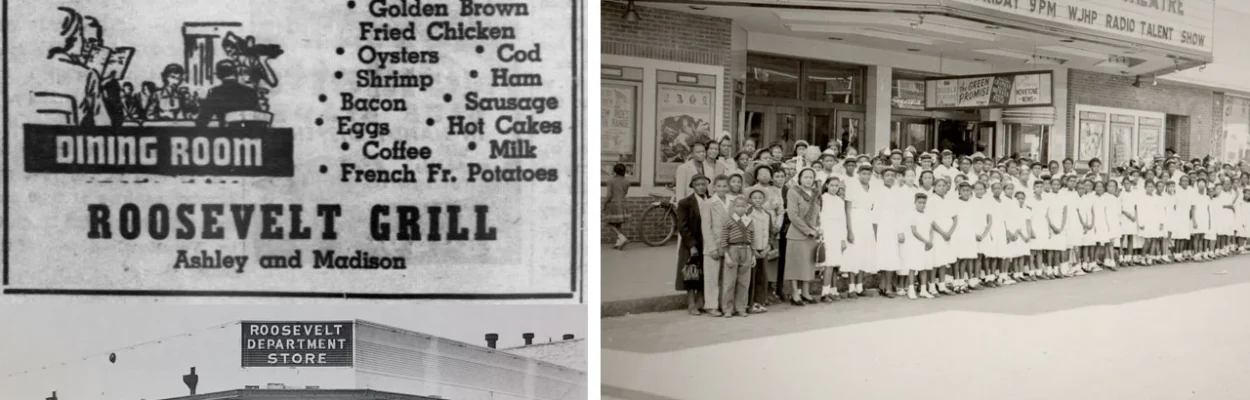
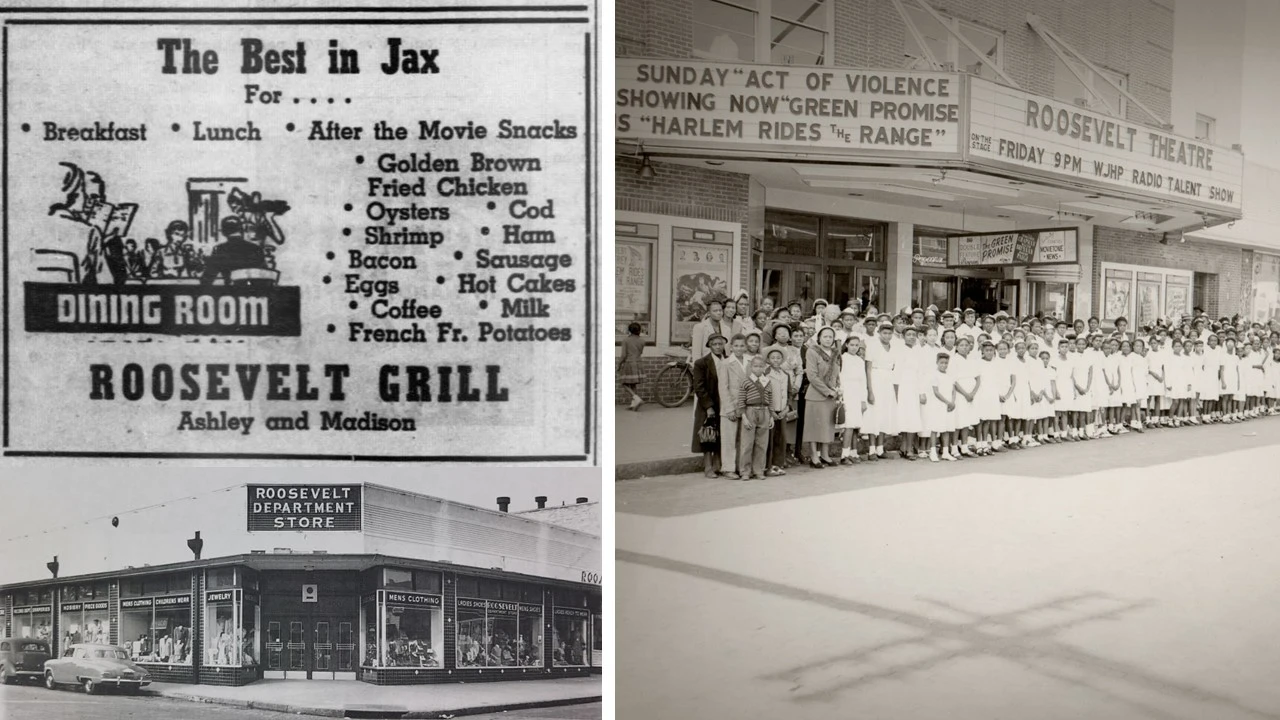
The Roosevelt Grill stood at 808 W. Ashley St., beside the Roosevelt Theatre, in what was then the center of Jacksonville’s African American entertainment district
Published on April 15, 2026 at 12:50 pm
Free local news and info, in your inbox at 6 a.m. M-F. Sign up for the Jacksonville Today newsletter.
In honor of National Arab American Heritage Month, The Jaxson takes a closer look at the Roosevelt Grill, a business that made a lasting impression on generations of Jaxsons who frequented the West Ashley Street strip.
On Saturdays in LaVilla, a quarter could carry a child into the Roosevelt Theatre for a matinee and still leave enough change for a paper bag of fries next door at the Roosevelt Grill. The walk home afterward required care. The fries were hot, the grease soaked quickly through the thin paper, and anyone who carried the bag from the top risked watching the bottom give way before reaching the corner. Longtime Jacksonville resident Russell Earl remembers learning to hold the bag from underneath as he left the theatre block and headed back through the neighborhood streets that surrounded West Ashley Street.
Jacksonville Today thanks our sponsors. Become one.
The restaurant stood at 808 W. Ashley St., beside the Roosevelt Theatre, in what was then the center of Jacksonville’s African American entertainment district. During the middle decades of the 20th century, Ashley Street carried a steady movement of families, performers, church groups, workers and visitors from across the South who came to LaVilla because it had become one of the region’s most active cultural corridors.
The Roosevelt Grill belonged to that movement. It served theatre crowds moving between afternoon matinees and evening shows, residents returning home after errands Downtown, and musicians traveling the touring circuit that connected Jacksonville to other Black entertainment districts across the South.
In the early 1950s, the Roosevelt Grill was a familiar part of neighborhood life along Ashley Street. A newspaper account from 1951 described a Girl Scout troop from St. Stephens AME Church stopping at the restaurant after attending a theatre program nearby, providing an important glimpse into how the establishment functioned within LaVilla during the Jim Crow era. Other restaurants across the South would serve Black customers while maintaining social distance from their surrounding communities, especially when it came to employing people. Yet the Roosevelt Grill’s employment advertisements confirm Black servers worked there, and neighborhood memories place church groups, families and young people frequenting the restaurant as part of their Ashley Street routines.

Jacksonville Today thanks our sponsors. Become one.
The Roosevelt Grill’s story during these years is also the story of brothers Larry and Rufus “Pop” Hazouri, members of Jacksonville’s Syrian-Lebanese merchant community who operated the restaurant during its busiest mid-century decades. Like many immigrant merchants who established businesses in Southern Black commercial districts during the early 20th century, the Hazouri family built their livelihood in relationship with the neighborhood around them rather than at a distance from it. Along Ashley Street, their restaurant depended on the people who filled the theatre seats next door, walked past its entrance each evening, gathered after church programs, and returned week after week as part of their normal routine in LaVilla.
The Hazouri family’s presence on Ashley Street reflected a broader tradition among Syrian-Lebanese merchants who opened groceries, cafés and retail storefronts throughout Downtown Jacksonville during the early 20th century.

Ashley Street itself formed part of a larger network of entertainment corridors that supported performers traveling through segregated America. Musicians, athletes, comedians, and touring performers passed through LaVilla regularly, appearing in clubs and theatres along the street before continuing to other cities on the circuit. Community memory places figures such as Ray Charles and Hank Aaron among those who spent time at the Roosevelt Grill while moving through the neighborhood. Newspaper references from the 1960s confirm that musicians performed there as well, reinforcing what residents already understood about the restaurant’s role in the entertainment life of Ashley Street. It was not simply a lunch counter serving theatre crowds. It was part of the corridor that sustained the district itself.
The story of the Roosevelt Grill also connects the mid-century life of Ashley Street to Jacksonville’s present civic leadership. Rufus “Pop” Hazouri, who helped operate the restaurant during its busiest years, was the grandfather of Mayor Donna Deegan. Families who operated businesses along Ashley Street during segregation-era Jacksonville were not temporary visitors to the neighborhood. They became part of its structure, its routines and its memory.
The Roosevelt Grill’s end

The Roosevelt Grill eventually disappeared along with the Roosevelt Theatre block that once anchored this section of West Ashley Street, and today the site is occupied by the LaVilla School of the Arts. Yet even after the building itself was gone, the memory of the restaurant remains vivid among residents who grew up along the corridor. They remembered the crowds moving between theatre doors and storefront windows. They remember the performers passing through the district. And they remember the familiar walk home after a Saturday matinee with a paper bag of fries that had to be carried carefully from underneath because the grease rarely stayed inside the paper long enough to reach the next block.