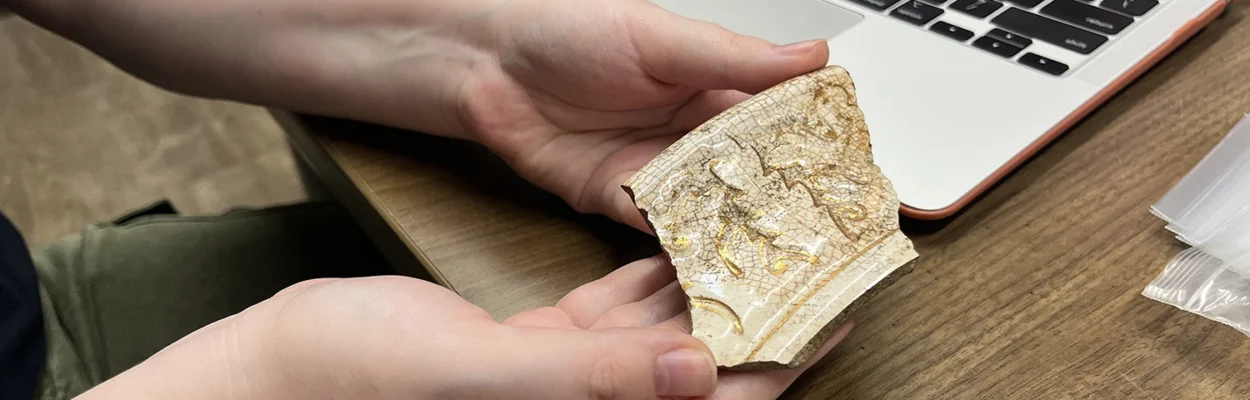
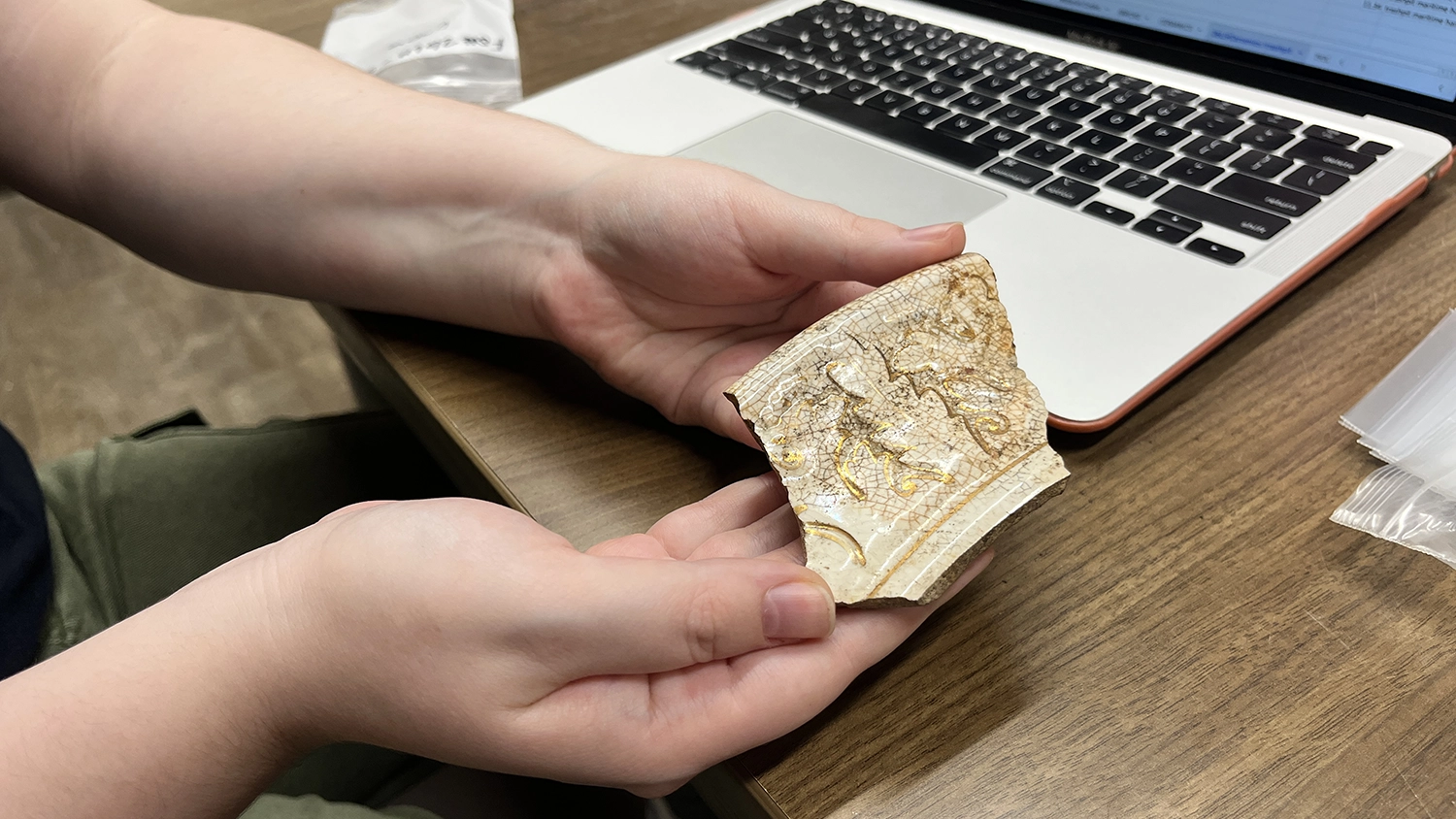
Flagler College student Abby Mahon shows off a shard from a piece of pottery that dates back to the 19th century. It's one of the pieces found in a recent dig at the St. Augustine Lighthouse and Maritime Museum. | Noah Hertz, Jacksonville Today
Published on April 6, 2026 at 2:40 pm
Free local news and info, in your inbox at 6 a.m. M-F. Sign up for the Jacksonville Today newsletter.
One man’s trash is another student’s learning opportunity, especially if that trash dates back more than a century.
That’s what archaeology students at Flagler College are learning this semester while they conduct research on artifacts found during a recent dig at the St. Augustine Lighthouse.
Jacksonville Today thanks our sponsors. Become one.
The lighthouse team typically focuses on maritime archaeology, so digs conducted on land are rare. This excavation all started thanks to a happy accident.
Chuck Meide, director of the Lighthouse Archaeological Maritime Program, says construction teams stumbled across “artifacts” while digging up dirt to build a new path to the museum’s visitor center.
“Broken bricks, a lot of glass,” Meide says. “They realized, ‘Oh, we better talk to the archaeologist. This is probably a trash pit.’”
Jacksonville Today thanks our sponsors. Become one.
A trash pit is exactly what it sounds like — a hole in the ground full of trash. But when that trash pit dates back more than 100 years old, researchers can learn a lot about the people who filled it.
“Historically, before there was garbage service, the easiest way to get rid of your trash was to dig a hole,” Meide explains. “That’s what the [lighthouse] keepers were instructed to do. Dig a hole and throw your debris in there.”
So Meide and his team set out to do the inverse: Dig a hole and remove the debris. In the process they excavated shards of broken ceramics, glass, hunks of metal and larger pieces, like a kerosene lamp and a nearly 100-year-old battery.
Meide says all of the discarded items tell researchers information about lighthouse keepers past.
For example, the team found an intact bottle of Lea & Perrin’s Worcestershire sauce that likely belonged to lighthouse keeper Peter Rasmussen.
“He was keeper from 1901 to 1924,” Meide says. “He was famous for his clam chowder recipe. … His recipe called for a fourth of a bottle of Lea & Perrin’s Worcestershire sauce.”
Hands-on archaeology
Meide worked with Flagler College archaeology professor Lori Lee to get the artifacts his team dug up into the hands of local students.
Lee’s students are working on a range of projects, from examining ground penetrating radar scans of a Green Cove Springs cemetery that has fallen into disrepair to studying the history of St. Augustine’s Fort Mose.
Lee says the experience of working on local projects can teach students a lot about Northeast Florida’s vibrant history.
And it’s a big help for the archaeology team at the Lighthouse and Maritime Museum.
“It’s great students are getting to benefit from this archaeology and they’re getting to learn and have a great hands-on authentic classroom experience,” Meide says. “It’s also great for us because we don’t really have the time to do the analysis to do that right now.”
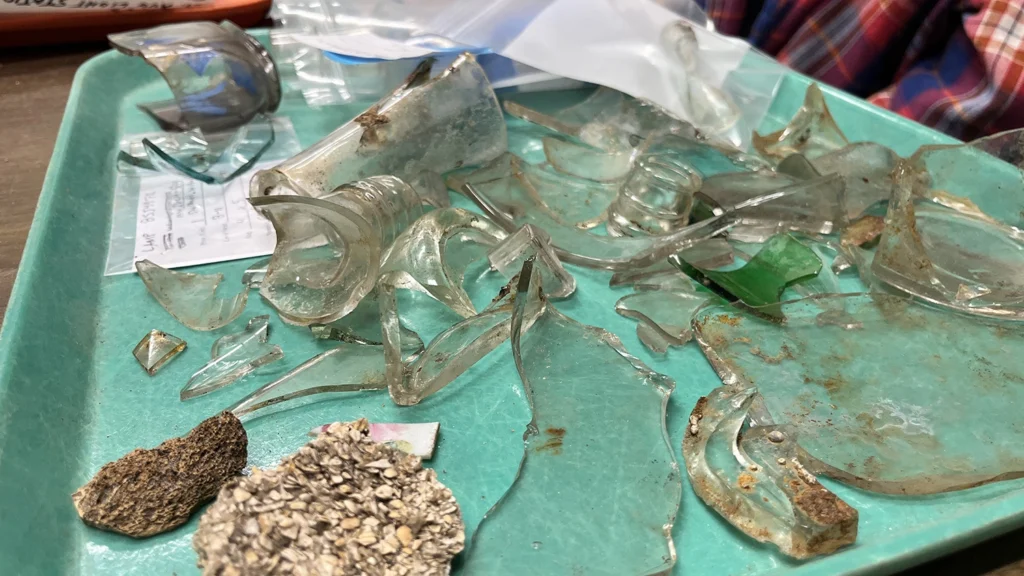
Jazmin Adams, Lucas Finsel and Abby Mahon, three of Lee’s students, have been hard at work cleaning, cataloging and learning as much as they can about the items found in the trash pit.
They’ve learned quite a bit — the students used a ceramic shard as an example. To the untrained eye, it looks like any random piece of broken pottery, but their research hints at a deeper story.
“It is an ironstone, and likely from a hotel,” Mahon explains. “Ironstone is usually more utilitarian and less easy to break. This one is really kind of strange because of its design. It has molding … along with gold leaf plus handpainted and transfer print. You don’t see that thrown on a lot, so that’s interesting.”
Finsel notes that the design and weight of the shard suggests it likely came from a large platter or something that sat on a shelf.
“They may have inherited it from a hotel that was closing in town,” Finsel adds. “It may have fallen off a shelf or got knocked over.”
The students’ place the shard’s origin to sometime around the late 1800s, and Finsel says that makes sense when you think about St. Augustine’s history.
“The late 1800s is really this transformation period for St. Augustine, and you see some of that in here where they go and experiment with crazy glasswares and ceramics,” he says. “Mass consumerism is really smacking St. Augustine, where you get a lot of new wares and stuff getting ported down here, and you get a lot of people with money down here because they’re vacationing here.”
Adams, Finsel and Mahon all want to pursue careers in archaeology or museum work, and all three agree that it is rewarding to learn more about the people who lived in St. Augustine before them.
“It’s one thing to think about the past,” Adams says, “but it’s another to think about people like us sitting here right now.”
You might not give much thought now to throwing away trash or tossing cans and bottles into your recycling bin, but give it a few hundred years. Researchers may be examining it in the centuries to come.
As archaeologist Chuck Meide puts it, “Everything thrown away here is part of our story.”