
Published on January 28, 2026 at 1:59 pm
Free local news and info, in your inbox at 6 a.m. M-F. Sign up for the Jacksonville Today newsletter.
Centered around Ward Street in LaVilla, Jacksonville’s notorious early 20th century red light district was a dense and complicated landscape that most Jaxsons know very little about. Once home to more than 60 bordellos and popular madams Cora Crane, Belle Orloff and Lyda De Camp, here are five forgotten facts associated with LaVilla.
“Disorderly houses,” not brothels
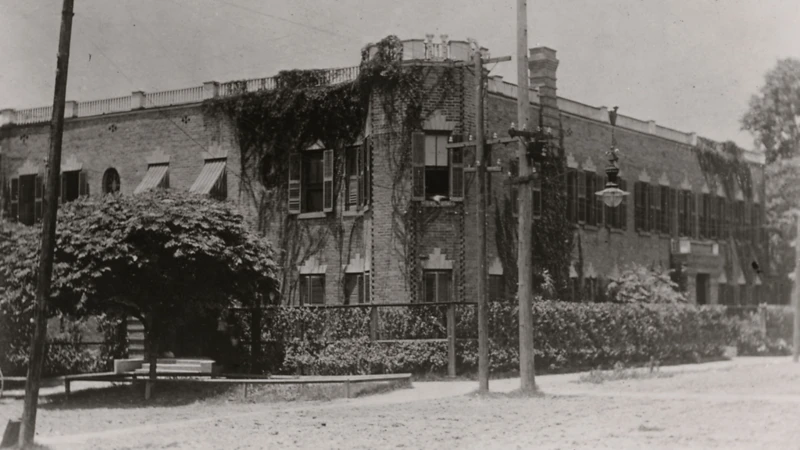
Locally, the terms brothel and bordello were rarely used. Instead, establishments in LaVilla’s red-light district were commonly referred to as “resorts” or “disorderly houses,” a label codified by city law. An 1876 Jacksonville ordinance formally defined any house of ill fame, used for prostitution or known as a resort of prostitutes or persons of lewd character, as a disorderly house, declaring such places dangerous to the peace and morals of the city. Owners, agents, lessees, and operators were all legally identified as keepers of disorderly houses. Women working in their disorderly houses were called inmates. The designation extended beyond prostitution. Gambling houses and saloons selling beer, wine, or spirituous liquors were also classified as disorderly houses, reflecting the city’s broad attempt to regulate vice through language rather than eradication.
Jacksonville Today thanks our sponsors. Become one.
A district of aliases and notorious names

Ward Street, later renamed Houston Street in an effort to soften the area’s image, served as the epicenter of the district, but disorderly houses also extended along Broad, Madison, Davis, Adams, Forsyth, and Bay Streets. These establishments included saloons, vaudeville theaters, and brothels operating side by side. Among the best-known bordellos were The Court, Turkish Harem, House of Spanish Marie, The Senate, The Club, New York Inn, and the Atlanta House. Aliases were common. Mary Ellen Norman, an inmate at 838 Ward Street and described in 1905 as one of the city’s most notorious women, was known locally as Hog Eye Missie. Vivian Harris, an inmate at 915 Ward Street in 1908, used the name Lottie Quiesenbary in Jacksonville and Katherine Hargins during her time in Lexington, Kentucky.
Opium dens in the shadows of Ward Street

Beyond prostitution, the red-light district supported a robust underground drug trade. Opium dens were common, many operated by Chinese laundry owners whose properties backed up to Ward Street’s bordellos. One of the most prominent figures was Lou Gat, known locally as Wah Hop, a wealthy businessman who operated a laundry at 713 West Adams Street. Arrested in 1912 for manufacturing opium, Hop’s business was described as a house of mystery, reportedly containing numerous rooms, bunks, trap doors, and subterranean caverns. In addition to laundry services, the shop sold teas, spices, manufactured goods, and Chinese medicines. Although Hop was released from prison after several months for good behavior, his operation returned to public attention a year later when an employee, Lewis Loget, was arrested for selling opium to Pansy Smith, an inmate of 905 Ward Street. Smith was also arrested for purchasing the drug.
A launching pad for early African American musicians and entertainers

Despite its reputation, the red-light district also served as one of Jacksonville’s earliest entertainment hubs. Patrick Chappelle, who would later dominate the southeastern vaudeville circuit, got his start here. In 1894, Chappelle opened the Rabbit Foot Saloon at 713 West Bay Street, offering liquor alongside billiards and pool. By 1898, he and his brothers founded the Excelsior Concert Hall at the intersection of Ward and Bridge (now Broad) Street. Excelsior was one of the first Black-owned theatrical venues in the South. Chappelle would go on to establish the Rabbit’s Foot Minstrel Company in 1900, earning him the nickname “the Black P.T. Barnum” and launched the careers of Ma Rainey, Bessie Smith, Ida Cox, and Louis Jordan.

Jacksonville Today thanks our sponsors. Become one.
Other venues were successful as well. Thomas Baxter’s Exchange Saloon & Theatre, which took over the Excelsior after a landlord dispute, employed 32 people and included a theater, café, saloon, and back rooms for inmates catering to the Ward Street crowd. Police Chief Vinzant publicly acknowledged the operation in 1900, stating that such establishments were necessary and as orderly as could be expected in that district. Nearby, Walter O’Toole’s Little Savoy Theatre opened in 1904 at 610 West Forsyth Street, becoming known for dramatic sketches and performances of compositions by Bob Cole and J. Rosamond Johnson.
Robbery was a common occurrence

For many visitors, particularly out-of-town men from prominent families, the red-light district promised discretion and indulgence. Instead, it often delivered financial ruin and public shame. Robberies were common, frequently involving intoxicated patrons targeted by women working in the district. In 1896, sailors Charles and Augustus Johnson were robbed of $20, leading to the arrest of disorderly house inmates Joseph Day and Josephine Jones. Unable to pay their fines, both were jailed. In 1905, R.H. Holmes of Live Oak, Florida, reported losing $76 at Hog Eye Missie’s establishment. That same year, Mack Williams of Ocilla, Georgia, claimed he was robbed while sleeping at Gertle Williams’ house in the Tenderloin. Newspaper accounts of the era showed little sympathy for such victims, often portraying them as reckless participants in their own downfall. Many robberies went unreported, as victims preferred to absorb the loss rather than risk public embarrassment.