
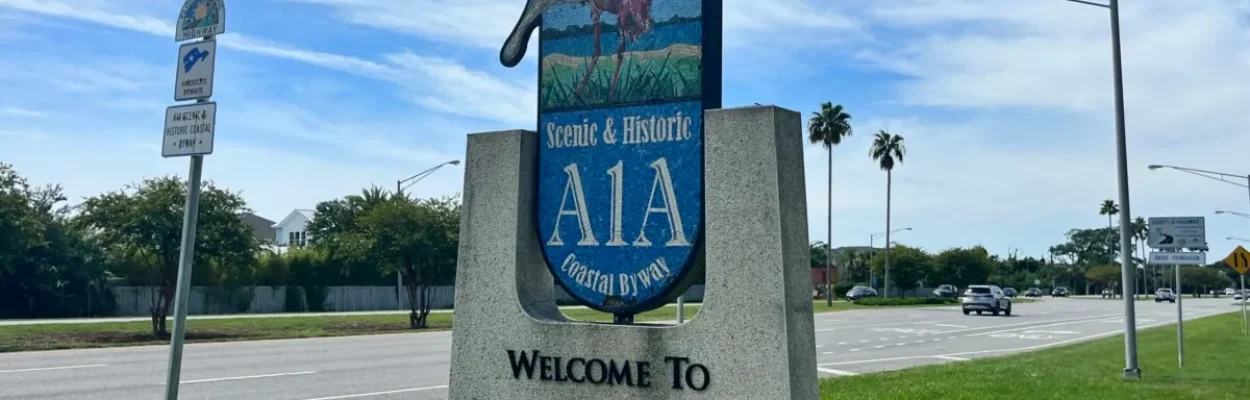

A sign welcomes people to St. Johns County, though many residents don't welcome more growth. | Noah Hertz, Jacksonville Today
Published on January 20, 2026 at 4:22 pm
Free local news and info, in your inbox at 6 a.m. M-F. Sign up for the Jacksonville Today newsletter.
The St. Johns County Commission approved its comprehensive plan Tuesday for the second time in a calendar year — after the state rejected the last plan for being too “restrictive” of development.
Despite calls from some local residents and environmental groups, the County Commission passed a plan that stripped out language the state objected to. The commission promised to revisit the plan if and when things change in Tallahassee.
Jacksonville Today thanks our sponsors. Become one.
The comprehensive plan, which is hundreds of pages long, functions as a set of guidelines for how land can be developed and how the county enforces its rules and regulations governing growth.
It’s also, as Keto Burns, the head of the South Anastasia Communities Association, puts it, “a key document that determines what our county looks like years from now.”
Burns’ nonprofit group, which fights to preserve natural lands on Anastasia Island, was among those opposing the county’s move Tuesday.


Jacksonville Today thanks our sponsors. Become one.
Burns says the county did a great job getting input from groups like his all around St. Johns County. That’s important, he says, because of how instrumental the comprehensive plan is in county decision-making.
But Burns had hoped the county would have waited until after the end of this year’s legislative session to pass what he calls a “watered-down” plan.
“It is a 25-year planning document,” Burns says. “It will outlive any commissioner or staffer at the county.”
Growth plan problems
Over the course of the two years the latest plan was in the works, measures focusing on environmental protection and workforce housing arose as priorities among elected officials and members of the community.
But the county hit a snag when it approved its new plan last summer. It ran afoul of a controversial set of guidelines that Gov. Ron DeSantis signed into law last year.
Those rules have become known as SB 180, after the bill that introduced them.
SB 180 was intended to help the state recover more quickly from hurricanes. But under the bill, the state informed local governments that their rules surrounding growth and development were too strict and had to be amended.
The state rejected St. Johns County’s plan for a number of items, including language that strengthened the county’s position on preserving environmentally sensitive lands and building bicycle and pedestrian infrastructure.
Some municipalities chose to sue the state over the measure, but St. Johns County opted to see how things would play out in the state capital when legislators met this year.
The more controversial elements of SB 180 may change — a bill amending that law is moving through legislative committees, and the original bill’s sponsor, Sen. Nick DiCeglie, R-Indian Rocks Beach, supports the changes. St. Augustine lawmaker Kim Kendall also has stated that she supports changing SB 180.
Local impact
Changes in the comprehensive plan were largely necessary because of language the state deemed as too strong, said St. Johns County Growth Management Director Mike Roberson.
“They identified certain policies … as more restrictive or burdensome,” Roberson says. “We looked at each of those policies and either softened or removed them for now.”
In the plan approved Tuesday, county staff softened language surrounding workforce housing and land conservation — from “include” to “may include” or from “prohibit” to “discourage.”
Burns, of the South Anastasia Communities Association, says language simply encouraging developers to consider things like development that is more considerate of environmental protection is pointless.
“You can consider it without even having the language,” he says.
Promises made…
The County Commission voted 3-2 on Tuesday to transmit the revised comprehensive plan to the state. Commissioners Krista Joseph and Ann Taylor pushed to wait on the measure.
The two argued that the revised plan was not what the board — or the community — really wanted. Joseph and Taylor were in favor of delaying a vote until the Legislature made its decision on altering SB 180, even if it left the county in a liminal state for some time.
“I think we can do it,” Joseph said. “We have attorneys. I don’t know why we can’t hold the line.”
But Commissioners Christian Whitehurst, Sarah Arnold and Clay Murphy pushed for passing the revised plan and revisiting it if the changes to SB 180 pass the Legislature during this session.
If that happened, Murphy said he would be “leading the charge” to approve the plan the board agreed on — the one that the two years of community involvement helped build — as soon as they could.
The comprehensive plan process is not over yet, though.
By agreeing to transmit the revised plan to Tallahassee, the county may still get more notes from state officials. Once the document comes back, notes or no notes, it will have to come back before the county’s Planning and Zoning Agency and the Board of County Commissioners for another approval before it is completely adopted.
Roberson estimates that won’t happen until May.