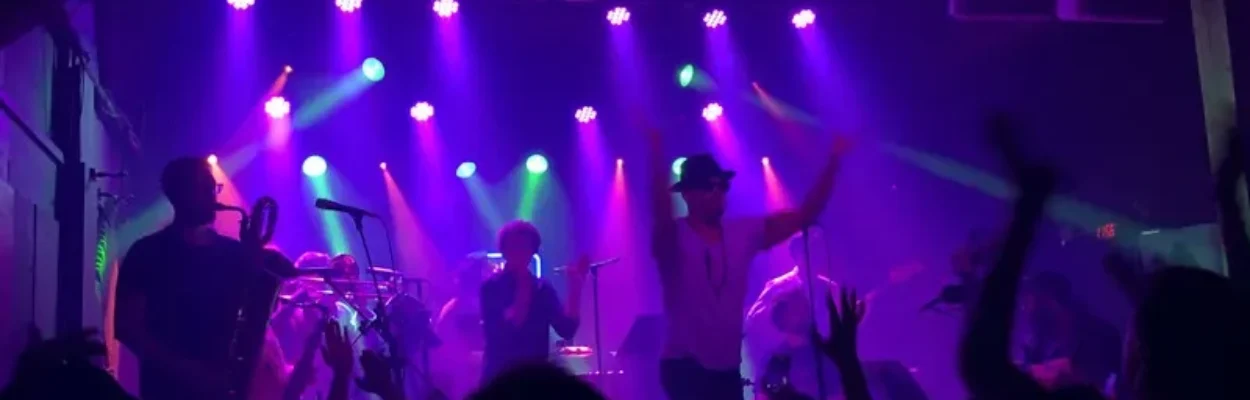
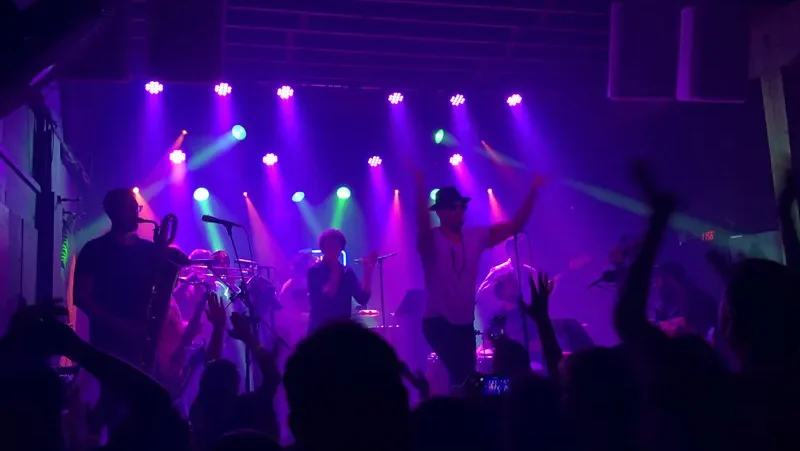
A live concert at Jack Rabbits Live | Ruston Kelly
Published on January 14, 2026 at 1:55 pm
Jacksonville Today seeks to include a diverse set of perspectives that add context or unique insight to the news of the day. Regular opinion columnists are independent contractors who are not involved in news decisions. Want to submit your own column on a matter of public interest? Email pitches to jessica@jaxtoday.org.
“Culture is a nebulous creature,” local author and historian Tim Gilmore told me. For the underground arts and culture scene beneath Jacksonville’s surface, it’s a creature built for survival.
Open mics, gallery openings, street cyphers, and concerts are happening across Jacksonville almost every night, showcasing the raw talent of local creators. If this comes as a shock to you, then the term underground still fits. Event curators rely on word of mouth, social media and proximity to build their audience.
Jacksonville Today thanks our sponsors. Become one.
U.S. Census Bureau stats reveal Jacksonville was one of the fastest growing cities between 2023 and 2024, with statisticians predicting the population will increase roughly 11% by 2028. As hundreds of new residents move to Jacksonville each day, the underground arts scene faces the challenge of reaching an entirely new audience of recent transplants with disposable income. For a culture driven by who you know, the survival of underground arts will be dependent upon its ability to tap into this new economic market while maintaining its identity — an identity that Jacksonville developers and investors would be prudent to protect, because a city with no culture is hardly a city at all.
Underground art in Jacksonville: A history

While culture itself may be a nebulous idea, the location of Jacksonville’s underground arts has a definitive center: Five Points. Similar to cities around the country, artistry has thrived in and around Black neighborhoods. Despite its adjacency to historically Black neighborhoods, the most recent voter demographic data from the Supervisor of Elections office shows Five Points’ City Council District 7 is today 59% white.
Local professor, author and historian Tim Gilmore argues the reason goes back to white flight after the Civil Rights Act passed and the Federal-Aid Highway Act of 1956. The mass exodus of affluent white families, combined with the destruction of urban core neighborhoods to build I-95, left a vacuum. Across Riverside, Durkeeville, and Springfield, property values fell, and wealthy families moved to the suburbs, leaving in their wake incredibly cheap housing and “an entirely new kind of culture,” according to Gilmore. Riverside and the surrounding areas become the mecca for hippies with very different opinions from their parents, and the ability to rent a floor in a grand mansion for dirt cheap. It’s there that the vanguards of the counterculture created bands, wrote poetry, and shared their art, forging a culture that only grew stronger over time.
Jacksonville Today thanks our sponsors. Become one.
This is the cultural scene that the local poet and performer, Love Reigns, stepped into nearly 20 years ago at Fuel Coffeehouse (now the location of Hoptinger’s Beer Garden), owned by Jim Webb. Tonya Smart, creator of Jax Youth Poetry Slam, started the WeSpeak poetry open mic there, joining the spoken word landscape with Soul Release Nokturnal Escape, hosted by Tiffany Duhart and Emanuel Washington at Stephen Dare’s Boomtown (now the location of the Dalton Agency). They, along with Al Letson and many others, were the forerunners of Jacksonville’s poetry scene. Boomtown’s open mic lasted over 10 years, attracting large crowds to listen to world-class poetry from local and national poets alike. Nokturnal Escape continues today at Nefertiti Books & Gifts. After Fuel closed in 2009, Smart approached Love Reigns to take over. Reign collaborated with Matthew Cuban Hernandez and Al Pete to turn WeSpeak into the Cypher, which is now the longest-running open mic in the city, currently hosted by Makeeta Lé Modél at Eclipse Bar. Reign’s long history within the poetry scene in Jacksonville is one of the many examples of how culture persists through times of upheaval.
Doing business underground

When I asked Webb, the owner of the now-defunct Fuel Coffeehouse, if the open mics contributed to their success, he responded, “Oh yeah. That was the scene that we were all of a sudden curating…it was what people were starting to call their third place. And we were definitely that.”
Over its nine-year run, Fuel hosted a range of artists from George Clinton to Every Time I Die. After Fuel closed in 2009, Webb continued to be a fixture in the intersection between culture and business, becoming a founding member of Friends of James Weldon Johnson Park (then Hemming Plaza), executive director of the Jacksonville Naval Museum, and a supporting partner of the Cultural Council of Greater Jacksonville through Manifest Distilling. He recounted working with the Cultural Council for one of their annual galas in the Marble Bank Building Downtown. The gala is one of the principal fundraisers for the cultural council, where financial supporters of the arts celebrate and award cultural leaders. At that year’s gala, Webb recounted, the adjacent parking lot was turned into event space for the artists who couldn’t attend the gala. Webb says this is when supporters of the arts first began asking, “If we’re going to have galas ‘for artists,’ why is it too expensive for the artist to go to the gala?”
Webb sees both sides. Fundraising galas at high price points can quickly raise money to support local artists, similar to the way global talent can attract a larger audience than a local artist can. On the other side, plenty of local artists have left Jacksonville due to a lack of financial support and exposure. For Webb, his confidence in the cultural council’s ability to forge those connections stems from his own experience as a collaborator between art and business. Arbus Magazine spotlighted the first time cultural council paid local artists to paint Manifest bottles, then auctioned the custom pieces to raise money. The artists not only received compensation, but also exposure — the two things artists crave most. Doing business within the arts community can be successful, but its core feature of being dependent on word of mouth can be its biggest challenge.
“Art has to be a business at some point. If someone wants to make a career out of it, there has to be some business component too.”
Jim Webb
Riverside’s Storyteller-In-Chief: Barbara Colaciello
I asked Barbara “Babs” Colaciello, owner of Babs’Lab in the CoRK Art District, about how she found success as a creator and business owner.
By the time Barbara opened her studio on the corner of Phyllis and King streets, she had a well-established and respected reputation in town. Teaching at Players by the Sea connected her to a rising generation of artists and their parents. Hosting soirees and theater parties in her home connected her to an even wider network of adults who all shared a love of storytelling. These living room performances were the start of Babs’Lab, before opening the space in 2016. For the last 10 years, Colaciello has brought people together through improv workshops, monthly story slams and special events, with considerable financial success. In their second year in operation, Babs’Lab was able to raise $13k in two weeks for production upgrades. The community presence she built over the prior 30 years served as the reputation capital that she leveraged into financial capital.
“I never asked for money in all that time. Except when I got Babs’Lab,” Colaciello says, “I was able to do that because I built a reputation of affecting people, teaching people, being reliable, getting along with people.”
She credits part of that development to the relationships she developed with fellow creatives such as Hope McMath, Ebony Payne, Philip Pan, and Charlotte Mayberry. This, in combination with her ability to train storytellers of all backgrounds, is what continues to attract performers and listeners to her ticketed story slams.
She encourages other visionaries and creators to keep creating, but more importantly, collaborating to keep crowds diverse and the experiences dynamic.
The importance of relying on other creatives in the community for growth was a sentiment echoed by Yellow House art gallery owner Hope McMath.
Good-faith collaboration is how Yellow House supports artists while being good stewards of the community. McMath’s space stands boldly in the intersection between the arts and counterculture, allowing artists to express themselves freely and contribute to the venue’s development.
When McMath opened Yellow House in 2017, she admitted that she didn’t think it would make it past six months. A part of her success in reaching eight years can be attributed to her and her team’s ability to allow the space to come into its own, on its own terms.
“Our sheer existence, to me, is a mark of success.”
-Hope McMath
“We’ve really let the communities that come in be the ones who shape it. We started as a visual arts space. Now we’re a place of community conversation, a place of mutual aid, and a place of the exchange of knowledge,” McMath says.
Yellow House also hosts open mics curated by Reign Supreme, creator workshops and a lending library spearheaded by multidisciplinary artist Jordyn Bowen. One of the most special traits of Yellow House is that it encourages art buyers to be in direct community with artists. Similar to Colaciello, McMath says her social capital is partially what allowed her to build the space in that manner. McMath worked at the Cummer Museum for 22 years, the last eight as its executive director.
Despite this exposure, McMath still finds it a challenge to market to new audiences, a struggle she shares with other business owners in the arts community. Like most local governments, Jacksonville has historically underfunded the arts. While financial, technical, or manufacturing companies from outside Jacksonville are constantly given tax incentives, countless talented artists and local entrepreneurs rarely receive the support needed to open.
And while Jacksonville has made incredible headway in supporting local arts and culture in recent years, McMath believes there is always more work to be done. She points to the cultural council’s 2024 Individual Artists Grant Pilot Program as a bold step in the right direction. McMath served as a mentor in the program that awarded 60 local artists grants of $10,000 each. While the program was groundbreaking for the arts community, McMath also recognizes that as the cost of living only gets higher, $10k isn’t enough to keep an artist from leaving the city.
She says, more than money, artists need visibility and access, something that requires an intentional approach over time. Just as large institutions such as the Florida Theater or the Jacksonville Symphony play a large role in the city’s development, so do the smaller, underground spaces that curate the local talent to headline those venues, she argues.
The Cultural Council of Greater Jacksonville’s role
Communicating the value of arts and culture on the economy and quality of life has been the mission of the cultural council’s executive director, Diana Donovan.
Murals, live performances and cultural experiences not only drive tourism but also promote a higher quality of life for residents. The return on investment is also evident, with the $6 million distributed through the 2023-2024 Cultural Service Grant Program resulting in a total economic impact of $135,293,802, according to the Cultural Council. “As much as we invest in stadiums, we have to invest in stages,” Donovan says.
According to statistics provided by the council, more than 5,000 Jacksonville residents earn their income through the arts and culture sector, including 3,500+ local artists and 1,500+ staff positions, representing a significant portion of the workforce.
Multidisciplinary artist Myah Freeman is one of the recipients of the inaugural Individual Artist Grant program. Freeman’s murals and paintings have been displayed at the Ritz Theatre and Museum, the Phoenix Arts District’s Mural Jam, and many 904 Happy Hour festivals across Jacksonville. She applauds the program as an example of local government supporting artists by providing them with valuable experience with the grant process. Freeman, who gained art grant experience through the Bachelor of Fine Arts program at Florida State University, encourages artists to constantly seek out new opportunities and reach out to those who can offer guidance in areas where they may be lacking. Freeman says for her, contacting more established artists like Christopher Clark, Jarett Walker and Suzanne Pickett, was influential in taking her career to the next level.
“I would definitely encourage any artists, emerging or established, not to be intimidated by grants. Even if you don’t get it, you practiced. And then you still can build relationships and learn from the people who have received the grant,” Freeman offered.
One of the goals of the cultural council, according to Donovan, is to expand its professional training to artists, creating even more development opportunities for artists to learn from each other. Time will tell how the trainings translate to financial success for artists, but Donovan acknowledges, regardless, the underground artists will find a way to thrive.
“[Underground artists] are resilient and innovative, and in the best of terms, survivalists. And if Jacksonville watered that and created safe soil for them, created resources, created development opportunities….we can do all those things, but we need the private funding. We’re open as a regranting resource to cultivate that funding,” Donovan said.
How the underground arts survive
While the lack of sufficient financial support from the general public is an issue for large institutions and smaller venues alike, underground artists and curators face a variety of unique challenges that money alone can’t solve. Making the future of the underground arts scene dependent on its ability to step outside the box and leverage this moment for success includes its own set of challenges.

The three main challenges facing the underground arts scene are marketing to the growing audience of visitors and new Jaxsons, maintaining its underground identity, and keeping venues open. Facing the first challenge requires a direct approach of creators stepping outside of their own spaces to build new relationships. Increased support by government-funded entities such as the cultural council and Visit Jacksonville could play a significant role in providing funding to market themselves.
Going to a Jags game on Sunday or the Florida Theater on Friday is one thing, but a world-class city needs entertainment for every other day of the week as well. This is where the proper promotion of the local arts community could be a huge asset in positioning Jacksonville for sustainable growth.
In my conversation with McMath, she shared her hopes that the city can one day provide incentives to help small arts venues stay open in the same way they give incentives to relocating fintech or manufacturing companies. She believes the lack of support for the arts from the government comes from the false assumption that small art spaces don’t function like businesses.
Relying on government or institutional support isn’t always the best course of action, though. Yellow House, for example, doesn’t receive any government or corporate funding, “because if we do, then I’m beholden,” McMath said .
While many try to avoid it, art and politics are inextricably linked. It is nearly impossible to separate underground culture from counterculture. Poets and artists with anti-capitalist, anti-imperialist, or anti-government sentiments often find refuge and identity in spaces where their expression cannot be censored. Challenging the status quo while trying to grow as an entity can be difficult.
One of the boldest and most prominent open mics pushing the boundaries is What’s In a Verse. The open mic was created in 2018 by Kathleen Shelton-Gilmore and found its home at Rain Dogs until the venue closed in December 2024. What’s in a Verse’s audience is predominantly young, Black and progressive. It is a place where poets on the rise can refine their craft. On any given night, you can hear about a person’s battle with depression, encounters with racism, or the frustration of trying to thrive in a city that refuses to acknowledge either. It’s raw, it’s unfiltered, it’s thought-provoking, and it may not be for everyone.
Rashad Hawkins, a local poet and author, is one of the staff members of the Monday night open mic currently held at Triple 9’s Bar. To him, the purpose of the open mic is to have a safe space for poets. That takes priority over audience, featured artists, or promotion. Hawkins stepped into the What’s In a Verse scene to sharpen his skills and, in the process, built a sense of community. The energy of the open mic became sacred, with some sharing that the Monday open mic was like church to them.
“Whatever you got going on that Monday, you’re not even thinking about that shit when you come up in this open mic. That was something I was proud of, ” Hawkins shared.
The closure of Rain Dogs in 2024 was a shock to the open mic and its loyal attendees. Not only did they have to find a new venue, but they also had to bring back the dispersed audience. New open mics have sprouted at Solune Coffee and the Alley (located between Keg & Coin and Dart Bar), providing more opportunities to perform, but also making it difficult to gather artists.
Individualism and the desire to self-promote are two barriers Hawkins sees as impediments to rebuilding that sense of community that was lost when Rain Dogs shut its doors. Hawkins believes it will take all event curators from across the art community coming together to reach that goal, but the art has to remain more important than material gain.
Event curators may come and go, businesses can close or relocate, but the artistry that fuels underground culture is one of the strongest forces shaping Jacksonville’s identity.
Corrected: This column was updated after publication to correct the amount of money distributed through the 2023-2024 Cultural Service Grant Program, as well as the location of Babs’Lab.