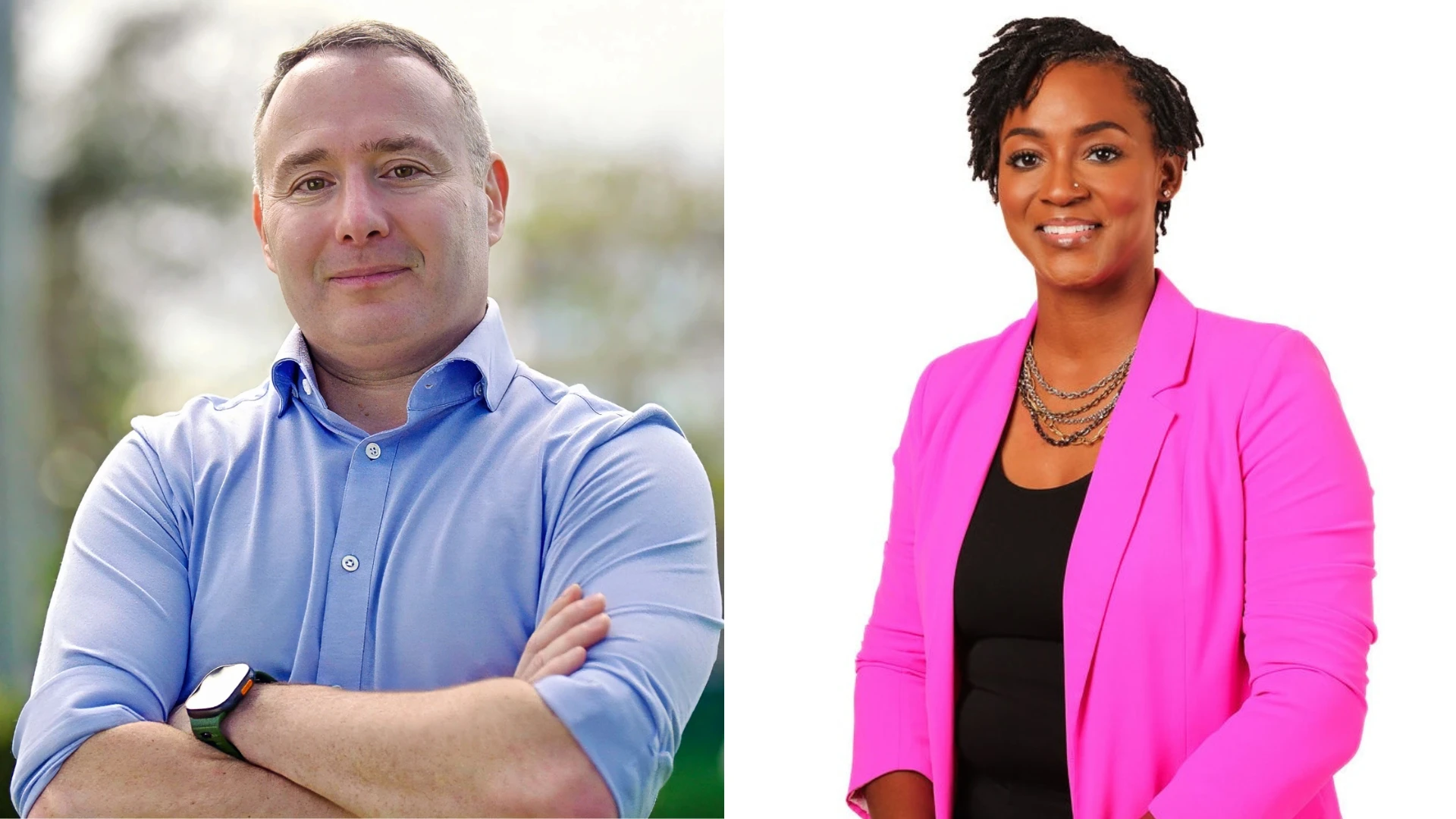
Alex Vindman (left) and Angie Nixon (right) seek to become the first Democrat from Florida elected to the United States Senate in 14 years. | Submitted
Published on August 2, 2026 at 1:33 pm
Jacksonville Today seeks to include a diverse set of perspectives that add context or unique insight to the news of the day. Regular opinion columnists are independent contractors who are not involved in news decisions. Want to submit your own column on a matter of public interest? Email pitches to jessica@jaxtoday.org.
In a campaign cycle that has looked like chaos theory with a ballot, it’s appropriate that we close the pregame analysis with an examination of a political wildcard U.S. Senate campaign and the butterfly effect it could create in local races.
I’ve written more than every other journalist in Florida combined about state Rep. Angie Nixon, D-Jacksonville, over the years, and as we head toward early voting and her U.S. Senate campaign hangs in the balance, here’s a few hundred more words for the pile.
Jacksonville Today thanks our sponsors. Become one.
Yet unlike those articles that look at her fundraising, her legislative record, or her legal controversies, this one examines the downballot effect created by her Senate race in this region.
As I write this, it’s unclear whether Nixon has the juice to overcome better-funded Lt. Col. Alex Vindman, an establishment candidate whose rep was built on animus to Donald Trump and who is on MSNBC so much one might assume he has a cot in their green room to sleep between shifts.
The money hasn’t shown up for Nixon, but big endorsements have, including from other Florida progressives like Congressman Maxwell Frost, state Sen. LaVon Bracy Davis, and state Rep. Anna V. Eskamani. She’s also gotten national backing, including from Rep. Ilhan Omar.
Jacksonville Today thanks our sponsors. Become one.
She’s not a formal Democratic Socialists of America member or candidate, but in terms of Florida’s rightward-slanting Overton Window, she’s as far left as any plausible statewide candidate has been in years, with recent gubernatorial hopeful Andrew Gillum being the only real competition there. The race, in some respects, resembles the Michigan Senate primary between moderate Haley Stevens and left-leaning Abdul El Sayed.
It’s unclear whether Nixon can win the way El Sayed appears poised to do in Michigan on Tuesday, especially since polling data of the primary race is virtually non-existent.
Vindman, who just moved to Florida, is running a duck-and-cover campaign against Nixon. He’s not debating her, and he seems to take Black and female voters for granted in the general election, which he believes will be won if he sells himself to independent voters on the I-4 corridor — the traditional graveyard for Democratic moderate campaigns.
Whether or not Nixon can win, what we do know is she is the overwhelming choice of Democrats in Northeast Florida. Polls from the Tyson Group and Change Research showed her with a 3-to-1 advantage, give or take. One assumes she will stack votes here, and that stack could impact races for Congress and City Council, potentially benefiting other Black women running for office against the odds.
In Congressional District 4, LJ Holloway is a known quantity who has been nominated and who has lost the general election to incumbent Republican Rep. Aaron Bean before. This time around, she faces former Jacksonville Ethics Commission Chair Michael Kirwan and Democratic Socialists of America member Brit Robinson in the primary. Kirwan has a considerable financial advantage, yet in polls from the Tyson Group and an internal from Robinson’s campaign, he’s not winning.
Kirwan’s camp says he is doing better in their internals, for what it’s worth.
But the question is: Do people outside of the Riverside-Avondale Historic District know who he is? Or will people vote for the name they know?
In a primary scenario favoring heavier turnout for Black voters as well as female voters, any victory strategy has to see him turn out people voting for Nixon on the 18th. It may be a tough sell in this environment.
Nixon’s campaign could also boost City Council candidate Mone Holder, a Democrat who is in a three-way battle with Republican police officer Deborah Wesley and Libertarian Addison Patrick.
Holder has a couple of ads on television funded by a political committee that has been heavily funded by lawyer Steve Pajcic, as Democrats look to get Holder the 50% she needs to win outright in August. There’s a good reason why it’s now or never.
If this goes to November as a run-off without a third-party candidate on the ballot, Wesley likely will benefit from the Republican Party’s superior infrastructure, and those backing Patrick will likely diffuse in a way that can’t be predicted this far out.
Ultimately, Wesley’s near-term fate may be a test of Sheriff T.K. Waters’ political capital. He endorsed her early and may have to flex his muscles since former Mayor Lenny Curry is locked in on making sure Donna Deegan doesn’t get a second term, amid some well-documented bad blood between the two.
Waters didn’t help Republican mayoral hopeful Daniel Davis much in 2023, of course, and is unproven on the ballot beyond his Gov. Ron DeSantis-assisted win in a 2022 special election to replace Mike Williams after he resigned once it was revealed he didn’t want to live in the county he sheriffed anymore. So Wesley may have an advantage here, particularly given the GOP gubernatorial primary is likely decided beyond figuring out how much protest vote James Fishback gets from the youth.
And those young voters, who lean libertarian and are irked at Republican big-government, war-friendly ways, are less likely to vote for a cop, which only boosts Holder’s hopes this month.