The current City Council district map | City of Jacksonville
Published on May 10, 2026 at 9:00 am
Jacksonville Today seeks to include a diverse set of perspectives that add context or unique insight to the news of the day. Regular opinion columnists are independent contractors who are not involved in news decisions. Want to submit your own column on a matter of public interest? Email pitches to jessica@jaxtoday.org.
Redistricting in recent years has on the balance been at the expense of representative democracy, if one zooms out and takes the long view.
We’ve seen that play out here in Florida in recent years, culminating with the congressional reapportionment approved last month that appears, unless Democrats really benefit from a mid-term ‘wave’ election, poised to give the GOP 24 of the state’s 28 congressional seats.
Jacksonville Today thanks our sponsors. Become one.
Not bad for a state that is 41% Republican.
Gov. DeSantis alternated various justifications for the map. He correctly anticipated the SCOTUS ruling in Louisiana v. Callais that kneecapped the concept of minority-access seats.
According to the governor’s interpretive approach, that ruling affirms the preeminence of the Equal Protection Clause over the Voting Rights Act nationally (except in the case of what Justice Alito called “intentional discrimination,” which is impossible to prove in this case).
By that same approach, it also kneecaps Florida’s popularly approved Fair Districts Amendments as it renders unconstitutional the provision that “districts shall not be drawn with the result or intent of denying or abridging the equal opportunity of racial or language minorities to participate in the political process or to diminish their ability to elect representatives of their choice.”

Jacksonville Today thanks our sponsors. Become one.
In the end, it’s all a matter of literary interpretation on the part of the conservative super-majority High Court, which jibes with centuries of American jurisprudence. There is every incentive for judges to craft an opinion to meet a desired outcome. And the desired outcome in this case by DeSantis, most Florida Republicans, and the Supreme Court is to turn back the clock on minority-access seats.
Conservatives will argue that the idea of a minority-access seat was itself a judicial construct. But it was one that they embraced. Florida’s seats, like the former one occupied by Corrine Brown from 1993 to 2016, had advocacy via an alliance of Black Democrats and Republicans in a Tallahassee, where Democrats had a lot more sway than they do today.
Ultimately, federal judges enacted a plan that created a few districts designed to be won by Black Democrats, and versions of that plan were affirmed until the last decade brought reversals that we saw locally.
2015’s League of Women Voters v. Detzner case spurred a change from the Jacksonville-to-Orlando configuration of the old Corrine Brown district to a district that ran west and suited Rep. Al Lawson in 2016.
Lawson, who local Republicans liked, was helped by Brown’s legal troubles keeping her from fundraising, and by a second Jacksonville Democrat, L.J. Holloway, in that primary.
Fast forward six years and Jacksonville’s minority-access seat would be gone for good. Legislators considered an option that would have been a Duval-only seat, but it was a non-starter for DeSantis, who rejected it and split Jacksonville into two seats that were safe Republican holds.
Despite DeSantis saying a reason to redraw the seats was because of population growth making them malapportioned, his team’s effort mysteriously didn’t go north of the I-4 Corridor.
This meant that growth in Flagler, St. Johns, Clay and Nassau, which could have been in play to bring another seat to the area in a true attempt to square representation with population, simply was ignored.
While there was no effort to deal with state legislative seats in this just-completed Special Session, noise is being made even more locally about a “race-neutral” map.
Term-limited Republican City Council member Rory Diamond is not ruling out running for mayor despite much of the establishment liking House Speaker Pro Tempore Wyman Duggan (who presided over the House passing the map last month). Diamond says he wants local redistricting and that there is time to do just that before the 2027 elections.
He’s right, of course, at least when it comes to the time element. Legal wrangling over Jacksonville’s attempt at local redistricting led to a judicially imposed map just weeks before qualifying in 2023.
But his proposal is a poison pill for other reasons, one that plays to a political base at the expense of other considerations.
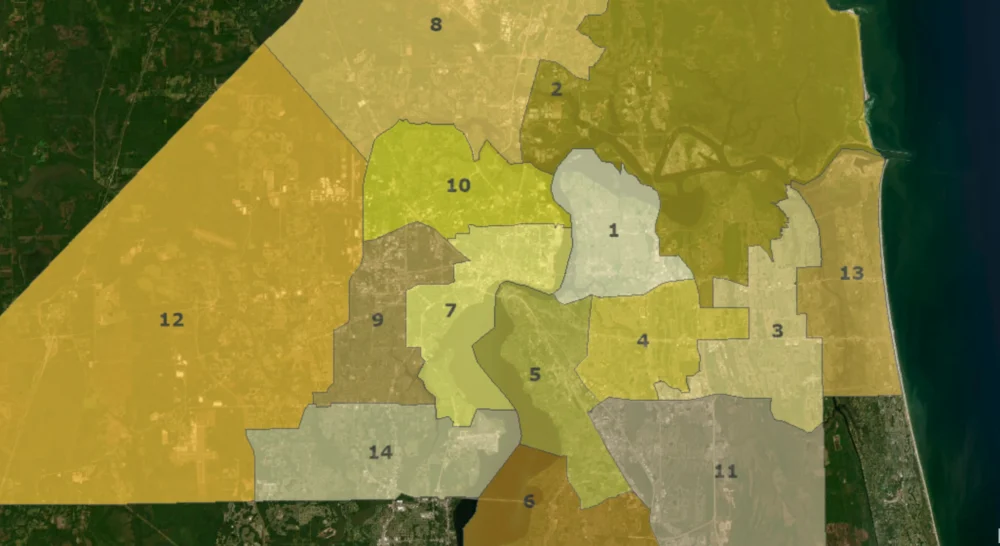
Jacksonville’s current City Council district map, which continues to try to make up for the disempowerment of Black politicians brought forth by Consolidation six decades ago, maintains four districts that are intended to allow Black candidates to be elected.
Three of them do just that, and the fourth – the Urban Core/Westside District 7 – is currently represented by Jimmy Peluso, who’s leaving the seat to run at large next year. The district will be the setting for a March “First Election” that will be an interesting test of whether voters in Avondale and the Eastside can line up behind the same candidate, as they did back in 2023.
Diamond’s “race-neutral” map could very easily chop up those districts. It doesn’t take much imagination to figure out how that could happen, even if districts are drawn without crossing the St. Johns River. It would be easy enough to dilute them. And if your goal is partisan domination, it would be political malpractice not to.
It’s hard to imagine this really gets legs in 2027 though. Incumbents running again don’t want surprises. There are still enough swing-vote Republicans on the City Council, like Ken Amaro, Michael Boylan and Matt Carlucci, to frustrate the scheme.
If this plan does get oxygen, it benefits two people ultimately.
Mayor Deegan could shore up her support by simply saying there is no reason to redistrict in the middle of the decade. And Rory Diamond would benefit from earned media like this.
The plan doesn’t benefit Wyman Duggan, who is given a no-win choice of opposing “race neutral” districts or launching his eventual campaign by supporting a gambit that would change Black representation as we know it.
To be sure, Black Republicans can and do get elected – like Sheriff T.K. Waters, Amaro and Terrance Freeman on the Council, Kiyan Michael in the House. For the Black Democrats who have benefited from maps as we’ve known them, local redistricting either in 2027 or 2031 will likely be the end of an era.
It’s worthwhile to mention, especially for those new to the area, that Jacksonville has had a lot of lowlights in race relations. From the Great Fire of 1901 to Axe Handle Saturday to tensions around integrating schools in the 1970s, the city’s history reflects institutional discrimination.
Has that been remediated?
A drive through Grand Park and Northwest and the Eastside and various other neighborhoods points to systemic neglect, even after multiple mayors vowed to do something about it. The council members, the state legislators and so on haven’t been able to move the needle, even with dedicated representation intended to address community needs.
Would a “race-neutral” map do anything to make the lives better of those who would be divested of representation by it? These questions don’t come up.
Ultimately, the next local map won’t look like the current one. That’s a given. But absent a successful, expedited legal challenge to the current map, city leaders simply don’t have the excuse to move forward for the 2027 cycle. And it’s not in any incumbent’s political interest to open up Pandora’s Box.
The best shot at immediate change would be a timely court challenge to the current map. It doesn’t cost much to file a lawsuit, and we will see if that is the move.