
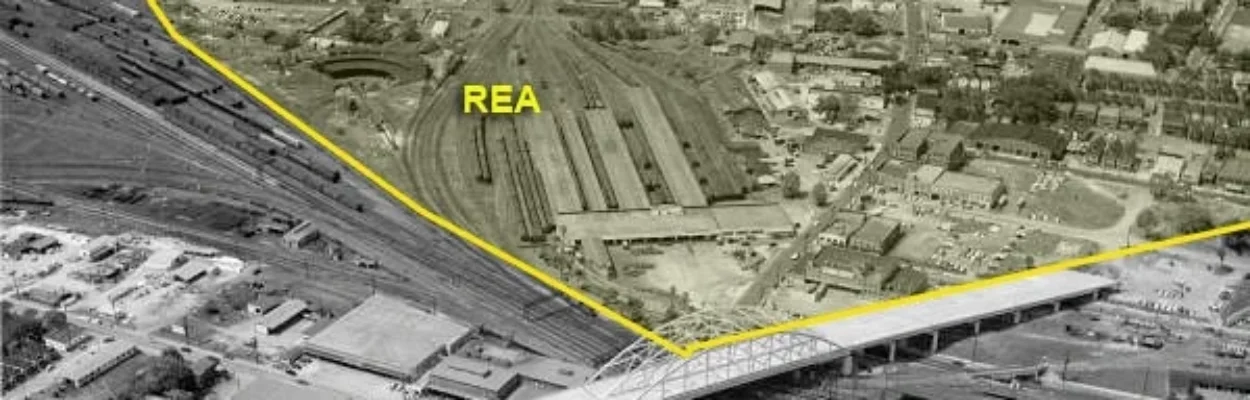
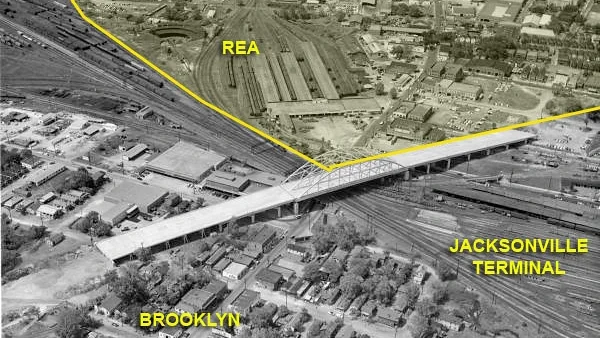
An aerial view of the former site of the Railway Express Agency Terminal.
Published on April 8, 2026 at 11:41 am
Free local news and info, in your inbox at 6 a.m. M-F. Sign up for the Jacksonville Today newsletter.
For nearly half a century, the Railway Express Agency shaped Jacksonville’s economy and identity, leaving behind a legacy still felt today.
Railway Express Agency: Early foundations and expansion
In the late 1920s, as railroads defined the rhythm of American commerce, Jacksonville emerged as a vital logistics hub in the Southeast. At the heart of this activity stood the Railway Express Agency Terminal on Myrtle Avenue, strategically positioned near Union Terminal and operated by the Jacksonville Terminal Co. What began as a modest operation using trucks and even horse-drawn wagons would grow into one of the most significant express shipping centers in the nation.
Jacksonville Today thanks our sponsors. Become one.
The Railway Express Agency itself was born in 1928, when 86 railroads united to acquire the American Railway Express Co. and form a new nationwide express delivery system. Jacksonville quickly became a key node in the network.
By the late 1920s, REA had established its presence on West Bay Street, handling shipments with a mix of modern vehicles and older transport methods reflective of a transitional era.
Soon after, operations shifted to a larger and more efficient facility at Bay Street and Myrtle Avenue. This move marked the beginning of Jacksonville’s rise as a major REA hub, with the new site accommodating the growing volume of freight moving through the city.


Jacksonville Today thanks our sponsors. Become one.
Peak operations: A national powerhouse

By the 1930s and 1940s, the Jacksonville REA terminal had reached extraordinary levels of activity. At its peak, the facility employed as many as 500 workers locally, and in December 1939 alone, more than 1,400 people were involved in operations. The Myrtle Avenue terminal was widely regarded as the largest express facility of its kind in the U.S., if not the world.
Daily operations were staggering. Approximately 275 railcars were processed each day, and payroll and operating expenses reached about $85,000, a significant sum at the time.
The terminal handled everything from agricultural products to high-value shipments, including consignments of silver coins worth up to $500,000 transported to the Federal Reserve Bank on Julia Street. Security was taken seriously. REA employees often “rode shotgun,” armed with company-issued weapons to protect valuable cargo. While Jacksonville avoided dramatic train holdups, theft still occurred in the form of break-ins, with entire trailers sometimes stolen.
World War II brought both challenges and opportunities. In 1943, the Jacksonville REA terminal made a notable shift by hiring more than 100 Black women as express handlers, a significant step in workforce diversification during a transformative period in American labor history.
The postwar years marked the agency’s peak nationwide. In 1946, REA employed approximately 83,000 people across the country, making it one of the largest logistics organizations in existence.
During the 1950s, Jacksonville’s REA terminal played a critical role in Florida’s citrus industry. The facility handled virtually all citrus shipments leaving the state. In one remarkable 24-hour period, workers transferred 183 carloads of fruit, underscoring the terminal’s importance to both regional agriculture and national distribution networks.
End of an era

Despite its dominance, REA could not escape sweeping changes in transportation and logistics. By 1965, the company began operating at a loss. The decline accelerated in 1966 when the Southern Railway discontinued the Royal Palm passenger train, which had connected Cincinnati and Jacksonville. This marked a turning point, prompting REA to shift more aggressively into over-the-road trucking.
A truck route between Jacksonville and Atlanta was soon established, and gradually, railroads began discontinuing express train services. Jacksonville’s role diminished as operations were consolidated elsewhere, particularly in Atlanta.
In 1969, ownership of REA changed hands when 50 major railroads sold the company to a group of private investors. The restructured entity, REA Express, Inc., struggled to adapt in an increasingly competitive and rapidly evolving logistics landscape.
By April 1974, Jacksonville’s REA operations had vacated their long-standing Myrtle Avenue site. The final chapter came in 1975, when REA Express, Inc., once the nation’s largest surface carrier, declared bankruptcy.
At the time of its closure, the company operated 232 terminals across the U.S., Canada and Puerto Rico. Its collapse resulted in the loss of approximately 8,000 jobs nationwide. In Jacksonville, the shutdown followed shortly after the opening of a new $300,000 service center on Lane Avenue, leaving around 25 local employees without work.
The closure marked the end of nearly 50 years of REA activity in Jacksonville, a period defined by the rumble of freight wagons, the clatter of railcars and the steady evolution of American transportation.
Railway Express Agency’s Jacksonville legacy
The rise and fall of Jacksonville’s Railway Express Agency terminal mirrors the sweeping transformation of American logistics, from a rail-dominated system to the trucking and air networks that define modern shipping. Though the REA is long gone, its legacy remains embedded in the city’s history.
Today, the site has been redeveloped as a Jacksonville Transportation Authority maintenance facility at 100 North M. Ave., but it once stood as a powerful symbol of the city’s role as a transportation crossroads, seamlessly connecting rail, road and eventually air freight in a way that helped shape the city’s growth and identity.