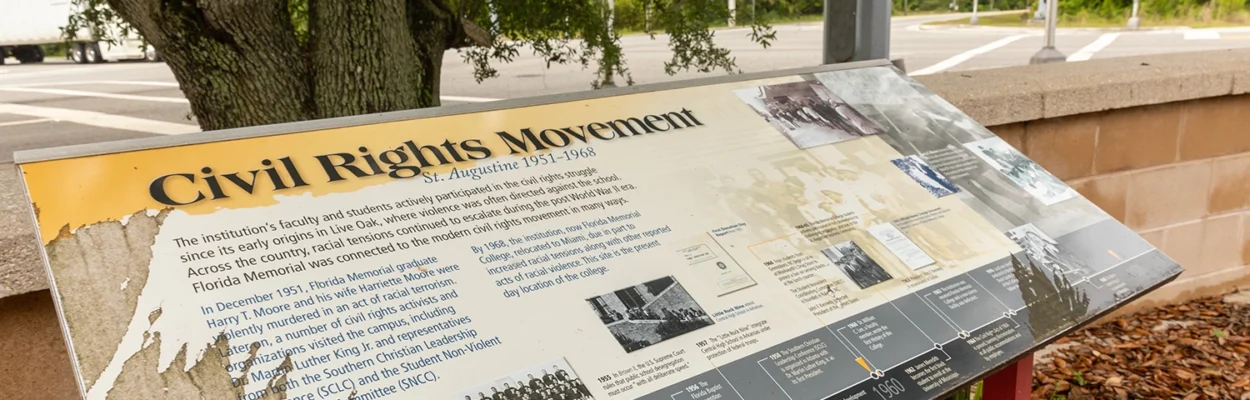
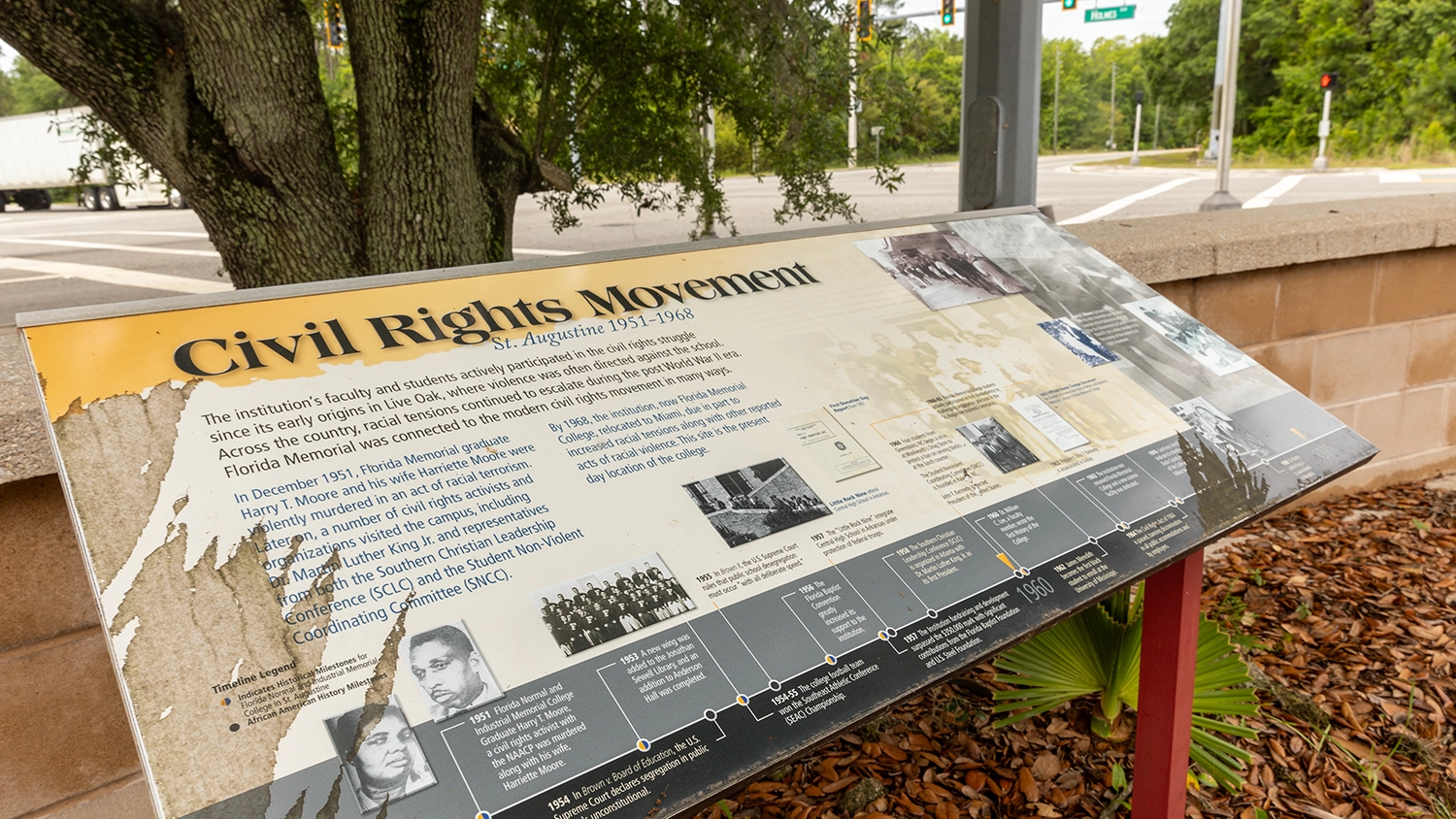
A historical display stands at the future site of the Florida Museum of Black History in West Augustine. | Will Brown, Jacksonville Today
Published on March 19, 2026 at 12:10 pm
Free local news and info, in your inbox at 6 a.m. M-F. Sign up for the Jacksonville Today newsletter.
For the second year in a row, a bill that would have codified St. Johns County as the home of Florida’s Black history museum failed to make it to Gov. Ron DeSantis’ desk.
Without legislative support, the people behind the museum say its timeline is a big question mark.
Jacksonville Today thanks our sponsors. Become one.
But County Administrator Joy Andrews still says there’s reason to be optimistic about the museum’s future — she says a change in leadership in Tallahassee could be beneficial for St. Johns County.
“We have sort of all of our eggs in next year’s basket,” Andrews says.
A bill sponsored by Sen. Tom Leek, R-Ormond Beach, has passed the Senate two years in a row, but the House version of the bill, sponsored by Rep. Kiyan Michael, R-Jacksonville, failed to pass both years it was filed.


Jacksonville Today thanks our sponsors. Become one.
To reach the governor’s desk and become a law, both bills must be approved in their respective chambers.
“We’ve got a great deal of support within the Black community. We’ve got a great deal of support around the state for taking on this museum,” Leek says. “Unfortunately, we’re at a place in the House of Representatives where one or two members can block a bill that’s got overwhelming support even within their own chamber.”
Leek says the bill is not necessarily a requirement to get the museum built. A task force appointed by DeSantis and lawmakers selected St. Johns County as the home for the state’s Black history museum, and no legislation has challenged that.
Leek’s bill would have created a governing body for the museum, and Andrews says that would make securing funding much easier.
“We’re talking about building something that has never been built before,” she says. “We’re kind of in this super new territory.”
But it’s not all setbacks for the museum’s future.
Last month, DeSantis said during the unveiling of a statue of Frederick Douglass in St. Augustine that “one way or another” the museum would be built.
In October, St. Johns County signed an agreement with the Florida Memorial University Foundation to use the land that was once the university’s campus as the site of the Black history museum.
And during last year’s legislative session, lawmakers approved $1 million in funding for St. Johns County to work on planning and design for the museum. Andrews says the county is finalizing a contract with the Department of State to get that money and start the process of designing the museum.
The Senate version of the state’s budget includes another $1 million for the museum’s design phase — and Leek says he would like to see that bumped up to $2 million — but Andrews says the county is not optimistic about the money making it into the finalized budget when lawmakers come back next month.
Andrews doesn’t believe even $3 million will cover the entire cost of designing and planning the museum, but she hopes the project will have better luck in the Legislature next year.
“We’re hopeful with the future speaker, Sam Garrison, seated we’ll get more support on the funding side.”
Andrews says Garrison, R-Fleming Island, is “very supportive” of the museum plan.
The future of the Black history museum
Few people have been involved in the effort to build the Black history museum longer than Howard Holley.
The retired business executive and CEO of EVOLVE Communications Group was a member of the task force that selected St. Johns County as the museum’s future home. He now sits on the board of the foundation that will help financially support it.
Holley says that everyone involved knew the museum would take years to come to fruition but that it’s still frustrating that some people who have advocated for the museum may not be around to see it when it’s finally done.
Without the bill creating the museum’s governing body, Holley says the foundation is in a holding pattern.
“Our role at the foundation is fundraising, statewide communication and community engagement,” he says. “You can’t do the latter two without fundraising. We’re not able to execute and operate as strongly as we had assumed.”
But that doesn’t mean the members are sitting on their hands.
The foundation’s board is expanding, and it recently launched a magazine, Estebana, and sponsored a play about the Civil Rights Movement at the Limelight Theatre in St. Augustine.
Holley, like County Administrator Andrews, remains optimistic that once the bill is finally heard in the House of Representatives — hopefully next year, Holley says — that it will be received as positively as he expects it will.
“It cleared the Senate 31-0. The task force was formed with only one dissenting vote in the House,” Holley says. “There is no sense that this is a political issue or it lacks support. It just has not been heard to allow it to move forward.”