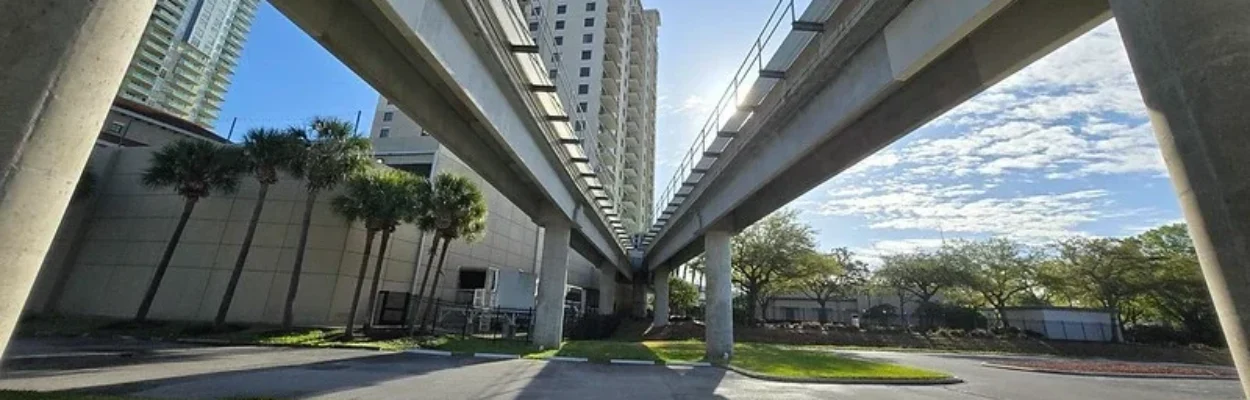
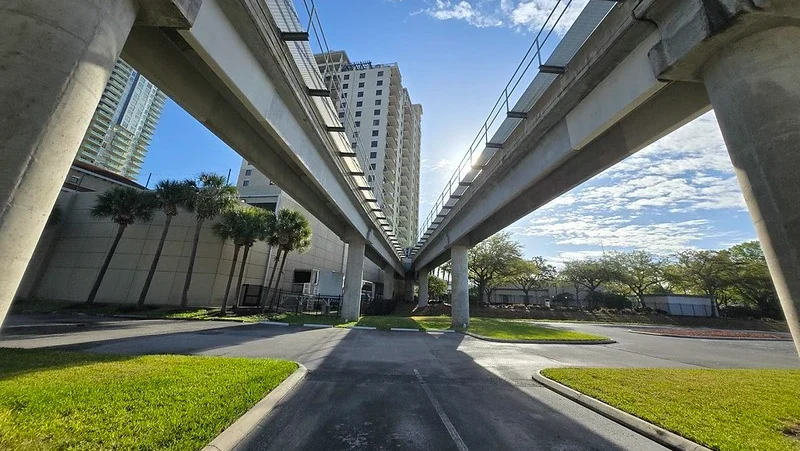
Skyway tracks, seen from ground level | Ennis Davis
Published on March 18, 2026 at 1:16 pm
Jacksonville Today seeks to include a diverse set of perspectives that add context or unique insight to the news of the day. Regular opinion columnists are independent contractors who are not involved in news decisions. Want to submit your own column on a matter of public interest? Email pitches to jessica@jaxtoday.org.
As Jacksonville revisits the future of its Skyway system, the choices made today will shape how people move through Downtown for decades. The question isn’t just how to fix an aging system, it’s what kind of transit future the city truly wants.
The Background
The Jacksonville Transportation Authority has launched a new project development and environment study to evaluate options for rehabilitating and modernizing the Skyway as part of its Ultimate Urban Circulator program. Nearly three decades after the system was upgraded with Bombardier technology in 2000, the Skyway now faces mounting challenges: aging prototype vehicles, limited availability of replacement parts and outdated software that complicates long-term maintenance and reliability.
Jacksonville Today thanks our sponsors. Become one.
The latest study effort echoes a similar evaluation conducted in 2015, once again placing the future of the Skyway at a crossroads. The current study will analyze a range of alternatives, weighing their benefits, trade-offs, community impacts and projected costs. Ultimately, the goal is to identify a preferred path forward for consideration by the JTA board.
At the same time, this moment presents a broader opportunity. Beyond addressing immediate infrastructure concerns, Jacksonville must also consider its long-term vision for urban transit and how the Skyway fits into a more connected, regional mobility system.
We recently attended the first in a series of public meetings focused on the Skyway Rehabilitation PD&E study. What we heard, and what’s being proposed, raises important questions about how best to improve mobility in and around Downtown Jacksonville.

Jacksonville Today thanks our sponsors. Become one.
Below are our thoughts on the six alternatives currently being presented for public input. Take a look, and join the conversation, as your feedback can help shape the future of transit in Jacksonville.
No build alternative
The “no build alternative” serves as the baseline for comparison against all other options. Under this scenario, the Skyway would continue operating in its current state with its last remaining vehicles essentially running the system until those cars fail completely.
We view this as a nonstarter. At its peak in 1997, the Skyway operated with 10 vehicles and four-minute headways. Today, allowing the system to simply deteriorate into obsolescence amounts to demolition by neglect. It would not only squander public investment but could also require the city of Jacksonville to repay federal funding due to failure to maintain the asset.
Put simply: This is the equivalent of ignoring a leaking roof for decades and hoping the mortgage disappears when the house collapses.
Alternative 1: Rehabilitation of existing cars

This option would maintain the current Skyway system while rehabilitating and modernizing the vehicle fleet. A manufacturer would be engaged to repair, retrofit and rebuild the cars to restore original service levels. The existing guideway would remain in place, supported by track repairs and a new automated train control system.
Of all the alternatives presented, this is our clear top choice.
Notably, an automated people mover manufacturer has expressed interest in refurbishing the full 10-car fleet and potentially adding a third car per train. This upgrade alone could increase capacity from 56 to 84 passengers per train, a roughly 50% gain.
This alternative is also likely the most cost-effective option that preserves true mass transit. In fact, it may cost less than recent local investments in the NAVI autonomous vehicle program.
When considering cost, timeline and minimal disruption to existing infrastructure, this option stands out as the most practical and impactful path forward.
That said, we have one critical recommendation: This plan should include an extension into Brooklyn. With much of the infrastructure already in place, this relatively modest investment could significantly increase ridership and system usefulness almost immediately.

Alternative 2: New automated people mover trains

This alternative replaces the existing Skyway vehicles with a new fleet of modern automated people mover trains, offering improved comfort, updated technology, and more frequent service.
For years, we’ve supported this option as well, particularly as a long-term investment in a modern transit system.
However, there are important considerations. New APM vehicles are typically larger and heavier than the current fleet, which could require substantial upgrades to the existing elevated guideway. These infrastructure modifications could significantly increase both cost and project timeline.
Given these realities, and Jacksonville’s history of prolonged transit planning cycles, it’s possible that even this option would require interim rehabilitation of the existing fleet just to maintain service over the next decade or more.
Alternative 3: Convert track and system to autonomous vehicles

This option would transform the Skyway into a dedicated roadway for autonomous vehicles. The elevated structure would be resurfaced and modified to accommodate AV operations, including changes to station platforms and the addition of access ramps.
We view this as a distant middle-tier option.
While it offers the benefit of a fully dedicated right-of-way, improving safety and reliability compared to AVs operating in mixed traffic, it comes with significant drawbacks. These include high costs, extended system shutdown during reconstruction, and a risky reliance on still-evolving unproven technology. We continue to maintain that the AV technology preferred by JTA, the NAVI shuttles, should not be a direct replacement for the Skyway and the mass transit benefits a train brings.
As a result, this alternative ranks well behind our preferred transit-based solutions.
Alternative 4: Remove Skyway structure and operate autonomous vehicles on existing streets

This alternative would remove the Skyway’s elevated infrastructure entirely and replace it with autonomous vehicles operating on Downtown streets, supported by new at-grade stations.
We strongly oppose this approach.
Jacksonville has already lost too much of its historic and functional infrastructure to demolition. Removing a fully grade-separated transit system, including a river crossing that would be extremely costly (nearly $1 billion) to replicate, would be a step backward.
Additionally, autonomous vans operating in street traffic are not a true replacement for fixed-guideway transit. This shift would reduce capacity, reliability, and the city’s ability to compete for future federal transit funding.
Alternative 5: Repurpose Skyway as a multiuse trail and operate autonomous vehicles on existing streets

This option repurposes the Skyway into an elevated multiuse trail connected to the Emerald Trail network, while shifting transit service to autonomous vehicles operating on city streets.
This is also a firm no.
While the idea of an elevated trail may sound appealing, it undermines ongoing investments in the Emerald Trail system and fails to deliver meaningful transportation benefits. Replacing high-capacity transit with slower, lower-capacity vehicles in mixed traffic represents a clear step backward.
Worse, this option would require substantial spending to basically demolish much of the Skyway’s elevated infrastructure, then reconstruct a much wider new sidewalk while saddling the city with long-term maintenance costs in the millions annually for new infrastructure with limited transportation utility.


The Jaxson’s ranking
Preferred
- Alternative 1: Retrofit the existing cars
- Alternative 2: New automated people mover trains
Neutral
- Alternative 3: Convert track and system to autonomous vehicles
Absolutely Not
- No build
- Alternative 4: Remove Skyway structure and operate autonomous vehicles on existing streets
- Alternative 5: Repurpose Skyway as a multiuse trail and operate autonomous vehicles on existing streets
Upcoming Skyway public meetings
JTA has four more public meetings planned to introduce the public to the alternatives under consideration:
- Tuesday, March 24, 11 a.m.-1 p.m. and 5-7 p.m. at FSCJ Advanced Technology Center,. Room T140, 401 W. State St.
- Thursday, March 26, 11 a.m.-1 p.m. and 5-7 p.m. at Doubletree Jacksonville Riverfront, 1201 Riverplace Blvd.
It’s anticipated a second round of public meetings will occur in May. We encourage everyone interested in the future of the Skyway and transit in Jacksonville to attend or watch this video and fill out this online survey.