
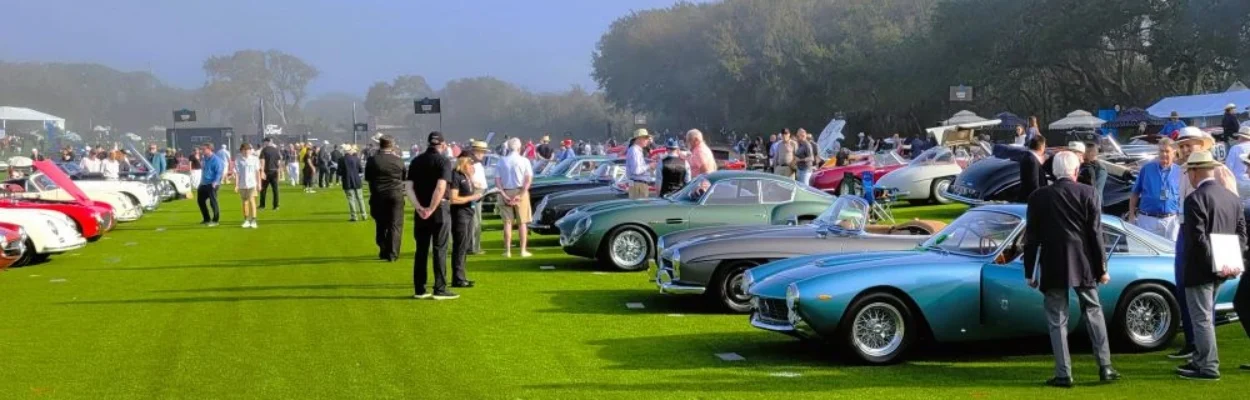
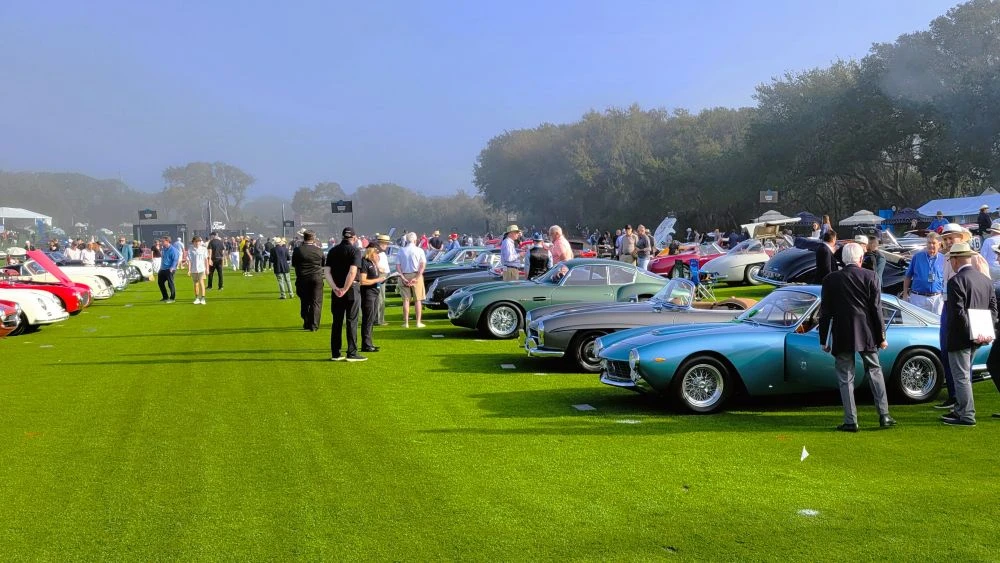
Thousands of fans flocked to see classics like these 1950s and 1960s Ferrari, Aston Martin, Mercedes-Benz and Porsches on the Amelia Concours show field. | Dan Scanlan, Jacksonville Today
Published on March 9, 2026 at 10:39 am
Free local news and info, in your inbox at 6 a.m. M-F. Sign up for the Jacksonville Today newsletter.
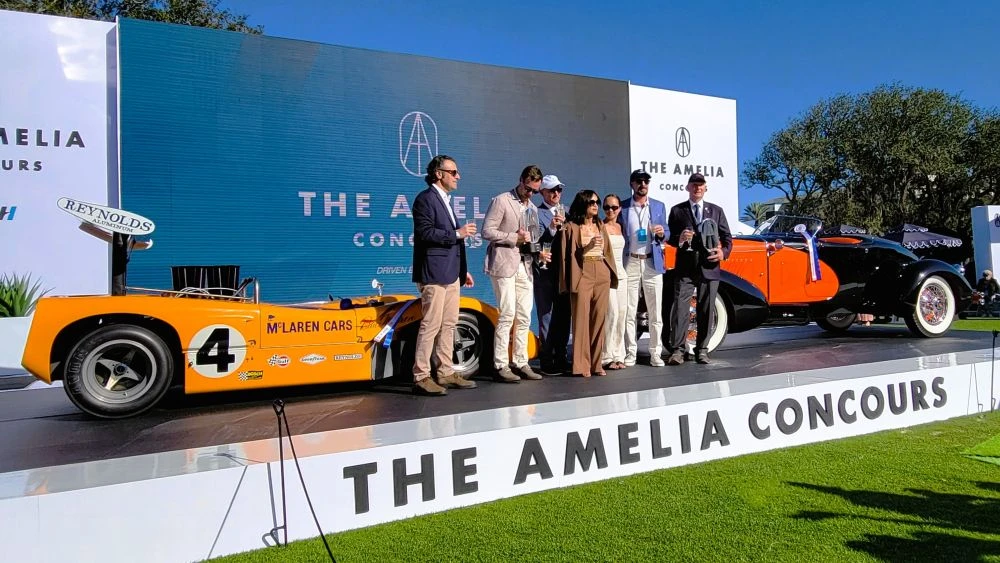
Mike Marzano drove the thundering 1969 McLaren M8B onto the stage at the 31st iteration of The Amelia Concours d’Elegance on Saturday afternoon. Its 7-liter Chevrolet V-8 engine used only a fraction of its 635 hp to roll up so he could get his Best of Show – Concours de Sport award.
Then he moved it nose to nose with Bill H. Lyon’s shapely orange and black 1931 Duesenberg J “Taper Tail” roadster that won Best of Show – Concours d’Elegance at the annual classic and race car display outside the Ritz-Carlton, Amelia Island.
Jacksonville Today thanks our sponsors. Become one.
As fireworks sparkled, both men earned their trophies after 250 cars and motorcycles competed for dozens of awards at a sunny, warm and crowded concours seen by thousands on the golf greens outside the hotel.
For Marzano, head of the Chicago-based collection, the win feels “awesome” for what he candidly calls an insane form of American auto racing in the 1960s and 1970s.
“This is as cool as it gets,” he said. “We hoped to bring a little more awareness of the early McLaren days. Obviously they are back dominating again (in Formula 1), which is great, but not a lot of people are aware of the early period.”



Jacksonville Today thanks our sponsors. Become one.
And as he held his trophy, Lyon said he feels great about the Weymann Coachbuilt “Duesy” winning a best of show.
“It’s a surprise. I have tried to keep my expectations low, but we had a lot of positive reaction to the car and a lot of encouragement to get it here — very excited to be the winner,” he said. “I think it’s just the overall design of the car — there’s not a bad angle or line. Gordon Buehrig, who was chief designer for Duesenberg, was way ahead of his time.”
The concours was founded in 1996 by Bill Warner, a Jacksonville collector and magazine photographer. The automotive charity event is held each March at The Ritz-Carlton, and the 10th and 18th fairways of the Golf Club of Amelia Island next door.
The event annually honors a famous racer and his cars, from Stirling Moss and Richard Petty to Roger Penske. This year, four-time IndyCar Series champion (2007, 2009–2011) Dario Franchitti was the honoree.
The Amelia Concours honoree
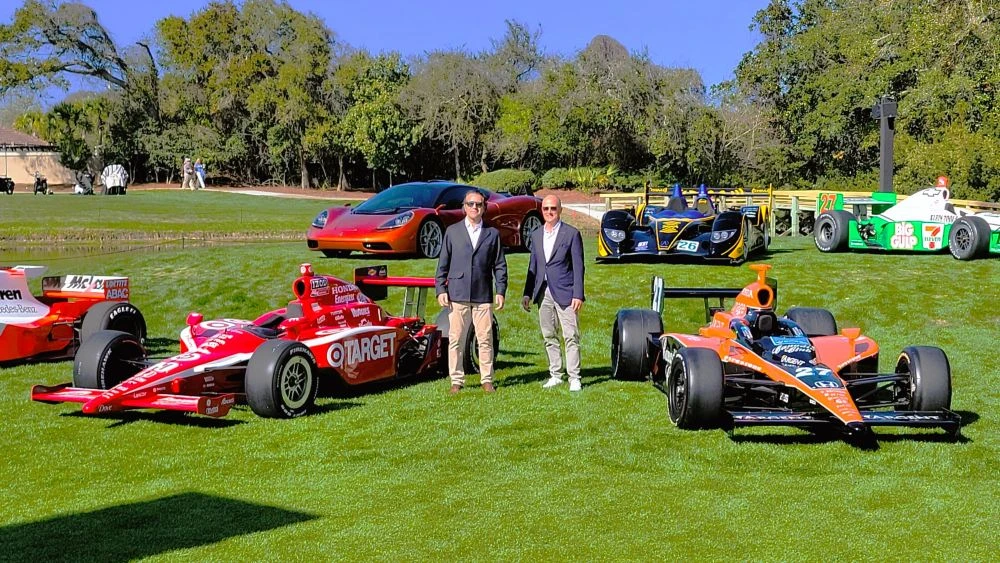
Standing among a collection of his past race cars at the concours, including a 2002 Dallara Chevrolet and 1995 McLaren MP4/10 that helped lead him to four IndyCar championships and three Indy 500s, Franchitti told Jacksonville Today that being named the honoree is “special to me.”
“To be recognized is lovely. My wife, my daughters, my Mum and Dad are here, and great friends are here,” he said. “I have always loved this event, so when I got asked ,it was absolutely a no-brainer. Then you come along here and see the cars that were so important to my past — and the Gordon Murray T.50, to my future.”
Franchitti added that he may be retired from professional driving,” but the “dance card’s really full.” He just tested the T.50s prototype at Bahrain International Circuit, wiping seven seconds off the track’s fastest GT3 lap time, allowing the 761-hp V-12 race car to get final approval.
Thousands of fans checked out 250 race cars, classics and special motorcycles under sunny skies at Saturday’s concours display. Franchitti joined them just a week after his NASCAR truck series race at St. Petersburg. “How great could this be?” asked McKeel Hagerty, CEO of the show’s owner, Hagerty.
“Franchitti kind of comes out of retirement to go racing and does pretty well, and he’s here, he’s having fun and we are having a blast and look at this amazing field of cars,” Hagerty said.
The new date
The concours display switched this year from its usual Sunday date to Saturday. Hagerty said the change seemed to be getting some serious praise.
“What it has allowed us to do is to make sure we get some of the people to actually come and be here with their cars all weekend,” he said. “Sometimes in the past, people would come for a day and leave, and we were stuck with cars and no owners. This is the best of all possible worlds.”
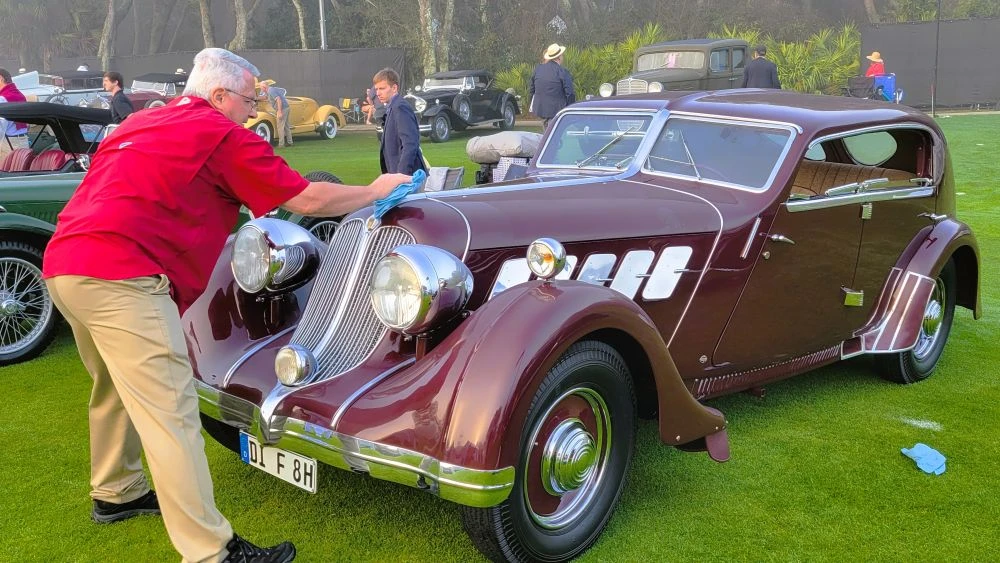
Shiny classic cars from the 1930s, 1940s and beyond decorated the show field, including a 1932 Röhr F8 Streamliner, a one-of-a-kind sedan with streamlined fenders, a very low roof and unique fleur-de-lis-embossed headliner, said Al Rogers, from Michigan’s Stahls Automotive Collection.
Built in Ramstadt, Germany, for the 1932 Berlin Auto show, the car was a last chance to save the company founded in 1926 by engineer Hans Gustav Röhr.
“It’s a 3.3-liter straight eight, and the really neat factor is Ferdinand Porsche built that engine, and was responsible for the engineering of the chassis and drivetrain,” he said. “One other really neat feature is that it is a cubular design — there are six 12-inch cubes that make up the passenger area, joined together to offset for the lower roofline.”
The metallic paint finish is actually ground herring fish scales mixed with its rich red color. The original technique duplicated in its last restoration 25 years ago.
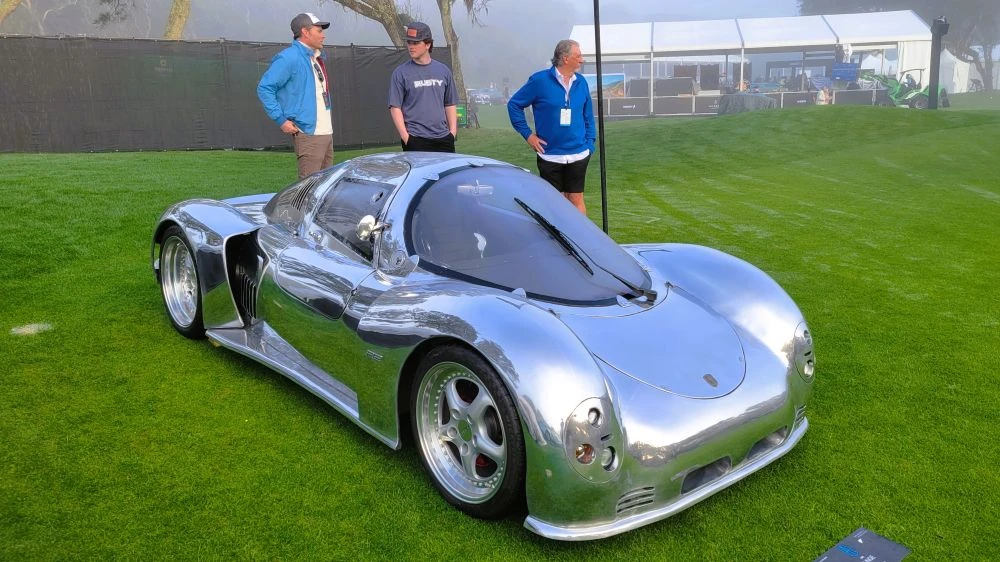
Chris Runge brought his hand-formed, aluminum bodied R2 Coupe. The second of 17 he’s made over the past few years, this one has a 3.6 liter Porsche engine visible through its back window, surrounded by curvaceous polished aluminum body work. And his inspiration came when he attended an Amelia concours years ago
“It’s because of this event, when I first saw raw aluminum used on a car body, possibly a Kellison — you could see the way that it was formed, where the faults were, and the authentic craftsmanship,” he said. “I picked up a Porsche in 2012, and there was a bunch of metal forming tools there too. I had no idea what I was doing, but I bought everything I could just to see if I could play around with it. And two years later, I have my first car.”
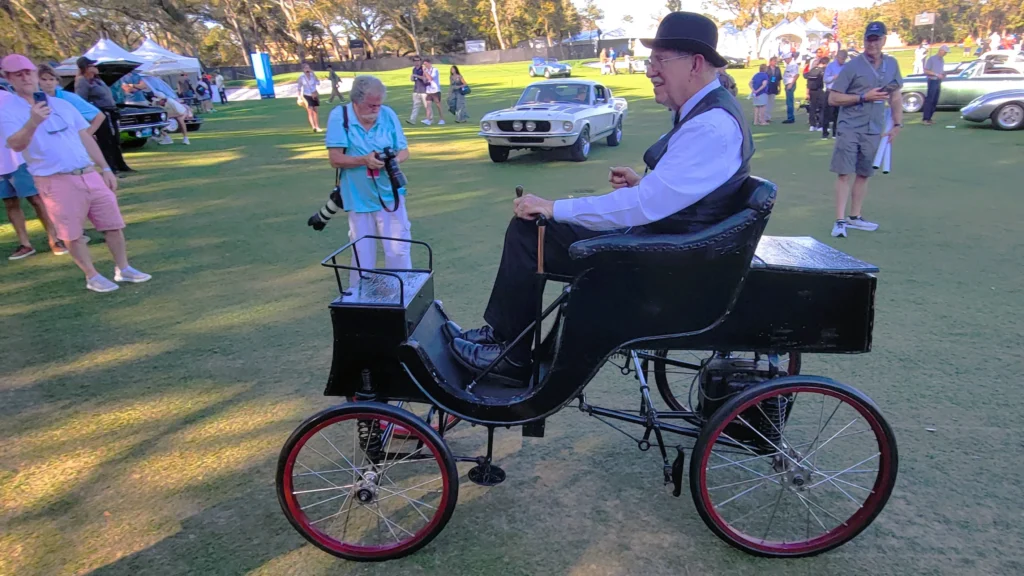
The oldest car at the concours was an 1896 Riker Electric Prototype Made in Brooklyn New York by A.L Riker. His grandson, Rick Riker, said people asked his grandfather back then if he would build an electric vehicle — and he did.
“He was in business for five years as a self-taught electrical engineer,” Riker said. “A lot of the public don’t realize they had electric cars back then. In fact, I was amazed when we went to Pebble Beach and they had eight electric vehicles there in our class, and they had electric cars I never heard of. It was fantastic.”
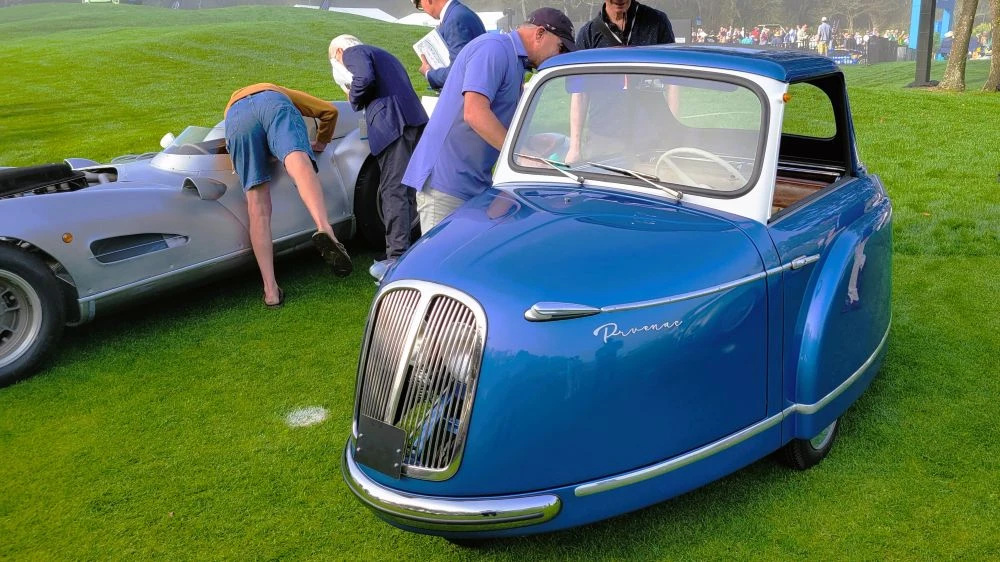
In the “One of One” class, there was a Harmon Splinter and a Mikasa Liza. But the strangest one-off may have been Professor Miroslav Nestorovic’s 1958 Prvenac (Yugoslavian for “firstborn”) diamond-chassis car. Its 14-hp motorcycle engine powers the left and right wheels — mounted on either side of the driver and passenger.
The Lane Motor Museum in Nashville brought the Prvenac to the show. Executive director Chris Brewer said the Prvenac never entered production.
“It has this great symmetrical look, like it could be coming or going,” said Brewer, a Jacksonville resident who just took over at the Lane. “The wheel in the front and back and both used to steer it, so there are these giant tie-rods that runs the length of the car. It can turn on a dime — it literally can do a spin. Like everything, you have to try things to see if they work.”
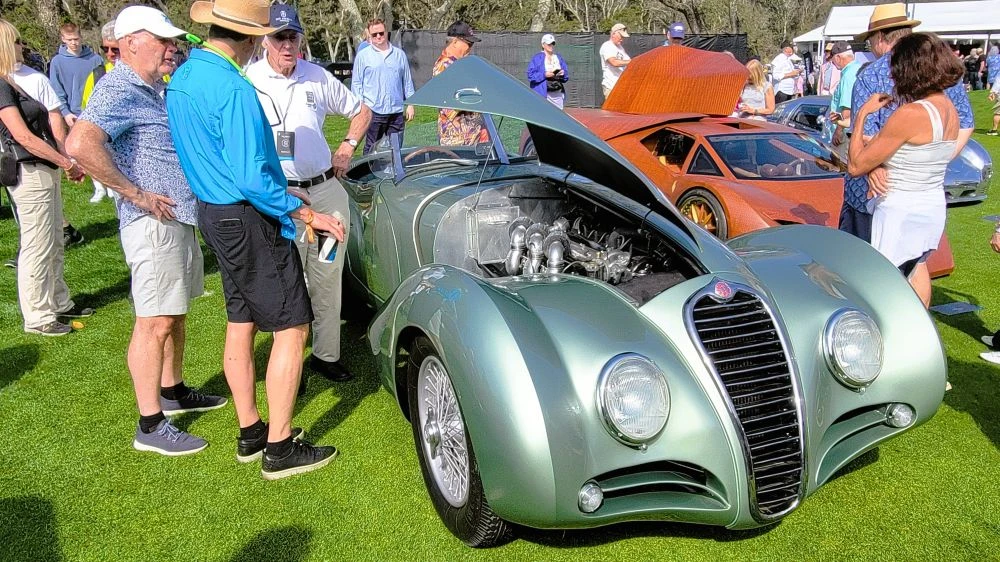
Many exotic Italian cars from Maserati, Lancia and Ferrari were on the show field, along with Paul Wilson’s curvaceous blue 1947 Alfa Romeo 6C-2500. But Alfa Romeo did not build the steel, tapered-tail body. Wilson did, over a decade.
“I am probably $20 million short of buying a real one,” he joked. “The other thing is … I am so picky that there are things they should have done that they didn’t. The real one had a flat windshield — you could have a V-windshield in 1947, and a V-windshield is sexier, so I wanted to design a car that was exactly my complete dream car.”
Economic impact
The weekend event’s economic impact is estimated at $30 million-plus a year, filling hotel rooms from Jacksonville to Camden County, organizers said. The event also has generated more than $4 million in donations to Community Hospice & Palliative Care, Spina Bifida of Jacksonville and Shop with Cops in its first 29 years.
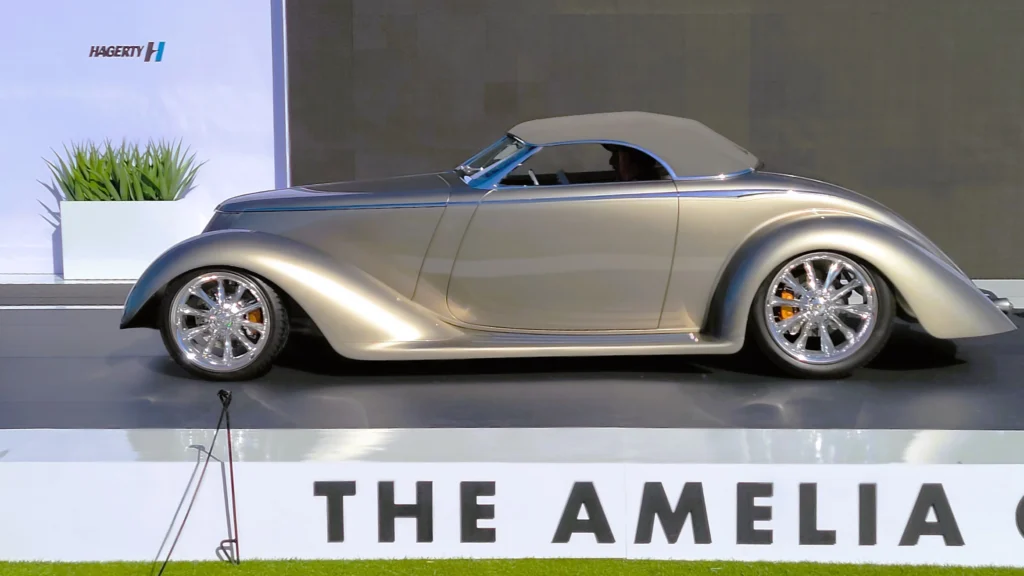
California car customizer and designer Chip Foose had a number of his creations on the field, including a one-of-a-Kind 1956 Continental coupe and a fully reimagined 1936 Ford Roadster. But he spent some time just looking over many of the other cars on display.
“It’s just a pleasure to be here and just phenomenal cars, and to be here with all my customers,” Foose said. “We build cars, but we also build relationships, and I am here with my friends, having a great time.”
After spending his 31st year judging cars, Peter Brock, who designed the Cobra Daytona race cars and co-designed the 1963 Split Corvette, said the show just seems to improve year after year.
“It is at the very pinnacle again. … You can see Hagerty is really trying to upgrade the show. All the details, all the people who make this thing go — it is absolutely sensational, and the cars this year are spectacular. There are cars I have never seen before that are just some of the most beautiful.”
The full video of the concours’ awards ceremony can be found here.