Published on March 4, 2026 at 10:07 am
Free local news and info, in your inbox at 6 a.m. M-F. Sign up for the Jacksonville Today newsletter.
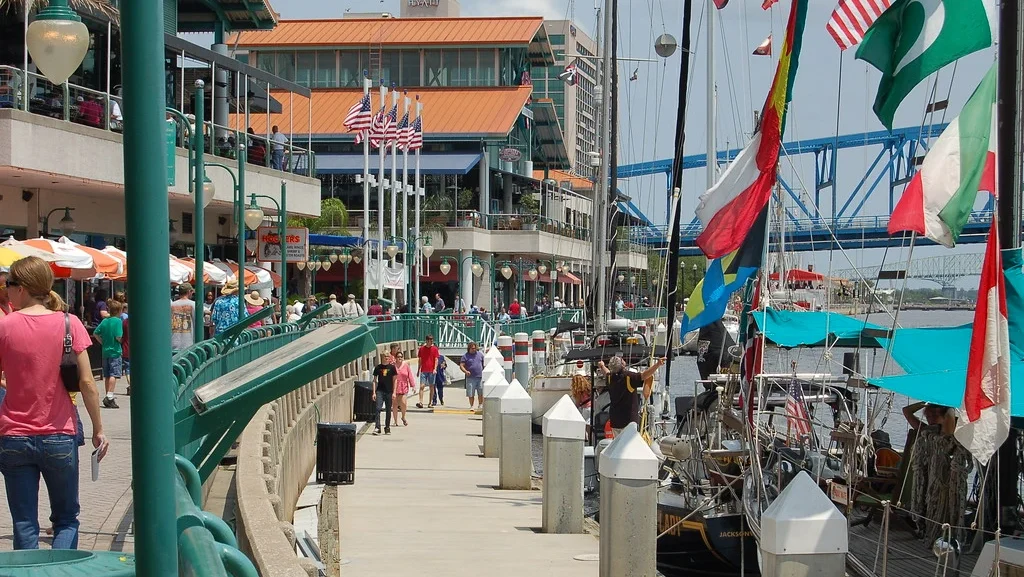
Today, diners struggle to find a restaurant along the river in Downtown Jacksonville that is not inside of a hotel. However, riverfront dining was a part of Downtown’s identity for more than a century.
Here are seven downtown riverfront dining experiences that no longer exist:
Jacksonville Today thanks our sponsors. Become one.
1. Ocean Street Market
Location: The foot of Ocean Street

Prior to World War II, the foot of Ocean Street was Jacksonville’s answer to the kind of interactive riverfront tourists seek when visiting cities like Seattle, San Francisco and Philadelphia. Located along the Northbank, it was home to a large open-air seafood market. Because seafood spoils quickly, commercial fish markets like the one on Ocean Street were historically concentrated in waterfront communities.
After the Great Fire of 1901, a number of businesses clustered around the commercial seafood market along the Ocean Street riverfront. Soon, most of Ocean Street south of Bay Street was lined with produce stands, meat and seafood vendors, dry goods merchants and restaurants.

For decades, it was an authentic destination where residents and visitors alike could experience local cuisine and culture. At its height, the working waterfront included an ice manufacturing plant, a crab meat processing factory, and railroad tracks serving nearby wharves and riverfront industries. Known for the unmistakable stench of fish, the Ocean Street market declined after World War II due to aging infrastructure and the dispersal of the city’s population.
Jacksonville Today thanks our sponsors. Become one.
Determined to clean up what was perceived as a blighted waterfront, Mayor Haydon Burns proposed an urban revitalization plan that replaced Downtown’s market and working waterfront with surface parking lots. By 1956, the place where generations of Jacksonville residents had once purchased their fresh catch had become one of the most scenic parking lots in the South.
2. Lobster House Restaurant (1945 – 1962)
Location: Between the two bridges on the Southside

Located between the Main Street and Acosta bridges, the Lobster House Restaurant was opened by Irving D. Glickstein along the St. Johns River in September 1945. According to Glickstein, he took over a wood-frame building constructed in 1907 that had originally been used by an elderly Polish immigrant as a marine and boat repair shop. The structure was later converted into a warehouse by the Shaw family. At the time, John R. Shaw owned a fleet of shrimp boats operating from the location. Coming from a family whose legacy was built on generations of fishermen, oystermen and crab suppliers, Shaw’s descendants continue to operate the family-owned Shaw Family Seafood Company along the Trout River in Panama Park.
Glickstein, who had previously operated the Dolphin Grille at Marineland, described the Lobster House as the only restaurant of its kind in Jacksonville. Its décor prominently featured marine life imagery, and it boasted a front deck that offered diners sweeping views of the Downtown skyline across the water.
Known as Jacksonville’s “wharf restaurant,” the Lobster House specialized in seafood, particularly its whole broiled Florida lobster. The menu also featured a family-style “giant seafood platter” that included lobster, deviled crab, shrimp, trout, bass, hush puppies, French fries, onion rings and an assortment of sauces. Beyond the main dining room, the property included a cocktail bar, a gift shop, Pier 7 (a private reservation room adjoining the restaurant), and 383 feet of riverfront frontage. In 1947, a second Lobster House location opened at Jacksonville Beach near the foot of the Boardwalk pier.
In 1955, the Lobster House was featured in scenes from the film Revenge of the Creature, the sequel to Creature from the Black Lagoon. At the time, this stretch of riverfront was considered part of the Southside rather than Downtown Jacksonville. The Lobster House ultimately met its demise after fires on December 17, 1962, and again on October 18, 1964. The remains were finally razed in September 1966.
3. Diamond Head Restaurant (1976 – 1986)
Location: 823 Gulf Life Drive
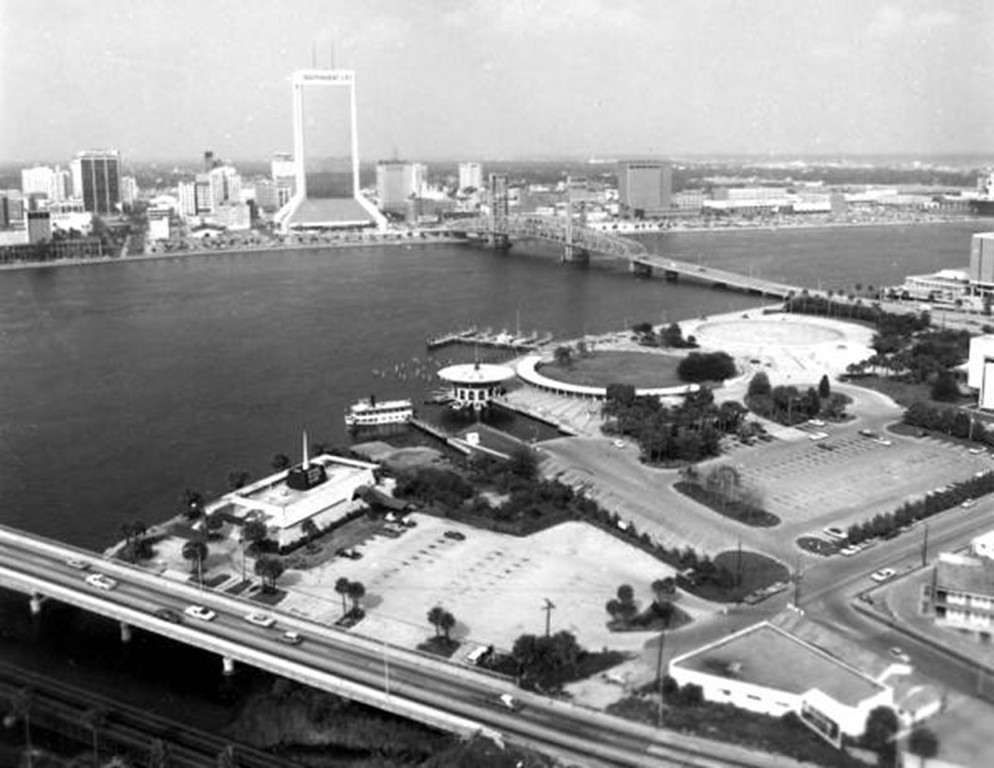
The Diamond Head was a Polynesian restaurant and lounge that opened in 1976 just north of the old Acosta Bridge. For many years, the Diamond Head was a popular restaurant and lounge that was a known gathering place for large “singles” crowds in the city. Over the years, it was also known as Diamondhead Lobster House and Crab Trapper’s Landing.
While popular, the Diamond Head stood in the way of a plan to replace the old Acosta Bridge structure, which had dated back to 1921. Preparing for its fate, owners Fred Levy and Patricia Wacholz opened the Harbormaster’s Restaurant on an adjacent property. They closed the Diamond Head in April 1986 after a decade in business. The Florida Department of Transportation purchased the former restaurant and the 2-acre parcel of land it sat on for $6 million from Alma Willis Shaw. The building was torn down in 1988 to make way for the new Acosta Bridge spanning the St. Johns River.
4. Crawdaddy’s Restaurant (1982 – 2002)
Location: 1643 Prudential Drive

For 20 years, Crawdaddy’s afforded diners and partygoers great food and a great view of the Downtown skyline. Legend has it a man named Beauregard “Crawdaddy” Belvedere owned a fish camp here on the St. Johns River back in the 1920s. Inaccessible then except by boat, it was the perfect location for a dining and entertainment establishment. People came from all over to enjoy Crawdaddy Belvedere’s special blend of hospitality.
Crawdaddy’s was said to be an attempt to re-create that dining and entertainment experience. Opened in 1982, the restaurant was designed to look like a rustic fish camp. However, before the restaurant could open, the state of Florida ordered it to demolish part of its cocktail lounge and dining room that extended 10 feet over the St. Johns River.
Owned by the Jacksonville Crawdaddy Corporation, a subsidiary of Specialty Restaurant Corporation of Long Beach, Calif., the restaurant was built as a part of the St. Johns Place redevelopment project. At the time, the Specialty Restaurant Corporation specialized in two types of themed dining experiences: waterfront and aviation.
Roughly 12,000 square feet, the restaurant had 240 seats and a cocktail lounge that sat 175. At its height, it employed between 150 and 190. Crawdaddy’s closed in March 2002 for remodeling but never reopened. By then, the rustic fish camp look had become an eyesore to its neighbor, the Radisson Riverwalk Hotel. It was torn down in 2004 in time for the 2005 Super Bowl. The site was later developed into a luxury apartment complex now known as the River House.
5. Harbormasters Restaurant (1986 – 1992)
Location: 835 Gulf Life Drive

If you were seeking good food, a beautiful view, and perhaps a taste of nightlife, Harbormasters was designed for you. Harbormasters opened in September 1986. Anchoring the western end of the Southbank Riverwalk, the restaurant and lounge offered guests panoramic views of the Downtown skyline and the St. Johns River. The 325-seat establishment accommodated those looking to enjoy lunch or dinner with family, host a business gathering or relax with cocktails in the lounge or on the outdoor patio deck.
With a staff of 150, the restaurant purchased fresh seafood daily from local suppliers. At the time, Harbormasters was also the only local restaurant certified by the National Black Angus Association.
The two-story structure featured expansive bay windows designed to provide unobstructed river views, along with two lounges. The downstairs lounge offered live entertainment from 9 p.m. to 2 a.m., Tuesday through Saturday. The original ownership group included Fred Levy, Patricia Wacholz, Warren Moody, George Register Jr., and George Register III. By 1989, the Register family had become the sole owners, but the restaurant soon faced mounting debt and legal challenges. Harbormasters closed permanently in 1992.
6. River City Brewing Company (1993 – 2021)
Location: 835 Museum Circle

After the city of Jacksonville foreclosed on the property, it was leased in 1993 to River City Brewing Company with an option to purchase. At the time, small regional breweries were well established nationwide, but the concept of pairing a restaurant with an on-site microbrewery was still relatively new. River City Brewing, originally owned by brothers Jim and Jeffrey Lee, aimed to produce approximately 1,000 barrels annually.
In 1998, the operators purchased the building from the city while entering into a 99-year ground lease for the land. In 2005, Mayor John Peyton publicly expressed interest in seeing the riverfront property more intensively utilized.
In 2020, Miami-based Related Group announced plans to develop a high-rise luxury apartment tower on the River City Brewing site. In 2021, just weeks after the Jacksonville City Council approved a redevelopment agreement, the restaurant closed to make way for the project. As of January 2026, plans for the 25-story development are in the permit review phase. The project includes a replacement riverfront restaurant, bar and speakeasy.
7. Jacksonville Landing (1987 – 2019)
Location: 2 Independent Drive

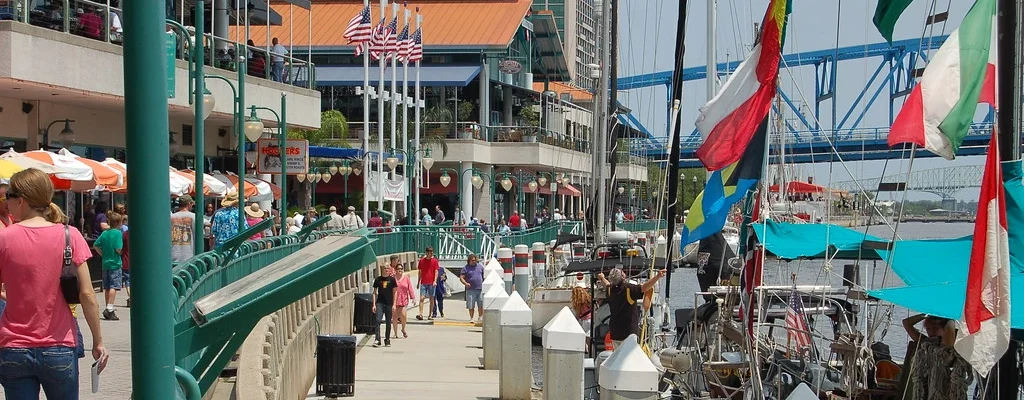
The Jacksonville Landing was developed by the Rouse Company and opened on June 25, 1987. Anchored by a U-shaped pavilion, the festival marketplace was designed to pay homage to the wharves that defined the city’s riverfront architecture prior to 1950s-era urban renewal.
When it opened, the first floor featured national retail tenants common to shopping malls of the era, including Foot Locker, The Gap and Victoria’s Secret. The Kings Road Market area also included smaller vendors such as Harry’s Seafood (now a regional restaurant chain), The Fudgery, Apple A Day, Goode’s Sweet Place, and the Walter Hawkins Fruit Company. Along the riverfront, five sit-down restaurants, Fat Tuesday, Cuco’s Mexican Restaurante, Annie Tiques, Hooters, and L&N Seafood Grill, offered waterfront dining.
The second floor of the 126,000-square-foot marketplace housed the Founders Food Hall, a food court with 18 vendors. The hall’s decor featured 17 silhouetted figures recognizing individuals who played a role in the area’s early settlement. In 1987, the food court’s tenants included Sakura Japan, Hovan Gourmet, Hot Dogs Plus, Gyro Wrap, Flamers, Farah’s, Fantastic Fried Chicken, Everything Yogurt and Bananas, Coastal Cookie Company, Chinese Combo King, Ben & Jerry’s, Barbeque Center, Rocky Rococo, Steak Escape, Taco’s Amigo, Big Apple Deli and Lubi’s.
The Rouse Company pioneered similar festival marketplaces across the country, including Harborplace in Baltimore and Bayside Marketplace in Miami. During the 1970s and 1980s, festival marketplaces were widely viewed as a leading strategy for revitalizing declining downtowns. Examples include Underground Atlanta, Boston’s Faneuil Hall, Chicago’s Navy Pier, New Orleans’ Riverwalk, Miami’s Bayside Marketplace, and New York City’s South Street Seaport.
Successful marketplaces were generally said to require three key ingredients: a strong mix of shops and entertainment, adjacency to water, and a large nearby population. When the Landing opened, it possessed two of the three. Rouse delivered a mix of retail and entertainment, and the St. Johns River provided the waterfront setting. What Downtown lacked, however, was a critical mass of residents and workers. At the time, Jacksonville was experiencing significant suburban flight, with businesses and residents leaving the central business district. Meanwhile, residents of nearby neighborhoods such as LaVilla and Brooklyn had been displaced by urban renewal.
Although many of the Landing’s interior retail tenants struggled following the 1990 opening of The Avenues Mall, the complex evolved into a central gathering space for major civic events. It hosted more than 300 events annually, including Florida–Georgia Weekend celebrations, the annual Christmas tree lighting, New Year’s Eve festivities, Gator Bowl celebrations, St. Patrick’s Day events, the Jacksonville Jazz Festival and Fourth of July fireworks.
In 2003, Sleiman Enterprises acquired the Landing and attempted to reposition it as a dining and entertainment destination. After years of legal disputes with the city of Jacksonville, Sleiman agreed in 2019 to transfer ownership of the property to the city for $15 million. The city then spent an additional $1.5 million to buy out the remaining tenants, including $853,333.31 to terminate leases for two popular riverfront restaurants, Hooters and Fionn MacCool’s. Another $1.5 million was allocated to demolish the complex, clearing the 9-acre site for a riverfront park. Riverfront Plaza, a 6-acre, $33 million first phase of the park, opened in December 2025 with no permanent dining options.
In January 2026, the Downtown Investment Authority board voted unanimously to support a resolution backing a proposal to fund construction of a new restaurant space and select an operator, returning dining to a site where it once thrived before being forced to leave.
Coming Soon: Jacksonville’s Gullah Geechee Heritage
A Community Story. A Cultural Record. A Call to Remember.
Jacksonville’s Gullah Geechee Heritage, a new book by Ennis Davis and Adrienne Burke, will be released by Arcadia Publishing on April 28, 2026.

Jacksonville’s Gullah Geechee history lives in the land, the water, the neighborhoods, and the memories passed down through generations. Jacksonville’s Gullah Geechee Heritage brings those stories forward, rooted in place, shaped by community and preserved for the future.
“An invaluable resource combining extensive research, lived experience and generational knowledge inherited directly from within the culture providing a variety of fresh insights into a truly unique mixture of faith, community, ingenuity and resilience that is definitively Gullah Geechee.”
— Ted Johnson, National Park Service, retired
Order your signed copy today
Preorder signed copies of Jacksonville’s Gullah Geechee Heritage, available in hard and soft cover.