
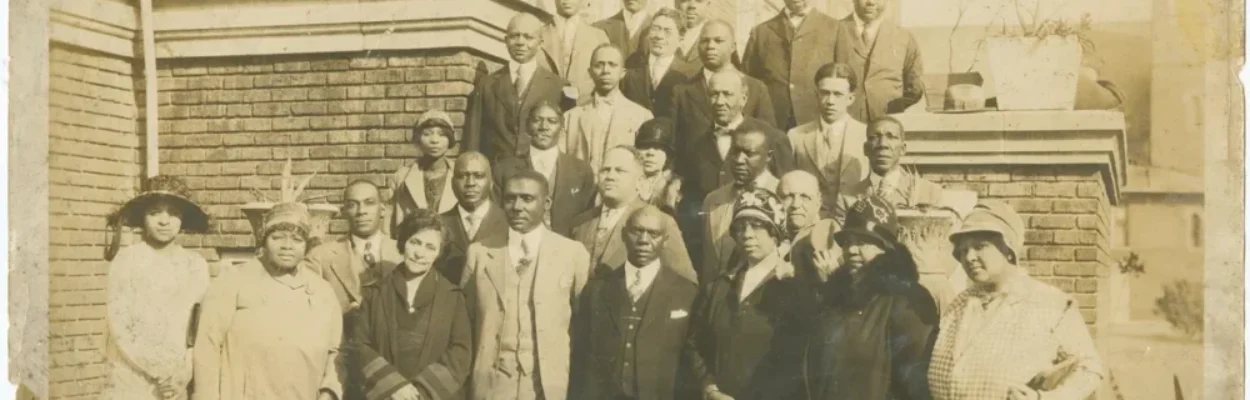
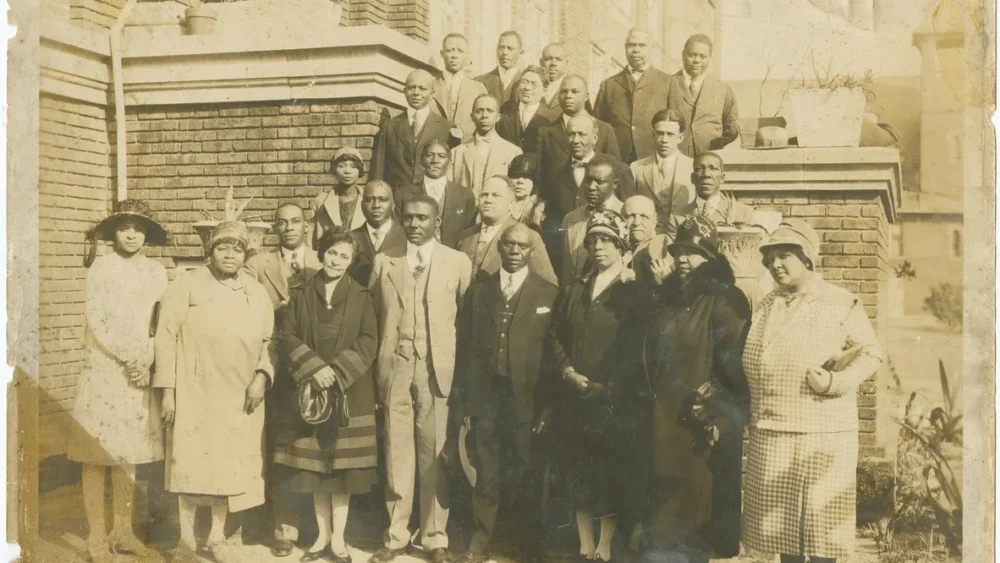
A group of early 20th century segregation era Black business leaders on the steps of Old Stanton High School in LaVilla. | University of North Florida
Published on February 25, 2026 at 9:56 am
Jacksonville Today seeks to include a diverse set of perspectives that add context or unique insight to the news of the day. Regular opinion columnists are independent contractors who are not involved in news decisions. Want to submit your own column on a matter of public interest? Email pitches to jessica@jaxtoday.org.
Black History Month exists not because Black history is separate from American history but because for generations it was deliberately excluded from it. The observance was created as a corrective, not as a cultural sidebar.
Whenever Black history becomes more visible, more detailed, and more honest, resistance tends to follow. That resistance comes from outside the Black community in the form of political and cultural backlash, and it sometimes arises within the community itself through internal pressures, disagreements, and distortions. Any serious defense of Black History Month must acknowledge both.
Jacksonville Today thanks our sponsors. Become one.
Black History Month began as Negro History Week in 1926 under the leadership of Dr. Carter G. Woodson, founder of Association for the Study of African American Life and History (ASALH). Woodson selected the second week of February to coincide with the birthdays of Frederick Douglass and Abraham Lincoln. His choice was strategic rather than symbolic. Schools were already commemorating those figures, making it harder to ignore the broader contributions of African Americans. February was not chosen to confine Black history to the shortest month of the year; it was chosen to secure a foothold in the national calendar.
By 1976, during the nation’s Bicentennial, the week expanded into a month, providing a concentrated period of national focus. The month was designed as a spotlight, not a container.
ASALH remains the first institutional line of defense for the integrity of Black historical scholarship. Founded in 1915, it was established because mainstream textbooks either omitted African Americans entirely or portrayed them in distorted and demeaning ways. Woodson understood that if a people’s history is erased, their contributions can be dismissed and their claims to citizenship weakened. Today, ASALH continues to publish research, convene scholars and provide annual themes that encourage rigorous study of labor, migration, public health, civic participation and the Black family. Its work reinforces a simple but essential principle: History is not ideology; it is documentation grounded in evidence.

Jacksonville Today thanks our sponsors. Become one.
The external challenges are real. Across several states, legislation has been introduced or passed that restricts discussions of race, limits African American Studies courses, and challenges books by Black authors. Organizations such as the NAACP Legal Defense Fund have characterized these efforts as part of a broader attempt to narrow conversations about race and inequality. Critics outside the Black community often argue that Black History Month is unnecessary because American history supposedly already includes everyone. That claim overlooks the long record of omission and distortion that made a corrective observance necessary in the first place. Others contend that focusing on slavery, segregation, or systemic racism is inherently divisive. Yet ignoring documented history does not produce unity; it produces misunderstanding. Black History Month predates contemporary political terminology and was conceived during the Jim Crow era as a scholarly initiative, not a partisan one. To label it as ideological is to ignore its historical origins.

At the same time, defense requires honest introspection within the Black community. There are internal pressures that can weaken historical clarity. One concern is the spread of pseudohistory and exaggerated claims, often born from a desire to counter centuries of erasure. Fabricated genealogies, unsupported assertions about ancient empires, or misattributed inventions may generate pride, but they undermine credible scholarship and provide critics with opportunities to dismiss legitimate research. The documented achievements of African Americans, from Reconstruction legislators to innovators, soldiers, educators, and entrepreneurs, are substantial and verifiable; they do not require embellishment.
Another internal pressure involves the lingering effects of internalized anti-Blackness. Generations of systemic discrimination can shape attitudes toward cultural memory, leading some to view Black history as secondary or unnecessary. There are also educators and parents who temper how history is taught because they fear backlash from school boards or employers. Their caution is understandable, but when fear dictates curriculum, truth is constrained. Generational differences can further complicate the conversation, as older leaders may emphasize respectability and strategic gradualism while younger advocates press for unfiltered examination of injustice. Debate over tone and strategy is healthy; what must be avoided is fragmentation that weakens collective defense.
Black History Month should not be misunderstood as confining Black history to a single month. The existence of a designated period of emphasis does not imply limitation. Americans observe Veterans Day without suggesting that service is confined to November, and Independence Day does not restrict freedom to July. In the same way, February functions as an annual reminder that Black history is woven throughout the nation’s development. The labor of enslaved people shaped early infrastructure; Black legislators during Reconstruction helped draft state constitutions; soldiers of African descent defended the Union and later served in every major conflict; entrepreneurs built business districts that fueled local economies; artists, writers, and musicians shaped American culture at home and abroad. Removing Black history from the national narrative does not simplify it, it renders it incomplete.
Ultimately, what is at stake is historical literacy. When Black history is censored, trivialized, or distorted, students lose context for understanding contemporary inequalities, myths replace documented evidence, and democratic discourse suffers. A nation that cannot confront its full history cannot govern itself wisely.
Defending Black History Month, therefore, is not about special recognition; it is about accurate recognition. It is about ensuring that the American story includes all who built it, challenged it, and expanded its promise.
ASALH stands as the institutional guardian of that mission, but the responsibility extends beyond any single organization. Scholars must remain disciplined in their research, educators must teach with integrity, parents must encourage inquiry, and communities must support institutions that preserve historical memory. February provides the spotlight that draws national attention, but the responsibility to tell the full story extends throughout the year.
Black history is not an addendum to America’s narrative. It is interwoven with it. To defend Black History Month is to defend the integrity of American history itself.